
Non-FictionInformativeEducational
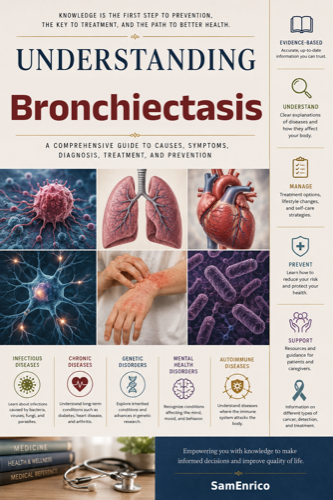
Understanding Bronchiectasis eBook
This disease publication, published by SamEnrico,
This disease publication, published by SamEnrico, covers Understanding Bronchiectasis
Formats
Free sample
Chapter 1: The House That Coughs...--It starts small. A tickle in the throat that lingers for a few days longer than a common cold. A cough that hangs around after everyone else in the family has recovered. You tell yourself it is nothing. Just allergies.
Just a touch of bronchitis. Just getting older. But weeks turn into months, and the cough does not leave. It changes. It becomes productive — bringing up phlegm that ranges from clear to yellow to green.
You clear your throat in meetings. You excuse yourself from dinner conversations. You have stopped saying "excuse me" because you would be saying it fifty times a day.Bronchiectasis is called a "silent epidemic" not because it makes no noise — it makes plenty of noise, rattling coughs and wet, gurgling breaths — but because most people have never heard its name. Unlike asthma, which appears in every television commercial for rescue inhalers, or COPD, which has become almost synonymous with "smoker's lung," bronchiectasis lurks in the shadows of respiratory medicine. And yet, it is anything but rare.
Current estimates suggest that over 350,000 people in the United States alone carry this diagnosis, and that number is rising rapidly as CT scanning technology improves. Many experts believe the true prevalence is two to three times higher — meaning that for every person diagnosed, one or two more are walking around with unexplained chronic coughs, recurrent chest infections, and the growing sense that something is wrong.This book is for those people. It is for the woman who has been treated for "recurrent bronchitis" seven times in the last three years. It is for the man whose doctor shrugged and said, "Some people just have a wet cough," and offered no further explanation. It is for the caregiver watching a loved one struggle for breath and feeling helpless.
And it is for the newly diagnosed patient who just read the words "permanent lung damage" on a radiology report and felt the floor drop out from under them.Here is the truth that no one tells you in the doctor's office: bronchiectasis is permanent, yes. The scarring in your airways does not go away. But permanent does not mean hopeless. It does not mean progressive decline is inevitable. It does not mean you cannot run a 5K, travel to high altitudes, or dance at your daughter's wedding.
What it means is that you need a different playbook than someone with healthy lungs. You need to understand exactly what is happening inside your chest, why it happened, and — most importantly — exactly what you can do about it.This chapter lays the foundation for everything that follows. We will build a shared language for understanding your lungs, introduce the master analogy that will guide us through the entire book, and confront the single most important concept in bronchiectasis management: the vicious cycle. By the time you finish these pages, you will understand not just what bronchiectasis is, but why your lungs behave the way they do — and why you have more control than you think.The Uninvited Guest: What Bronchiectasis Actually Is Let us start with a precise definition. Bronchiectasis (pronounced brong-kee-EK-tuh-sis) is a chronic respiratory condition characterized by permanent, abnormal widening of the airways — the bronchi and bronchioles, the branching tubes that carry air from your trachea down into the deepest parts of your lungs.
The word itself comes from Greek roots: "bronkhia" (airways), "ektasis" (stretching or widening). In plain English, your airways have stretched out of shape and cannot return to their normal diameter.But this widening is not like stretching a rubber band, where release returns everything to normal. Think instead of a plastic straw that has been repeatedly squeezed and twisted. Eventually, the straw does not spring back. It stays kinked, misshapen, permanently altered.
In bronchiectasis, the walls of your airways have been damaged by repeated cycles of infection and inflammation. The smooth muscle and elastic fibers that normally allow airways to expand during inhalation and recoil during exhalation are destroyed. Scar tissue replaces healthy tissue. The airways become floppy, baggy, and inefficient.This structural damage leads to a functional disaster. In healthy lungs, the airways are lined with two essential features: a thin layer of mucus and millions of microscopic hair-like structures called cilia.
The mucus traps bacteria, viruses, dust, and other inhaled particles. The cilia beat in coordinated waves — about 1000 beats per minute — sweeping the mucus upward toward your throat where you either cough it out or swallow it unconsciously. This system, known as the mucociliary escalator, is one of the most efficient cleaning mechanisms in the human body. It processes about 10 to 100 milliliters of mucus per day, all without you ever noticing.In bronchiectasis, that escalator breaks down. The cilia are damaged or destroyed by inflammation.
The mucus thickens, becoming sticky and adhesive rather than thin and fluid. Worse, because the airways are widened and floppy, mucus pools in the bottom of the lungs instead of being swept upward. Pooled mucus is a perfect breeding ground for bacteria. They colonize these stagnant pools, multiply, and trigger more inflammation. That inflammation further damages the cilia and the airway walls, widening them even more.
This is the vicious cycle, and we will return to it shortly.First, let us correct a common and dangerous misconception. Bronchiectasis is not the same as COPD (Chronic Obstructive Pulmonary Disease), though the two can coexist — a condition sometimes called bronchiectasis-COPD overlap or ACO. The distinction matters because treatments differ. In pure COPD, the primary problem is airflow obstruction caused by narrowed airways and destroyed air sacs. In bronchiectasis, the primary problem is mucus retention and recurrent infection.
A patient with bronchiectasis who is treated only with COPD medications (bronchodilators and steroids) may continue to decline because the underlying mucus is never cleared. Conversely, a patient with COPD who is treated only with airway clearance techniques may miss out on bronchodilators that could significantly improve their symptoms.Nor is bronchiectasis the same as asthma. Asthma is characterized by reversible airway narrowing triggered by allergens or irritants. Bronchiectasis is fixed, structural damage. Some people have both conditions, but they are distinct diseases with distinct mechanisms.So, to summarize: bronchiectasis is permanent airway widening caused by infection and inflammation.
It leads to mucus pooling, bacterial colonization, and recurrent infections. It is not COPD. It is not asthma. It is its own condition, and it requires its own approach.Your Lungs Are a House: The Master Analogy Throughout this book, we will return to a single unifying analogy: Your Lungs Are a House. This analogy was chosen because it maps directly onto the biology of bronchiectasis in ways that other analogies (tree branches, fans, balloons) cannot.
A house has hallways, a foundation, pipes, pests, and a cleaning system. So do your lungs.Here is how the analogy works, and we will refer back to this framework in every subsequent chapter:The Hallways (The Airways): Your bronchial tubes are the hallways of the house. In a healthy house, hallways are smooth, properly sized, and allow free movement. In bronchiectasis, these hallways have been permanently stretched and scarred. They are now wider than they should be — imagine a hallway where the walls have bulged…
This is the end of the free sample. Get the eBook to keep going. Buy now
About this book
Details
- Author
- Edmond Evette
- Publisher
- SamEnrico
- Language
- English
- Genre
- Non-Fiction, Informative, Educational
- Released
- 2026-05-07
- Pages (approx.)
- 152
- Available as
- eBook, Audiobook

Read better in the ZLOADR app
Your eBooks on your phone or tablet. Sign in with your SamEnrico account and start reading.
More by Edmond Evette
 Baghdad Round City PlanningEdmond Evette$11.99
 Panic Disorder Substance Induced GuideEdmond Evette$11.99
 Aging Pituitary Gland FunctionEdmond Evette$11.99
 The Gambling Addiction Recovery WorkbookEdmond Evette$11.99
 AI Cinematography Analysis CourseEdmond Evette$11.99
 The Last Flight of the Concorde: When Supersonic Dreams CrashedEdmond Evette$11.99
 Into the Amazon's Heart: The Perils and Triumphs of the Xingu River ExpeditionEdmond Evette$11.99
 Mig WelderEdmond Evette$11.99
 Ecommerce Startup Funding OutlookEdmond Evette$12.99
 Coding Bootcamp Dropout RatesEdmond Evette$12.99
 How to Become a Saw FilerEdmond Evette$11.99
You may also like
 Hong Kong Handover 1997Dunn Johnnie$11.99
 Zumba For Postnatal Recovery CourseNeal Christian$11.99
 Zumba for BeginnersLadner Nikia$11.99
 YouTube Comment Mining GuideHumes Pandora$12.99
 Worry Box MeditationCarlin Rudy$11.99
 Workplace Stress MeditationNguyen Lynn$11.99
 Workplace Stress and Sleep RepairHawley Ivory$11.99
 Workplace Perfectionism CureDelaney Jeffry$11.99
 Workplace Injustice Anger GuideWallen Isabelle$11.99
 Work Addiction and Burnout LinkGreenwood Ester$11.99
 Women in Yoga and WellnessBeattie Galina$11.99
 Women in Stand Up ComedyChun Evangeline$11.99