

Non-FictionInformativeEducational
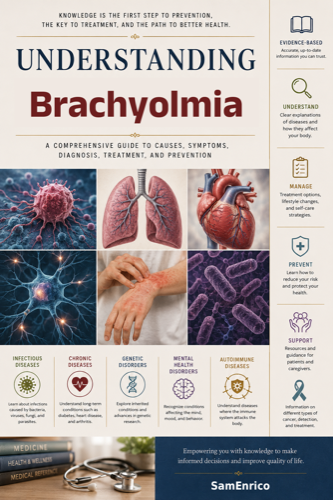
Understanding Brachyolmia eBook
This disease publication, published by SamEnrico,
by Ly Morgan
This disease publication, published by SamEnrico, covers Understanding Brachyolmia
Formats
Free sample
Chapter 1: The Short Spine...--Imagine waking up one morning with a back that simply will not bend. You try to touch your toes—nothing. You reach for a coffee mug on a high shelf—your arm falls short. For years, doctors tell you that you have growing pains, or that you are just unusually stiff, or that your height is simply a family trait. Then one day, a radiologist glances at an X‑ray of your spine and notices something peculiar: every single vertebra from your neck to your lower back is flattened, like a stack of pancakes rather than a column of bricks.
That single observation changes everything. That is the moment when the word brachyolmia enters your life.Brachyolmia is one of the rarest skeletal dysplasias—a family of disorders that affect the growth and structure of bones and cartilage. Its name comes from two Greek roots: brachy, meaning short, and oligos, meaning few or scant. The name describes the appearance of the vertebrae, which are both shortened in their vertical dimension and flattened in a way that makes the entire spinal column look compressed. But the name does more than describe bones.
It points to a lifelong journey of medical discoveries, daily adaptations, and a community of patients, families, and clinicians who work together to understand a condition that most doctors will never see.This chapter is the gateway to that journey. It will explain what brachyolmia is and what it is not, where it fits among hundreds of other bone disorders, and how the medical understanding of this condition has evolved from vague X‑ray shadows to precise genetic diagnoses. More importantly, this chapter will give you—whether you are a newly diagnosed patient, a parent, or a caregiver—a clear, honest, and hopeful foundation for the rest of this book.What Is a Skeletal Dysplasia?Before we can understand brachyolmia, we must understand the category of diseases it belongs to. Skeletal dysplasias are disorders that disrupt the normal growth and remodeling of bone and cartilage. They are not metabolic bone diseases like osteoporosis, where bones become porous and brittle later in life.
They are not fractures or infections or tumors. They are developmental conditions, often present from before birth, that change the very blueprint of the skeleton.There are more than 450 distinct skeletal dysplasias, ranging from relatively mild conditions like isolated short stature to severe, life‑limiting disorders like thanatophoric dysplasia. Some affect only the long bones of the arms and legs. Others primarily involve the skull, the ribs, or the hands and feet. Brachyolmia belongs to a smaller subset called the spondylodysplasias—conditions that predominantly affect the vertebral column, or spine.
The word spondylo refers to the vertebrae, and in brachyolmia, it is the vertebrae that bear the brunt of the genetic mutation.What makes brachyolmia distinctive among spondylodysplasias is that the long bones—the femurs, tibias, humeri, and radii—remain relatively normal in length. A child with brachyolmia may have a short trunk and a stiff back, but their arms and legs will look proportionally typical for their age. This is the opposite of achondroplasia, the most common skeletal dysplasia, where the long bones are dramatically shortened while the spine is relatively spared. Understanding this distinction is crucial because it guides doctors toward the correct diagnosis. A child who comes to clinic with short stature and a rigid spine but normal limb proportions should prompt a skeletal survey that looks carefully at the vertebrae.
That X‑ray, in turn, will reveal the flattened vertebral bodies that are the hallmark of brachyolmia.The Vertebral Signature: Platyspondyly The single most important feature of brachyolmia is platyspondyly. This term comes from the Greek platys (flat) and spondyly (vertebra). In a healthy spine, each vertebra has a roughly rectangular shape on a side view, with a slightly taller height in the front than the back (which creates the natural curves of the spine). In brachyolmia, the vertebrae lose their vertical height. They become flattened from top to bottom, like coins stacked on a table rather than building blocks.
The flattening is generalized, meaning it affects nearly every vertebra from the cervical spine (neck) down to the sacrum (pelvis).But platyspondyly alone does not make brachyolmia. Many skeletal dysplasias cause some degree of vertebral flattening. What sets brachyolmia apart is the appearance of the vertebral endplates—the thin layers of cartilage and bone that sit on the top and bottom of each vertebra. In brachyolmia, these endplates are irregular, often described as "wrinkled," "stepped," or "rolled." On an X‑ray, the normally smooth contour of the upper and lower borders of each vertebra looks jagged or undulating. This finding is so characteristic that an experienced radiologist can often suspect brachyolmia just by looking at a single film of the thoracolumbar spine.In addition to the flattened and irregular vertebrae, the intervertebral disc spaces—the gaps between the bones that house the shock‑absorbing discs—may appear slightly increased in height.
This is a paradoxical finding: the bones are shorter than normal, but the spaces between them are a bit taller, which partially compensates for the loss of overall spinal height. The net effect is a person who is shorter than average but not as dramatically short as one might expect given the degree of vertebral flattening.A Brief History: From Shadows to Sequences The story of brachyolmia as a medical diagnosis begins in the mid‑20th century, when radiologists first started cataloging the X‑ray findings of children with unexplained short stature and back stiffness. At that time, most skeletal dysplasias were grouped by their appearance on plain films. There was no genetic testing, no molecular classification—just careful observation and pattern recognition.In 1968, the Belgian radiologist J. Spranger and his colleagues described a group of patients with a previously unrecognized form of spondylodysplasia characterized by generalized platyspondyly, irregular endplates, and normal long bones.
They gave the condition the name brachyolmia, from the Greek roots we have already encountered. For the next two decades, brachyolmia remained a purely radiographic diagnosis. Doctors would see the flattened vertebrae, rule out other conditions like Morquio syndrome or spondyloepiphyseal dysplasia, and then tell families that their child had a "rare form of short trunk dwarfism." No one knew the cause.The first genetic breakthrough came in 1998, when researchers studying a large consanguineous family (a family where parents are blood relatives) mapped the condition to a region on chromosome 10. A few years later, in 2003, the specific gene PAPSS2 was identified as the cause of what is now called brachyolmia type 1. This discovery opened the floodgates.
In 2008, mutations in TRPV4 were found to cause an autosomal dominant form of brachyolmia (type 3), along with a spectrum of other skeletal and neurological disorders. Rare cases linked to COL2A1 have also been reported. Suddenly, a condition that had been defined by shadows on X‑rays became a family of disorders defined by the letters of the genetic code.Today, the classification of brachyolmia rests on three pillars: clinical examination, radiographic findings, and molecular genetics. Each new patient adds to our understanding, and each genetic discovery raises new questions about how these mutations disrupt the complex process of…
This is the end of the free sample. Get the eBook to keep going. Buy now
About this book
Details
- Author
- Ly Morgan
- Publisher
- SamEnrico
- Language
- English
- Genre
- Non-Fiction, Informative, Educational
- Released
- 2026-06-02
- Pages (approx.)
- 157
- Available as
- eBook, Audiobook

Read better in the ZLOADR app
Your eBooks on your phone or tablet. Sign in with your SamEnrico account and start reading.
More by Ly Morgan
 Creativity Trance MethodLy Morgan$11.99
 The Tosfot Yom TovLy Morgan$11.99
 Agoraphobia Hair Salon Anxiety GuideLy Morgan$11.99
 Menopause Growth Hormone ShiftLy Morgan$11.99
 AI Camera Tracking for VFXLy Morgan$11.99
 The Secret Codebreakers: How a Teen Girl Cracked the NazisLy Morgan$11.99
 Frozen Echoes: Unlocking the Secrets of the Arctic’s Oldest ArtifactsLy Morgan$11.99
 Ecommerce Fraud Prevention OutlookLy Morgan$12.99
 CS Degree Internship PathwayLy Morgan$12.99
 Hedge Fund AnalystLy Morgan$11.99
 10 Ways to Use Cola (Recipe Book)Ly Morgan$11.99
You may also like
 Hong Kong Handover 1997Dunn Johnnie$11.99
 Zumba For Postnatal Recovery CourseNeal Christian$11.99
 Zumba for BeginnersLadner Nikia$11.99
 YouTube Comment Mining GuideHumes Pandora$12.99
 Worry Box MeditationCarlin Rudy$11.99
 Workplace Stress MeditationNguyen Lynn$11.99
 Workplace Stress and Sleep RepairHawley Ivory$11.99
 Workplace Perfectionism CureDelaney Jeffry$11.99
 Workplace Injustice Anger GuideWallen Isabelle$11.99
 Work Addiction and Burnout LinkGreenwood Ester$11.99
 Women in Yoga and WellnessBeattie Galina$11.99
 Women in Stand Up ComedyChun Evangeline$11.99