
Non-FictionInformativeEducational
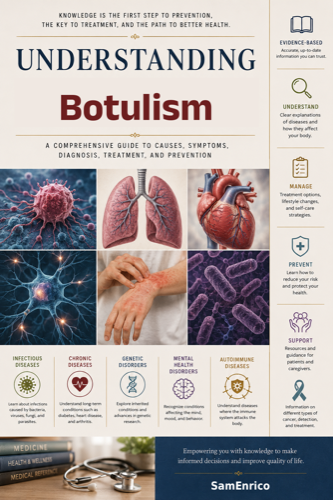
Understanding Botulism eBook
This disease publication, published by SamEnrico,
by Curtis Irvin
This disease publication, published by SamEnrico, covers Understanding Botulism
Formats
Free sample
Chapter 1: The Silent Feast...--It began as a perfect evening. The summer of 1977 had been kind to the small town of Roscommon, Michigan, and on a warm Friday night in late August, the local American Legion hall was filled with the sounds of laughter, clinking glasses, and the comfortable chatter of neighbors who had known each other for decades. A birthday dinner was underway—nothing formal, just good people, good company, and good food. The menu was unremarkable: fried chicken, salads, and a large batch of homemade potato salad that someone had brought in a ceramic bowl. The potato salad was creamy, well-seasoned, and disappeared quickly.
No one gave it a second thought.By Sunday morning, the town's small hospital was overwhelmed.The first patient arrived with double vision so severe he could not drive. The second complained of a dry mouth and a strange, thick feeling in her throat—as though she were trying to swallow cotton balls. The third, a 47-year-old man who had been the life of the party just 48 hours earlier, could not keep his eyes open. His wife said he looked drunk, but he had not touched alcohol. By Sunday evening, three people were on ventilators.
Within a week, thirty-four people had been hospitalized. One man was dead.The culprit was not a virus, not a bacterium in the traditional sense, and not anything that could be seen, smelled, or tasted. It was a poison so potent that a single gram—the weight of a paperclip—could theoretically kill more than a million people. It had no color, no odor, no flavor. It had entered the potato salad through a single cracked jar of home-canned green beans that someone had mixed in as an ingredient.
And it had turned a celebration into a catastrophe without leaving a single trace.This is the story of botulism—the most poisonous poison on Earth. And this chapter is where we begin to understand how something so small can be so deadly, how history has shaped our knowledge of this invisible enemy, and why every person who eats food should understand the science of what nearly killed a Michigan town in the summer of 1977.The Name That Means "Sausage"The word "botulism" has a humble and somewhat ironic origin. It comes from the Latin word botulus, which simply means "sausage." In 18th-century Germany, a region known for its love of sausages and preserved meats, a series of mysterious poisonings occurred with alarming frequency. Whole families would sit down to a meal of blood sausage—a traditional German delicacy made from pork, pork blood, and spices—and within days, some would be dead, paralyzed from the neck down while still fully conscious. The connection was so consistent that German physicians began calling the illness Wurstvergiftung, or "sausage poisoning."For nearly a hundred years, the cause remained a mystery.
The symptoms were unmistakable: double vision, drooping eyelids, difficulty speaking, trouble swallowing, and a progressive paralysis that moved inexorably downward from the face to the chest. But the mechanism was invisible. Physicians of the era blamed everything from spoiled animal fats to mystical "miasmas" in the air. The scientific method had not yet caught up to the reality that the deadliest poison known to humanity was hiding in plain sight, inside the very foods that families trusted.The breakthrough came not in Germany but in Belgium, in 1895, at a funeral feast that went terribly wrong. Thirty-four members of a music club gathered for a meal after a funeral in the village of Ellezelles.
Among the dishes served was raw, salted ham—a preserved meat similar in principle to the German sausages that had caused so much grief. Within days, twenty-three of the thirty-four attendees were sick. Three died. A young Belgian bacteriologist named Emile van Ermengem was dispatched to investigate, and what he found would change the course of food safety forever.Van Ermengem did something that no one had done before: he took samples of the leftover ham and, instead of discarding them, he cultured them in his laboratory. He discovered an anaerobic, spore-forming bacillus—a rod-shaped bacterium that grew only in the absence of oxygen.
He named it Bacillus botulinus, after the Latin word for sausage. Later, the name was changed to Clostridium botulinum, the name we use today. Van Ermengem had not only identified the bacterium; he had also observed that the illness was caused not by the bacterium itself but by a toxin it produced. It was a revolutionary insight: the poison and the poisoner were not the same thing.The Most Potent Poison on Earth To understand botulism, one must first grapple with a number that defies intuition: one nanogram per kilogram. That is the lethal dose of botulinum toxin for a human being.
A nanogram is one-billionth of a gram. To put that in perspective, a single grain of table salt weighs approximately 0.06 milligrams—which is 60,000 nanograms. Theoretically, a single grain of salt-sized amount of pure botulinum toxin, properly distributed, could kill 60,000 people.Let that sink in.Compare this to other infamous poisons. Cyanide, which has been used as a poison for centuries and is familiar to anyone who watches crime dramas, has a lethal dose of approximately 250 milligrams per kilogram. That means cyanide is 250 million times less potent than botulinum toxin.
Sarin gas, the nerve agent used in terrorist attacks and chemical warfare, has a lethal dose of approximately 0.5 milligrams per kilogram—half a million times less potent than botulinum toxin. Among all known toxins and poisons, natural or synthetic, botulinum toxin stands alone at the top. It is, quite simply, the most lethal substance ever discovered.This potency is not an accident of chemistry. Botulinum toxin is an enzyme—a biological catalyst that attacks a single, specific target inside human nerve cells. The toxin does not need to flood the body to be effective.
It does not need to destroy tissues or cause inflammation. It needs only to find its way to the nerve endings that control muscle contraction, and then it does its work with surgical precision. One molecule of botulinum toxin can disable a nerve ending permanently (at least for weeks or months). This is why the quantities involved are so staggeringly small. Evolution has crafted a weapon of exquisite efficiency.The Seven Faces of the Poison Not all botulinum toxin is identical.
Scientists have identified seven distinct types of the toxin, labeled A through G. Each type is produced by a different strain of Clostridium botulinum, and each type has slightly different properties, different geographic distributions, and different effects on humans.Type A is the most potent and the most common cause of human botulism worldwide. It is found primarily in the soils of the western United States, Argentina, and China. It is also the type used in cosmetic Botox injections because its effects are long-lasting and predictable. Type A is the strain responsible for most of the large foodborne outbreaks in American history.Type B is the second most common cause of human disease.
It is prevalent in the soils of the eastern United States and much of Europe. Generally slightly less potent than type A, type B still causes…
This is the end of the free sample. Get the eBook to keep going. Buy now
About this book
Details
- Author
- Curtis Irvin
- Publisher
- SamEnrico
- Language
- English
- Genre
- Non-Fiction, Informative, Educational
- Released
- 2026-05-25
- Pages (approx.)
- 154
- Available as
- eBook, Audiobook

Read better in the ZLOADR app
Your eBooks on your phone or tablet. Sign in with your SamEnrico account and start reading.
More by Curtis Irvin
 One on One Pitch Anxiety ProtocolCurtis Irvin$11.99
 Meth Long Term Recovery GuideCurtis Irvin$11.99
 Kidnapped Aid WorkerCurtis Irvin$11.99
 Hearst Propaganda TechniquesCurtis Irvin$11.99
 AI Color Grading for Video EditorsCurtis Irvin$11.99
 The Frozen Odyssey: The Lost U.S. Air Force Crew Who Mapped the ArcticCurtis Irvin$11.99
 Hiring Remote QA Engineers PolandCurtis Irvin$12.99
 Slack Virtual Intern SecretsCurtis Irvin$12.99
 How to Start a Hobby in Inline SkatingCurtis Irvin$11.99
 Career CounselingCurtis Irvin$11.99
You may also like
 Hong Kong Handover 1997Dunn Johnnie$11.99
 Zumba For Postnatal Recovery CourseNeal Christian$11.99
 Zumba for BeginnersLadner Nikia$11.99
 YouTube Comment Mining GuideHumes Pandora$12.99
 Worry Box MeditationCarlin Rudy$11.99
 Workplace Stress MeditationNguyen Lynn$11.99
 Workplace Stress and Sleep RepairHawley Ivory$11.99
 Workplace Perfectionism CureDelaney Jeffry$11.99
 Workplace Injustice Anger GuideWallen Isabelle$11.99
 Work Addiction and Burnout LinkGreenwood Ester$11.99
 Women in Yoga and WellnessBeattie Galina$11.99
 Women in Stand Up ComedyChun Evangeline$11.99