
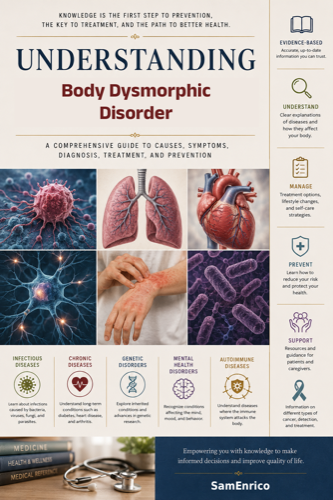
Non-FictionInformativeEducational
Understanding Body Dysmorphic Disorder eBook
This disease publication, published by SamEnrico,
by Strong Allyn
This disease publication, published by SamEnrico, covers Understanding Body Dysmorphic Disorder
Formats
Free sample
Chapter 1: The Silent Epidemic...–- Emma had taken forty-seven selfies in the past two hours. She had deleted forty-six of them. The one she kept she would never post—it was saved only to examine later, to zoom in on the curve of her nose, to measure whether it looked as crooked as she feared. Her thumb ached from swiping. Her eyes burned from staring at her own face under the cold glare of the bathroom light.
Across town, Marcus stood naked in front of his full-length mirror for the third time that morning, flexing his biceps, then relaxing them, then flexing again. He pinched the skin around his triceps, searching for the fat that he was certain lay beneath the muscle, invisible to everyone but him. His girlfriend had called him beautiful twenty minutes ago. He had not heard her. He was already late for work.
In a suburban kitchen a hundred miles away, fourteen-year-old Maya asked her mother for the seventh time, "Does this acne cream look like it's working?" Her mother sighed, gave the same answer, and wondered why her bright, funny daughter had stopped smiling in photographs two years ago. Maya's face was clear. She could not see it.These three people do not know each other. They live in different cities, different circumstances, different bodies. But they share a condition that affects approximately one in fifty people—as common as obsessive-compulsive disorder, more common than schizophrenia or bipolar disorder—and yet nearly eighty percent of those who have it will never tell a single healthcare provider.
They will suffer in silence, convinced that their problem is vanity, that they are shallow, that if they could just stop thinking about their nose, their skin, their hair, their muscle size, they would be fine. They will spend thousands of dollars on therapy for "anxiety" or "depression" without ever mentioning the mirror. They will undergo cosmetic procedures that make nothing better. Some of them will die by suicide. The condition is Body Dysmorphic Disorder, and this book is written for everyone who has ever looked in a mirror and seen a stranger.What This Book Is and Who It Is For Before we go any further, let me tell you what this book is not.
It is not a textbook. It is not a dry academic review of the literature, though the research behind it is rigorous and every claim can be traced back to peer-reviewed studies. It is not a collection of inspirational platitudes ("love the skin you're in") that, while well-intentioned, have never helped anyone whose brain is screaming that they are disfigured. It is not a substitute for professional treatment, though it will teach you exactly what that treatment looks like and how to access it.What this book is: a practical, compassionate, science-based guide to understanding and recovering from Body Dysmorphic Disorder. It is written for three audiences, in order of priority.
First and most importantly, it is written for people who suspect they might have BDD or who have already been diagnosed and want to understand what to do next. Second, it is written for the families and friends who love someone with BDD and are exhausted, confused, and desperate to help. Third, it is written for mental health practitioners, physicians, and cosmetic providers who encounter BDD in their practices and need a clear, evidence-based roadmap.Throughout this book, you will find clinical information presented in plain language, real examples drawn from the research literature (with identifying details changed), and practical exercises that you can begin using immediately. You will also find warnings about what not to do—because in BDD, the intuitive solutions (get surgery, check the mirror one more time, ask for reassurance one more time) almost always make things worse.If you are reading this because you are suffering, let me say this directly: you are not vain. You are not shallow.
You are not broken beyond repair. You have a medical condition that affects how your brain processes visual information and emotional threat. That condition has a name, and because it has a name, it has treatments that work. The road out is not easy—nothing worth doing ever is—but it exists. Tens of thousands of people have walked it before you.
This book is your map.What Is Body Dysmorphic Disorder? Toward a Working Definition Body Dysmorphic Disorder is defined in the Diagnostic and Statistical Manual of Mental Disorders, Fifth Edition (DSM-5), as a condition characterized by four core features. Let me translate them from clinical language into English.First feature: A preoccupation with one or more perceived defects or flaws in physical appearance that are not observable to others or appear only slight. This is not simple dissatisfaction. This is obsessive, consuming, hours-per-day thinking about a specific feature—the nose, the skin, the hair, the chin, the eyes, the breasts, the genitals, the muscle mass.
The preoccupation is intrusive. It shows up when you are trying to work, when you are trying to sleep, when you are trying to have a conversation. It feels like a radio playing in the background of your entire life, and you cannot find the off button.Here is a critical point that many descriptions of BDD get wrong, and I want to be precise about it. The perceived flaw may be entirely imagined. You may believe your nose is deformed when in fact it is objectively, measurably average.
But the flaw may also be real and observable—a slightly crooked tooth, a small scar, a nose that is genuinely asymmetrical, a receding hairline. The difference between BDD and normal appearance concern is not whether the flaw exists. The difference is the degree of distress and dysfunction. A person without BDD might notice their crooked tooth, consider braces, and move on. A person with BDD believes that crooked tooth makes them disgusting, that everyone stares at it, that they cannot be loved, promoted, or even looked at until it is fixed.
The feature may be real. The catastrophic meaning attached to it is not.Second feature: The preoccupation is accompanied by repetitive behaviors or mental acts in response to the appearance concerns. These are the compulsions. They include mirror checking (the classic symptom, which we will address in depth in Chapter 9), excessive grooming, skin picking, comparing the hated feature to other people, seeking reassurance from family and friends ("Does this look bad?"), excessive exercise (in muscle dysmorphia), and researching cosmetic procedures. These behaviors are not pleasurable.
They are urgent, driven, anxiety-relieving-in-the-moment, and ultimately reinforcing of the obsession.Third feature: The preoccupation causes clinically significant distress or impairment in social, occupational, or other important areas of functioning. This is the threshold that separates a diagnosable disorder from ordinary insecurity. If you think about your appearance for an hour a day but still go to work, maintain relationships, and enjoy life, you may not meet criteria for BDD. If you cancel plans because of how you look, if you avoid dating entirely, if you have taken leaves of absence from work or dropped out of school, if you have turned down promotions because they would require more public speaking—you have crossed that threshold.Fourth feature…
This is the end of the free sample. Get the eBook to keep going. Buy now
About this book
Details
- Author
- Strong Allyn
- Publisher
- SamEnrico
- Language
- English
- Genre
- Non-Fiction, Informative, Educational
- Released
- 2026-05-11
- Pages (approx.)
- 149
- Available as
- eBook, Audiobook

Read better in the ZLOADR app
Your eBooks on your phone or tablet. Sign in with your SamEnrico account and start reading.
More by Strong Allyn
 Delegation Scripts Using MatrixStrong Allyn$11.99
 Opioid Dependency Treatment OptionsStrong Allyn$11.99
 Hearst San Simeon PartiesStrong Allyn$11.99
 The 10 10 10 Rule for Presentation WorryStrong Allyn$11.99
 The SRO Hotel ScientistStrong Allyn$11.99
 The Silk Road Act: How a 19th-Century Trade War Shaped Modern DiplomacyStrong Allyn$11.99
 The Day the Internet Stood Still: The Great Facebook Outage of 2021Strong Allyn$11.99
 Amazon Inventory Forecasting ToolStrong Allyn$12.99
 Polish Remote Developer RetentionStrong Allyn$12.99
 Travel Sales RepresentativeStrong Allyn$11.99
 How to Become a Insulation-worker ApprenticeStrong Allyn$11.99
You may also like
 Hong Kong Handover 1997Dunn Johnnie$11.99
 Zumba For Postnatal Recovery CourseNeal Christian$11.99
 Zumba for BeginnersLadner Nikia$11.99
 YouTube Comment Mining GuideHumes Pandora$12.99
 Worry Box MeditationCarlin Rudy$11.99
 Workplace Stress MeditationNguyen Lynn$11.99
 Workplace Stress and Sleep RepairHawley Ivory$11.99
 Workplace Perfectionism CureDelaney Jeffry$11.99
 Workplace Injustice Anger GuideWallen Isabelle$11.99
 Work Addiction and Burnout LinkGreenwood Ester$11.99
 Women in Yoga and WellnessBeattie Galina$11.99
 Women in Stand Up ComedyChun Evangeline$11.99