
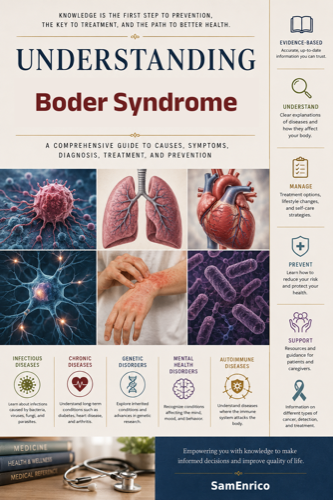
Non-FictionInformativeEducational
Understanding Boder Syndrome eBook
This disease publication, published by SamEnrico,
This disease publication, published by SamEnrico, covers Understanding Boder Syndrome
Formats
Free sample
Chapter 1: The Diagnostic Labyrinth...-- Every medical student learns early that the human body is a map of known territories—each syndrome a plotted island, each symptom a lighthouse guiding the diagnostician safely to harbor. But what happens when a patient presents with a constellation of findings that appears in no textbook, matches no familiar pattern, and defies every algorithm in the differential diagnosis software? What happens when the medical literature contains fewer than ten descriptions of your patient's condition, scattered across decades, buried under misspellings and misclassifications? This is the reality of ultra-rare disease medicine, and it is the world into which Boder Syndrome—or more precisely, Odontomatosis-Aortae Esophagus Stenosis Syndrome—was born.The story of Boder Syndrome is not merely a clinical description of a rare malformation syndrome. It is a cautionary tale about the fragility of medical knowledge, the persistence of nomenclature confusion, and the extraordinary journey that patients and physicians undertake when they venture beyond the boundaries of familiar diagnosis.
This chapter establishes the historical and classificatory foundation of the syndrome, tracing its first descriptions, untangling its naming controversies, distinguishing it from a neurologically distinct condition with a deceptively similar name, and situating it within the broader spectrum of genetic malformation syndromes. In doing so, we will see that understanding Boder Syndrome requires not only mastering its clinical features but also appreciating how medical knowledge is constructed, lost, and sometimes—with painstaking effort—recovered.The Birth of an Eponym: Bader, Boder, and the Perils of Translation The first description of what we now call Boder Syndrome emerged from the medical literature in 1967, when a researcher named Bader published a case report of a child with a startling combination of findings. The patient presented with multiple odontomas—benign, disorganized masses of dental tissue that resemble miniature, malformed teeth—scattered throughout the maxilla and mandible. These were not isolated dental curiosities; they were accompanied by severe esophageal stenosis so pronounced that the child experienced life-threatening dysphagia. Surgical intervention was attempted, but tragically, the child died at six years of age following esophageal surgery complicated by leiomyomatosis—an overgrowth of smooth muscle tissue—within the muscularis propria of the esophagus -9.This original description, published under the name "Bader," would become the source of a persistent and medically significant naming confusion.
Depending on the database, the journal, or the citation, the syndrome appears as "Bader syndrome" or "Boder syndrome"—a vowel shift that might seem trivial until one discovers that "Boder" is also attached to a completely different, far more common neurological condition -1-4. This is not mere pedantry. In medicine, accurate naming is the first step toward accurate diagnosis, and an eponym that points to two distinct diseases is an eponym that endangers patients.The stakes of this confusion become clear when we examine the literature on ataxia-telangiectasia. In 1958, researchers Boder and Sedgwick published a landmark description of eight cases of a progressive neurological disorder characterized by cerebellar ataxia, oculocutaneous telangiectasias (dilated blood vessels on the eyes and skin), and recurrent sinopulmonary infections -2. This condition, which became known as Boder-Sedgwick syndrome or Louis-Bar syndrome, is an autosomal recessive disorder caused by mutations in the ATM gene, leading to immunodeficiency, cancer predisposition, and progressive neurological degeneration -3-6.
It is, in every conceivable way, a different disease from the one we are examining—different genetics (autosomal recessive versus suspected autosomal dominant), different pathophysiology (DNA repair deficiency versus smooth muscle dysmotility), different organ systems (immune and neurological versus dental, gastrointestinal, and cardiovascular), and different prognosis (progressive neurodegeneration versus structural malformations with variable outcomes) -10.Yet because of the similarity between "Boder" and "Bader," and because both eponyms entered the medical literature within a decade of each other, confusion has been rampant. A clinician searching for "Boder syndrome" might find themselves reading about ataxia-telangiectasia, missing the dental and esophageal findings entirely. A researcher investigating the genetic basis of odontomatosis might waste months exploring ATM gene mutations that have nothing to do with their condition. This book aims to resolve that confusion once and for all, establishing a clear distinction between these two entities and advocating for descriptive nomenclature that prevents future errors.The Expanding Phenotype: From Isolated Case to Recognizable Syndrome For nearly a decade following Bader's initial report, the condition remained a medical curiosity—a single case report that might have been an anomaly rather than a syndrome. The transformation from isolated observation to recognized clinical entity began in 1974, when Schönberger published a report that would fundamentally reshape understanding of the condition.
This second description was not another sporadic case; it was a family.Schönberger described a father and three children—two sons and one daughter—all affected by multiple odontomas that were either present at birth or became apparent in infancy -5. One child died of pneumonia at just one week of age, a loss that in retrospect might have been preventable had the diagnosis been recognized. The father and one son also suffered from severe dysphagia caused by stenosis and dysmotility of the inferior esophagus. The pattern was unmistakable: the condition was running through generations, appearing in both sexes, transmitted from father to children. This was the first strong evidence for what would later be formally suspected: autosomal dominant inheritance -9.But the Schönberger report did more than establish inheritance patterns.
It expanded the phenotype—the observable characteristics of the condition—beyond dental and gastrointestinal findings. The affected individuals in this family also demonstrated hepatopathy of unknown origin, pulmonary and aortic stenosis, recurrent aspiration pneumonias, and an increased susceptibility to infections manifesting as recurrent skin abscesses -9. Each of these findings added a new dimension to the syndrome, suggesting that what had appeared to be a localized problem of dental and esophageal development was actually a multisystem disorder with potentially life-threatening complications.The significance of this expanded understanding cannot be overstated. A child with multiple odontomas and mild dysphagia might be managed by a dentist and a gastroenterologist as outpatients. A child with odontomas, dysphagia, aortic stenosis, hepatic disease, and recurrent infections requires a cardiologist, hepatologist, immunologist, and likely hospitalization.
The difference between these two scenarios is the difference between recognizing a syndrome and missing it.The Nosological Journey: Classification and Reclassification Every rare disease undergoes a nosological journey—a process of being named, classified, reclassified, and sometimes renamed as medical understanding evolves. Boder Syndrome's journey reflects broader trends in medical genetics and reveals important lessons about how we categorize developmental disorders.Initially, the condition was classified primarily as a dental anomaly. The odontomas were the most visible and striking feature, and early reports focused heavily on their characteristics. Odontomas themselves are not exceptionally rare; they are the most common benign odontogenic tumor, accounting for approximately 22% of all odontogenic tumors -9. They come in two pathological varieties: compound odontomas, which consist of multiple tooth-like structures arranged in an orderly configuration that mimics rudimentary teeth, and complex odontomas, which lack tooth-like structures and instead present as a disorganized mass of dentin, enamel, enamel matrix, pulp, follicular tissue, and odontogenic epithelium.
Mixed forms, containing features of both types, have also been described.What made Boder Syndrome distinct was not the presence of odontomas—again, those are relatively…
This is the end of the free sample. Get the eBook to keep going. Buy now
About this book
Details
- Author
- Newkirk Ailene
- Publisher
- SamEnrico
- Language
- English
- Genre
- Non-Fiction, Informative, Educational
- Released
- 2026-06-02
- Pages (approx.)
- 159
- Available as
- eBook, Audiobook

Read better in the ZLOADR app
Your eBooks on your phone or tablet. Sign in with your SamEnrico account and start reading.
More by Newkirk Ailene
 Young People in Twelve Step ProgramsNewkirk Ailene$11.99
 Emotional Regulation for Fear HandbookNewkirk Ailene$11.99
 Saying No with PrioritizationNewkirk Ailene$11.99
 Rabbi Jonathan Sacks LegacyNewkirk Ailene$11.99
 Murdoch Brexit InfluenceNewkirk Ailene$11.99
 The Great Art Heist: How a Forger Fooled the WorldNewkirk Ailene$11.99
 Silk & Spice: The Unseen Trade Wars of the Han DynastyNewkirk Ailene$11.99
 Remote Team Security PhilippinesNewkirk Ailene$12.99
 Jumia Account Suspension FixNewkirk Ailene$12.99
 Travel NurseNewkirk Ailene$11.99
 10 Ways to Use Cooking Base (Recipe Book)Newkirk Ailene$11.99
You may also like
 Hong Kong Handover 1997Dunn Johnnie$11.99
 Zumba For Postnatal Recovery CourseNeal Christian$11.99
 Zumba for BeginnersLadner Nikia$11.99
 YouTube Comment Mining GuideHumes Pandora$12.99
 Worry Box MeditationCarlin Rudy$11.99
 Workplace Stress MeditationNguyen Lynn$11.99
 Workplace Stress and Sleep RepairHawley Ivory$11.99
 Workplace Perfectionism CureDelaney Jeffry$11.99
 Workplace Injustice Anger GuideWallen Isabelle$11.99
 Work Addiction and Burnout LinkGreenwood Ester$11.99
 Women in Yoga and WellnessBeattie Galina$11.99
 Women in Stand Up ComedyChun Evangeline$11.99