
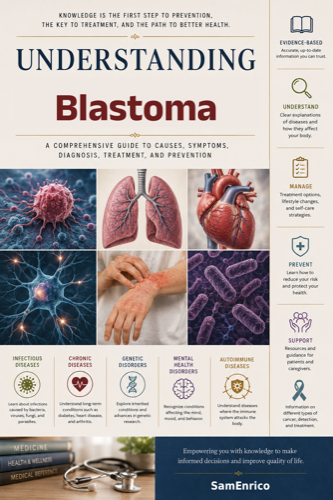
Non-FictionInformativeEducational
Understanding Blastoma eBook
This disease publication, published by SamEnrico,
This disease publication, published by SamEnrico, covers Understanding Blastoma
Formats
Free sample
Chapter 1: The Unfinished Blueprint...–- The soft thud of a mother’s heartbeat, the warm rush of nutrient-rich blood, the furious symphony of cells dividing, migrating, and specializing—this is the hidden world where every human being begins. For nine miraculous months, a single fertilized egg transforms into a complex organism composed of trillions of cells, each knowing precisely when to grow, when to stop, and what to become. This process, which we call development, is the most carefully choreographed dance in all of biology. And yet, like any intricate performance, it can go terribly wrong.When it does, the result is sometimes a blastoma.The word itself sounds foreign, almost clinical—a term best left to pathologists and oncologists. But for the thousands of families who receive this diagnosis each year, the word becomes deeply personal, terrifyingly real, and urgently in need of understanding.
Understanding Blastoma begins here, not in the sterile language of medical textbooks, but in the messy, beautiful, and vulnerable process of becoming human.This first chapter strips away the mystery and the fear by answering the most fundamental question: What, exactly, is a blastoma? Not by memorizing a dry dictionary definition, but by understanding the story of our own beginnings—and how that story can take an unexpected, tragic turn.The Symphony of Development: How a Human Is Built Before we can understand what goes wrong in a blastoma, we must first appreciate the breathtaking precision of what goes right. Every person reading this book began as a single cell—a zygote—containing a complete set of genetic instructions encoded in DNA. That single cell divided into two, then four, then eight, then sixteen. At first, all these cells were identical, a cluster of what scientists call pluripotent stem cells, capable of becoming anything.
But very quickly, they began to specialize.By the third week of embryonic life, three distinct layers had formed: the ectoderm (which would become skin and nervous system), the mesoderm (muscles, bones, blood, and kidneys), and the endoderm (lungs, gut, and liver). Within each layer, cells received chemical signals that told them, "You will become a neuron," or "You will become a kidney tubule cell," or "You will become a lung lining cell." This process is called differentiation, and it is the cornerstone of normal development.But differentiation does not happen everywhere at once. The body contains specialized regions called developmental niches, where primitive, undifferentiated cells—known as blast cells or precursor cells—wait for their final marching orders. These blast cells are the construction workers of the developing body, present in large numbers during fetal life and early childhood. They are not yet committed to a final identity, which makes them both powerful and dangerous.
Powerful because they can generate entire organs. Dangerous because they remain vulnerable to the kinds of genetic errors that lead to cancer.In a healthy child, these blast cells receive their final differentiation signals, mature into their designated cell types, and then either disappear or become quiescent stem cells that only activate for repair. By adulthood, most organs contain no remaining blast cells. This is the crucial insight that explains nearly everything about blastomas: these tumors only occur where and when blast cells are still present.Defining the Enemy: What Makes a Blastoma a Blastoma A blastoma is a malignant tumor that arises from primitive, undifferentiated precursor cells—blast cells—that have failed to receive or respond to normal differentiation signals. Instead of maturing and taking their place in a functioning organ, these cells continue to proliferate uncontrollably, forming a mass that disrupts normal tissue architecture and can spread to other parts of the body.This definition contains three essential elements that distinguish blastomas from other cancers:First, the cell of origin.
Blastomas arise from blast cells—embryonic or fetal precursors that are normally present only during development. This is fundamentally different from carcinomas, which arise from fully differentiated epithelial cells (like the cells lining the breast, lung, or colon), or from sarcomas, which arise from mesenchymal cells (like fat, muscle, or bone) that can persist throughout life. In adults, carcinomas and sarcomas can occur at any age because their cells of origin are always present. Blastomas, by contrast, are developmental tumors—they only occur in the window when blast cells are still active.Second, the differentiation arrest. Blastoma cells are stuck.
They have not completed their normal maturation program. Under the microscope, they look like embryonic or fetal cells, not like the mature cells of the organ they are invading. This is why pathologists use terms like "blastemal-predominant" to describe these tumors—the cells resemble the primitive blastema (the undifferentiated cell mass) of a developing organ.Third, the embryonal context. Because blast cells are most abundant during fetal development and early childhood, blastomas are overwhelmingly pediatric tumors. More than 90% of all blastomas are diagnosed in children under the age of 10, with many appearing before the fifth birthday.
When blastomas rarely occur in adults, they almost always arise in tissues that retain some embryonic potential (like the testis or ovary) or represent recurrences of a pediatric tumor that was never fully eradicated.The Family of Blastomas: Five Common Types and Their Stories Blastomas are not a single disease but a family of related tumors, each named for the organ or tissue in which the blast cells normally reside. The five most common types represent the major developmental hotspots of the human body.Neuroblastoma: The Great Mimic Neuroblastoma arises from neural crest cells—the same primitive cells that normally give rise to the sympathetic nervous system, the adrenal medulla, and certain nerve ganglia. These cells are supposed to migrate from the developing neural tube to locations throughout the body, where they mature into functioning nerve cells. In neuroblastoma, they get stuck in their primitive state and begin to multiply.The most common location is the adrenal gland, which sits atop each kidney. But neuroblastoma can also arise anywhere along the sympathetic chain, from the neck to the pelvis.
This tumor is the most common solid cancer of infancy, accounting for approximately 6-10% of all childhood cancers. Its behavior is wildly unpredictable: some neuroblastomas regress spontaneously without any treatment (especially those diagnosed in the first year of life), while others are among the most aggressive and treatment-resistant cancers known to medicine.This paradox—the same tumor type behaving so differently in different patients—is one of the central mysteries of blastoma biology. As we will explore in Chapter 2, the answer lies in the genetic orchestra playing inside each tumor.Nephroblastoma (Wilms Tumor): The Kidney's Developmental Error Nephroblastoma, more commonly known as Wilms tumor, arises from primitive blast cells in the developing kidney. The fetal kidney contains a nephrogenic zone—a rim of undifferentiated metanephric blastema that should transform into mature nephrons, the functional units of the kidney. When this process goes awry, the blastema persists and proliferates, forming a solid, often massive tumor that can fill the entire abdominal cavity.Wilms tumor is the most common renal malignancy of childhood, accounting for approximately 90% of pediatric kidney cancers.
It is also one of the great success stories of modern pediatric oncology: before effective treatments, Wilms tumor was almost…
This is the end of the free sample. Get the eBook to keep going. Buy now
About this book
Details
- Author
- Moreland Laquanda
- Publisher
- SamEnrico
- Language
- English
- Genre
- Non-Fiction, Informative, Educational
- Released
- 2026-06-02
- Pages (approx.)
- 160
- Available as
- eBook, Audiobook

Read better in the ZLOADR app
Your eBooks on your phone or tablet. Sign in with your SamEnrico account and start reading.
More by Moreland Laquanda
 Personal Ing For Success Consulting PipelineMoreland Laquanda$11.99
 Benzodiazepine Tapering WorkbookMoreland Laquanda$11.99
 Prioritization for PerfectionistsMoreland Laquanda$11.99
 Medication Diary For DoctorsMoreland Laquanda$11.99
 Single Parent Anger BreakthroughMoreland Laquanda$11.99
 Laughter in the Dark: The Unseen Terror of the Killer Clown EpidemicMoreland Laquanda$11.99
 Echoes in the Abyss: The Forgotten Divers of the Indian OceanMoreland Laquanda$11.99
 SponsorMoreland Laquanda$11.99
 Jumia Seller Performance MetricsMoreland Laquanda$12.99
 Degree in US Bootcamp OverseasMoreland Laquanda$12.99
 How to Become a Scraper OperatorMoreland Laquanda$11.99
You may also like
 Hong Kong Handover 1997Dunn Johnnie$11.99
 Zumba For Postnatal Recovery CourseNeal Christian$11.99
 Zumba for BeginnersLadner Nikia$11.99
 YouTube Comment Mining GuideHumes Pandora$12.99
 Worry Box MeditationCarlin Rudy$11.99
 Workplace Stress MeditationNguyen Lynn$11.99
 Workplace Stress and Sleep RepairHawley Ivory$11.99
 Workplace Perfectionism CureDelaney Jeffry$11.99
 Workplace Injustice Anger GuideWallen Isabelle$11.99
 Work Addiction and Burnout LinkGreenwood Ester$11.99
 Women in Yoga and WellnessBeattie Galina$11.99
 Women in Stand Up ComedyChun Evangeline$11.99