
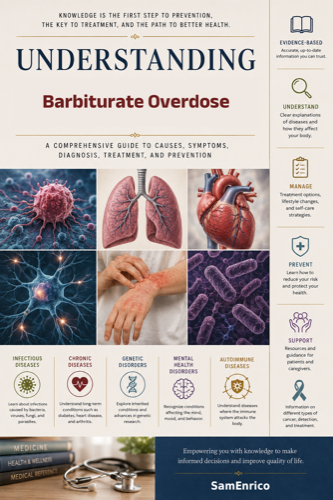
Non-FictionInformativeEducational
Understanding Barbiturate Overdose eBook
This disease publication, published by SamEnrico,
This disease publication, published by SamEnrico, covers Understanding Barbiturate Overdose
Formats
Free sample
Chapter 1: The Forgotten Bottle--The overdose patient arrived at 2:47 AM on a Tuesday, which is to say she arrived at the most dangerous time of the week. The emergency department was understaffed, the overnight resident was on his third cup of coffee, and the toxicology fellow was at home, asleep, with her pager set to vibrate under her pillow. The paramedics wheeled in a woman in her early forties, intubated, bagged, and barely perfusing. Her skin was mottled. Her pupils were two millimeters and sluggish.
Her blood pressure was 78 over 40 despite a liter of saline en route. The paramedic report was brief: "Found down by her husband. Empty pill bottles next to the bed. Unknown what she took. Naloxone given, no response."That last detail—no response to naloxone—narrowed the possibilities but did not simplify the case.
The patient was not in opioid overdose, or not only in opioid overdose. The resident ran through the differential: hypoglycemia? No, fingerstick glucose was 110. Wernicke's? No history of alcohol misuse.
Trauma? No external signs, but a head CT would follow. The empty bottles were eventually identified: phenobarbital, prescribed for a seizure disorder the husband had not known about. The patient had been hiding her diagnosis from her family for eleven years.This is a book about what happened next. It is also a book about what happened before—about a class of drugs that built the first overdose epidemic in American history, that killed more people in the 1960s and 1970s than heroin ever did, and that then faded from public memory only to linger in medicine cabinets, veterinary clinics, and online marketplaces.
Barbiturates are the forgotten overdose. Every emergency physician knows fentanyl. Every parent knows the opioid crisis. But how many know that a single bottle of phenobarbital from 1998—still sitting in a grandmother's bathroom cabinet—contains enough lethal potential to put three adults into comas?This chapter establishes why barbiturates still matter. It is not a history lesson for its own sake.
It is an argument that familiarity with these drugs is not optional for clinicians, and that public awareness of their dangers is dangerously low. We will travel from the 19th-century laboratories where barbituric acid was first synthesized, through the Golden Age of sedative-hypnotics when "sleeping pills" were prescribed like candy, to the benzodiazepine revolution that pushed barbiturates to the margins, and finally to the modern resurgence that has put these drugs back into circulation through veterinary euthanasia solutions, medical aid in dying, and treatment-refractory epilepsy protocols. Along the way, we will meet the patients who died, the physicians who sounded alarms, and the regulatory gaps that persist to this day.The goal of this chapter is simple: by the time you finish reading, you will understand why barbiturates are not a relic. They are a present danger, hiding in plain sight.The Nineteenth-Century Quest for Sleep Before barbiturates, there were bromides. Before bromides, there was alcohol.
And before alcohol, there was simply insomnia—untreated, unexplained, and endured. The human desire for sedation is as old as human consciousness itself, but the scientific pursuit of reliable hypnotic drugs began in earnest in the nineteenth century, when chemistry emerged as a discipline capable of synthesizing new compounds rather than merely extracting existing ones from plants.The first modern sedatives were crude by today's standards. Bromides, introduced in the 1850s, were effective but toxic. Chronic use caused bromism: a syndrome of skin rashes, cognitive impairment, slurred speech, and psychotic symptoms indistinguishable from schizophrenia. Patients taking bromides for epilepsy or insomnia often ended up in asylums, not because of their underlying condition but because of the treatment.
Chloral hydrate, the "knockout drops" of Victorian era medicine, worked well but had a narrow therapeutic index and caused gastric irritation, cardiac arrhythmias, and dependence. It was also famously misused: the first documented death from chloral hydrate overdose occurred in 1870, and by the 1890s, "chloral drinking" was a recognized public health problem in Britain.Into this landscape came a young chemist named Adolf von Baeyer. In 1864, working in a laboratory in Berlin, von Baeyer synthesized a new compound by combining urea with malonic acid. The resulting crystalline substance had no particular medical properties that von Baeyer could identify, but he noted it in his notebook and named it barbituric acid. The origin of the name is disputed.
Some say von Baeyer named it after a waitress named Barbara whom he had met on Saint Barbara's Day. Others say he derived it from the Latin "barbarus" (barbaric), a reference to his frustration with the compound's resistance to further chemical manipulation. Whatever the truth, barbituric acid remained a laboratory curiosity for nearly forty years. It was not until 1903 that von Baeyer's student, Emil Fischer, working with Joseph von Mering, discovered that a derivative of barbituric acid—diethylbarbituric acid, which they named barbital—could induce reliable sleep in dogs. They marketed it under the trade name Veronal.The dawn of the barbiturate era had begun.The Golden Age of Sedation Barbital was a revelation.
For the first time, physicians had a synthetic compound that reliably induced sleep without the toxicity of bromides or the unpredictability of chloral hydrate. Patients with insomnia could take a pill at bedtime and wake up eight hours later. Patients with epilepsy experienced fewer seizures. The drug was not without side effects—morning drowsiness was common, and dependence developed with chronic use—but compared to what came before, barbital was a miracle.The floodgates opened. Over the next four decades, chemists synthesized more than 2,500 barbiturate derivatives, of which approximately fifty entered clinical use.
Each new iteration promised something better: faster onset, shorter duration, fewer side effects. Phenobarbital (Luminal) arrived in 1912 and remains in use today, primarily for epilepsy. Pentobarbital (Nembutal) followed in 1930, prized for its rapid onset and short duration of action. Secobarbital (Seconal) came soon after, marketed as the ideal sleep aid because it put patients to sleep quickly and wore off before morning.The 1930s through the 1960s were the Golden Age of barbiturates. They were prescribed for everything: insomnia, anxiety, epilepsy, morning sickness, motion sickness, and even as "psychic energizers" in low doses.
They were available in bright red capsules (secobarbital was famously called "reds" or "red devils"), yellow jackets (pentobarbital), and purple hearts (a combination of phenobarbital and amphetamine, prescribed for weight loss). They were in every medicine cabinet, every hospital formulary, every nursing home medication cart.And they were killing people.The first deaths were dismissed as accidents or suicides, but the pattern became impossible to ignore. By the 1940s, barbiturates were the leading cause of fatal drug overdose in the United States. The problem was not just misuse—though misuse was rampant—but the fundamental pharmacology of the drugs themselves. Barbiturates have a narrow therapeutic index, a term we will explore in depth in Chapter 2.
In plain language: the difference between a dose that helps a patient sleep and a dose that stops a patient from breathing is terrifyingly small. For some barbiturates, as few as five to ten times the therapeutic dose can be lethal. Compare this to benzodiazepines, which replaced barbiturates in the 1960s and 1970s: it is nearly impossible to die from a benzodiazepine overdose alone.The…
This is the end of the free sample. Get the eBook to keep going. Buy now
About this book
Details
- Author
- Mcfarland Loria
- Publisher
- SamEnrico
- Language
- English
- Genre
- Non-Fiction, Informative, Educational
- Released
- 2026-06-02
- Pages (approx.)
- 157
- Available as
- eBook, Audiobook

Read better in the ZLOADR app
Your eBooks on your phone or tablet. Sign in with your SamEnrico account and start reading.
More by Mcfarland Loria
 Letting Go of TailgatersMcfarland Loria$11.99
 Gambling Addiction and Anxiety ManualMcfarland Loria$11.99
 Breath Work for Deeper StretchingMcfarland Loria$11.99
 Daily Review for Minimalists GuideMcfarland Loria$11.99
 The Last Telegram: The Secret Codebreakers of Room 40Mcfarland Loria$11.99
 The Bone Whisperers: How Prehistoric Hunters Mastered Probability in the Ice AgeMcfarland Loria$11.99
 Fulfillment SupervisorMcfarland Loria$11.99
 Boomer Pet Spending PatternsMcfarland Loria$12.99
 One Page Podcast Marketing PlanMcfarland Loria$12.99
 10 Ways to Use Chilli Oil (Recipe Book)Mcfarland Loria$11.99
You may also like
 Hong Kong Handover 1997Dunn Johnnie$11.99
 Zumba For Postnatal Recovery CourseNeal Christian$11.99
 Zumba for BeginnersLadner Nikia$11.99
 YouTube Comment Mining GuideHumes Pandora$12.99
 Worry Box MeditationCarlin Rudy$11.99
 Workplace Stress MeditationNguyen Lynn$11.99
 Workplace Stress and Sleep RepairHawley Ivory$11.99
 Workplace Perfectionism CureDelaney Jeffry$11.99
 Workplace Injustice Anger GuideWallen Isabelle$11.99
 Work Addiction and Burnout LinkGreenwood Ester$11.99
 Women in Yoga and WellnessBeattie Galina$11.99
 Women in Stand Up ComedyChun Evangeline$11.99