
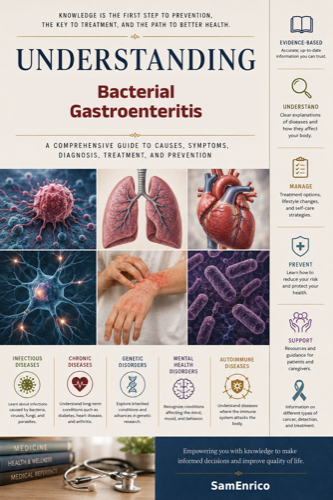
Non-FictionInformativeEducational
Understanding Bacterial Gastroenteritis eBook
This disease publication, published by SamEnrico,
This disease publication, published by SamEnrico, covers Understanding Bacterial Gastroenteritis
Formats
Free sample
Chapter 1: The Unseen Epidemic--–- The young mother arrived at the rural health clinic carrying a child who no longer had the strength to cry. The baby, just eleven months old, had been having watery diarrhea for three days. At first, the mother had not been overly worried. Diarrhea was common in their village. But on the second day, the baby stopped breastfeeding.
On the third day, the sunken eyes and the skin that remained folded when pinched told a terrifying story. The baby was severely dehydrated. The clinic had intravenous fluids, but the nearest hospital with a laboratory was four hours away. No one knew what pathogen was causing the illness. The only thing anyone knew for certain was that without immediate rehydration, this child would likely die before morning.This scene repeats itself somewhere in the world every few seconds.
A child with diarrhea. A parent who cannot afford to stop working. A clinic without diagnostic capacity. And a clock ticking toward severe dehydration, organ failure, and death.The World Health Organization estimates that diarrheal diseases kill approximately 525,000 children under five years of age each year. That is one child every minute.
While global efforts have reduced this number significantly over the past three decades, the persistent reality is that bacterial gastroenteritis remains one of the leading infectious causes of death in young children, particularly in low-resource settings where clean water, adequate sanitation, and timely medical care are not universally available.But bacterial gastroenteritis is not only a problem of the developing world. In developed nations, it accounts for millions of healthcare visits annually, thousands of hospitalizations, and significant economic losses from missed work, foodborne outbreaks, and long-term complications. The 1993 Jack in the Box outbreak of enterohemorrhagic E. coli O157:H7 sickened over 700 people and killed four children, transforming the public understanding of food safety in the United States. More recently, multidrug-resistant Shigella and Campylobacter have emerged as urgent public health threats, challenging the effectiveness of our antibiotic armamentarium.This chapter introduces the fundamental concepts of bacterial gastroenteritis: what it is, how common it is, why it matters, and how it differs from other causes of diarrheal illness.
By the end of this chapter, the reader will understand the global burden of disease, appreciate the historical context of key discoveries, recognize the clinical features that suggest a bacterial rather than viral or parasitic cause, and understand why bacterial causes require special attention in clinical practice and public health.What Is Bacterial Gastroenteritis?Bacterial gastroenteritis refers to inflammation of the gastrointestinal tract, specifically the stomach and intestines, caused by infection with bacterial pathogens. The term "gastroenteritis" combines "gastro" (stomach), "entero" (intestine), and "itis" (inflammation). The condition typically presents with diarrhea, abdominal pain, nausea, vomiting, and sometimes fever. However, the clinical presentation varies considerably depending on the specific bacterial pathogen involved, the number of organisms ingested (the inoculum size), the host's age and immune status, and the presence of any underlying medical conditions.One of the most useful clinical distinctions is between small intestinal infections and large intestinal infections. Small intestinal pathogens, such as Vibrio cholerae and enterotoxigenic E.
coli, typically cause profuse, watery diarrhea without blood. These pathogens often produce toxins that activate fluid secretion in the small intestine without directly invading or destroying epithelial cells. The resulting diarrhea is large in volume (sometimes exceeding one liter per hour in severe cholera) and carries a high risk of dehydration if fluid losses are not replaced.In contrast, large intestinal pathogens, such as Shigella, enterohemorrhagic E. coli, and Campylobacter, typically cause inflammatory diarrhea with blood and mucus, a syndrome termed dysentery. These pathogens invade the colonic epithelium, trigger an intense inflammatory response, and cause mucosal ulceration and bleeding.
The stools are frequent but small in volume, accompanied by abdominal cramping, tenesmus (a painful, urgent sensation of needing to pass stool), and fever. Dysentery indicates a more invasive process and typically warrants diagnostic evaluation and consideration of antibiotic therapy.Bacterial gastroenteritis must be distinguished from viral gastroenteritis (caused by rotavirus, norovirus, adenovirus, or astrovirus), parasitic infections (caused by Giardia lamblia, Cryptosporidium, or Entamoeba histolytica), and non-infectious causes of diarrhea (medications such as antibiotics or laxatives, inflammatory bowel disease, irritable bowel syndrome, endocrine disorders such as hyperthyroidism, and surgical conditions such as appendicitis). While definitive diagnosis requires laboratory testing, understanding the typical clinical presentations of different causes can guide initial management and testing decisions.Global Burden and Epidemiology Acute diarrheal diseases remain among the leading causes of morbidity and mortality worldwide. The Global Burden of Disease Study estimates that diarrheal diseases caused over 1.6 million deaths in 2019, making them the eighth leading cause of death globally. While this represents a significant reduction from earlier decades, the burden remains substantial, particularly in low-resource settings.The Burden in Developing Nations.
In low- and middle-income countries, bacterial gastroenteritis disproportionately affects young children. The reasons are multifactorial. Contaminated water supplies are a primary driver, as many communities lack access to piped, treated water. Open defecation and inadequate sewage treatment allow fecal pathogens to contaminate drinking water sources and the environment. Food safety is compromised by limited refrigeration, cross-contamination during food preparation, and consumption of raw or undercooked animal products.
Healthcare access is constrained by distance, cost, and limited diagnostic capacity. Malnutrition, which impairs immune function and reduces gastric acid production, is both a consequence and a cause of recurrent diarrheal illness, creating a vicious cycle of infection and undernutrition.The Burden in Developed Nations. In high-income countries, bacterial gastroenteritis more often manifests as self-limited illness in otherwise healthy individuals, though severe cases and outbreaks continue to occur. Foodborne transmission represents a major pathway, with poultry products implicated in Campylobacter and Salmonella infections, ground beef in enterohemorrhagic E. coli outbreaks, produce in Shigella and Salmonella outbreaks, and seafood in Vibrio infections.
Person-to-person transmission is particularly important for Shigella, which has an extremely low infectious dose (as few as 10 to 100 organisms can cause disease), and for Clostridium difficile, which spreads via spores in healthcare settings. International travel to regions with high rates of enteric pathogens places travelers at risk for so-called traveler's diarrhea, most commonly caused by enterotoxigenic E. coli.Seasonality. Many bacterial enteric infections exhibit seasonal patterns. Campylobacter infections peak in summer months, correlating with outdoor cooking and consumption of undercooked poultry.
Vibrio infections also peak in summer, when warmer waters support bacterial growth and shellfish consumption increases. Shigella and Salmonella have summer peaks as well. C. difficile, by contrast, lacks a strong seasonal pattern because it is primarily healthcare-associated.Historical Context: How We Learned What We Know The history of understanding bacterial gastroenteritis is rich with scientific discovery, driven by careful observation, meticulous laboratory work, and occasional serendipity.The Birth of the Germ Theory. Before the late nineteenth century, the prevailing theory of disease causation was miasma theory, which held that diseases were caused by "bad air" or poisonous vapors.
The work of Louis Pasteur in France and Robert Koch in Germany established the germ theory of disease, demonstrating that specific microorganisms cause specific diseases.Koch and Cholera. Robert Koch's discovery of Vibrio cholerae in 1884 during an outbreak in Egypt and India was a landmark achievement. Using his famous postulates (the organism must be present in every…
This is the end of the free sample. Get the eBook to keep going. Buy now
About this book
Details
- Author
- Armstrong Lindsay
- Publisher
- SamEnrico
- Language
- English
- Genre
- Non-Fiction, Informative, Educational
- Released
- 2026-06-03
- Pages (approx.)
- 135
- Available as
- eBook, Audiobook

Read better in the ZLOADR app
Your eBooks on your phone or tablet. Sign in with your SamEnrico account and start reading.
More by Armstrong Lindsay
 Feynman Woman in PhysicsArmstrong Lindsay$11.99
 DoorDash Peak Pay DecoderArmstrong Lindsay$11.99
 The Model Overdose ConfessionArmstrong Lindsay$11.99
 The Recovery Capital CourseArmstrong Lindsay$11.99
 Remote Fundraising CommunicationArmstrong Lindsay$11.99
 Growth Hormone Myths DebunkedArmstrong Lindsay$11.99
 Blood Moon Standstill: The 2019 Hong Kong SiegeArmstrong Lindsay$11.99
 The Complicated Parent GriefArmstrong Lindsay$11.99
 Cannabis and MemoryArmstrong Lindsay$11.99
 Visualization Protocol For TalksArmstrong Lindsay$11.99
 The Last Oracle of Delphi: Prophecy, Power, and the Fall of a Divine InstitutionArmstrong Lindsay$11.99
 The Linguistic Architects of Timbuktu: Decoding the World's WisdomArmstrong Lindsay$11.99
You may also like
 Hong Kong Handover 1997Dunn Johnnie$11.99
 Zumba For Postnatal Recovery CourseNeal Christian$11.99
 Zumba for BeginnersLadner Nikia$11.99
 YouTube Comment Mining GuideHumes Pandora$12.99
 Worry Box MeditationCarlin Rudy$11.99
 Workplace Stress MeditationNguyen Lynn$11.99
 Workplace Stress and Sleep RepairHawley Ivory$11.99
 Workplace Perfectionism CureDelaney Jeffry$11.99
 Workplace Injustice Anger GuideWallen Isabelle$11.99
 Work Addiction and Burnout LinkGreenwood Ester$11.99
 Women in Yoga and WellnessBeattie Galina$11.99
 Women in Stand Up ComedyChun Evangeline$11.99