
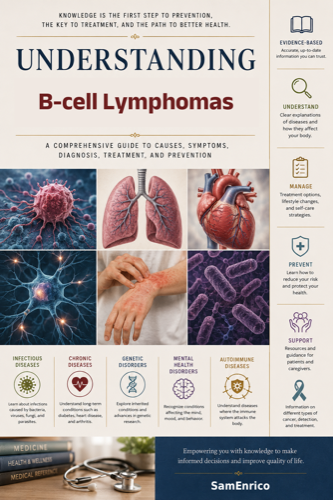
Non-FictionInformativeEducational
Understanding B-cell Lymphomas eBook
This disease publication, published by SamEnrico,
This disease publication, published by SamEnrico, covers Understanding B-cell Lymphomas
Formats
Free sample
Chapter 1: The Broken Factory--–- The human body is a marvel of controlled chaos, a swirling metropolis of trillions of cells, each one following a genetic script written over millennia. Among the most sophisticated citizens of this metropolis is the B-cell, a specialized white blood cell that functions as a living antibody factory. Its sole purpose is to protect you, to recognize invaders that have never touched your skin, and to remember them for a lifetime. But what happens when the factory itself becomes the threat? What happens when the very machinery designed to mutate DNA for your survival—the sophisticated process of somatic hypermutation and class-switch recombination—misfires catastrophically?
The answer, as this chapter will reveal, is B-cell lymphoma. To understand this disease, you must first understand the B-cell’s journey from birth in the bone marrow to its fateful appointment in the germinal center, where the mechanisms that create immunity also plant the seeds of cancer.The Birth of a Guardian: B-cell Development Every B-cell begins its life in an unlikely place: the spongy interior of your bones, the bone marrow. Here, amidst a niche of supporting cells and growth factors, a hematopoietic stem cell makes a decision. This master stem cell, capable of becoming any blood cell—red, white, or platelet—commits to the lymphoid lineage. It becomes a common lymphoid progenitor, then a pro-B cell, then a pre-B cell.
This isn't a passive transformation; it's a series of high-stakes genetic rearrangements.Imagine you are building a library, but you have no books. Instead, you have millions of shuffled sentence fragments. The B-cell, during its development, performs a feat known as V(D)J recombination. It takes Variable (V), Diversity (D), and Joining (J) gene segments on chromosome 14 and literally cuts and pastes them together. This creates a unique B-cell receptor (BCR), the antenna on the B-cell's surface that will eventually recognize a specific antigen (like a virus spike protein or a bacterium's capsule).
The sheer diversity of this process is staggering; the body can generate billions of distinct BCRs, ensuring that no matter what pathogen emerges, at least a few B-cells are theoretically equipped to recognize it.If the developing B-cell successfully assembles a functional receptor (first a pre-BCR, then a mature BCR), it receives a survival signal. Failed rearrangements lead to apoptosis, or programmed cell death—a clean, quiet suicide that prevents defective cells from causing trouble. The surviving, naïve B-cells, now equipped with their unique antigen receptor, exit the bone marrow and travel through the bloodstream, seeding the secondary lymphoid organs: the lymph nodes, spleen, and mucosa-associated lymphoid tissue (MALT). They wait here, silent and ready, for their first encounter with an enemy they are uniquely designed to recognize.This is the first critical point in our story. The genetic machinery that creates BCR diversity—the RAG complex (Recombination Activating Genes)—is an inherently dangerous tool.
It cuts DNA deliberately. Usually, the repair is flawless. But when it isn't, the first oncogenic mutations can occur. Many B-cell leukemias originate from errors at this very early, pre-germinal center stage.The Germinal Center: The Danger Zone The real transformation, however, the one most relevant to B-cell lymphomas, happens later. When a naïve B-cell encounters its specific antigen, usually in the dark zone of a lymph node's germinal center, it doesn't just activate.
It undergoes a radical metamorphosis. It becomes a lymphoblast, proliferating rapidly and migrating into the light zone. Here, with the help of follicular helper T-cells, the B-cell enters the most dangerous phase of its existence: the germinal center reaction.Two processes occur here, and both are double-edged swords.First is somatic hypermutation (SHM) . The B-cell takes its successfully rearranged antibody gene and unleashes an enzyme called Activation-Induced Cytidine Deaminase (AID). AID deliberately introduces point mutations into the variable region of the immunoglobulin gene at a rate one million times higher than the background mutation rate of the rest of the genome.
This is evolution in fast-forward. The B-cell mutates its antibody receptor, creating thousands of variants. Those variants that now bind the antigen with higher affinity are selected to survive; those that bind poorly die. This is how your body creates "high-affinity" antibodies that can neutralize viruses with incredible precision.Second is class-switch recombination (CSR) . The same AID enzyme orchestrates the deletion of large chunks of DNA to swap the constant region of the antibody.
This changes the antibody's function without altering its antigen specificity. A B-cell can switch from making Ig M (the first responder) to making Ig G (the workhorse of the blood), Ig A (the guardian of mucosal surfaces), or Ig E (the allergen alarm).From an evolutionary perspective, SHM and CSR are miracles. From an oncological perspective, they are a controlled explosion inside the nucleus. AID doesn't just target antibody genes. It is a promiscuous enzyme that causes off-target DNA breaks throughout the genome.
It can accidentally activate proto-oncogenes like MYC (a master transcription factor that drives cell division) or BCL6 (a repressor of differentiation). It can also disable tumor suppressor genes like TP53 (the guardian of the genome) or BCL2 (which normally keeps the cell's "suicide switch" in check).Most of the time, the B-cell's DNA repair machinery fixes these breaks. But in the high-stakes environment of the germinal center, where B-cells are dividing every few hours, errors accumulate. If a B-cell acquires a translocation that places the MYC gene next to the powerful immunoglobulin enhancer, MYC becomes stuck in the "on" position. The cell proliferates uncontrollably.
If it also acquires a mutation that disables TP53, it loses the ability to arrest the cell cycle or initiate apoptosis. If it overexpresses BCL2 due to a translocation like t(14;18), it loses its ability to die. The cell is now proliferating aggressively and refusing to die. That is the very definition of a cancer cell.The Three Failures of the Broken Cell Not all lymphomas are the same. The specific "failure" that occurs in the germinal center dictates the subtype of lymphoma and its clinical behavior.
We can categorize these failures into three broad mechanisms, which serve as a framework for understanding every chapter that follows.1. Failure of Apoptosis (The Immortal Cell)Apoptosis is the body's clean-up crew. It's the programmed death that eliminates cells that are old, damaged, or no longer needed. The most famous regulator of this process is the BCL-2 protein (B-cell lymphoma 2). BCL-2 sits on the outer membrane of the mitochondria, acting as a shield that prevents the release of cytochrome c, the chemical signal that initiates the cell's suicide cascade.
In a healthy germinal center, BCL-2 is turned off. Germinal center B-cells are supposed to be short-lived; they either become plasma cells (antibody factories) or memory cells, or they die.In Follicular Lymphoma, the t(14;18) translocation places the *BCL-2* gene under the control of the immunoglobulin heavy chain enhancer. BCL-2 is now expressed constantly, even in the germinal center. The cell simply refuses to die, even when it is damaged or when it loses the competition for antigen. These cells accumulate slowly, forming crowded, abnormal follicles.
This is the hallmark of an indolent lymphoma—it doesn't grow fast because proliferation isn't dramatically increased; it just won't go…
This is the end of the free sample. Get the eBook to keep going. Buy now
About this book
Details
- Author
- Ainsworth Francine
- Publisher
- SamEnrico
- Language
- English
- Genre
- Non-Fiction, Informative, Educational
- Released
- 2026-06-02
- Pages (approx.)
- 148
- Available as
- eBook, Audiobook

Read better in the ZLOADR app
Your eBooks on your phone or tablet. Sign in with your SamEnrico account and start reading.
More by Ainsworth Francine
 Road Rage Video Self AnalysisAinsworth Francine$11.99
 The Parent Death Work LeaveAinsworth Francine$11.99
 Hypnosis for Quitting SmokingAinsworth Francine$11.99
 Child Microbiome NutritionAinsworth Francine$11.99
 Elizabeth I Poor Laws Social GovernanceAinsworth Francine$11.99
 Whispers of the Last Wild: The Secret Life of the VaquitaAinsworth Francine$11.99
 Rhythm of the Stars: How Ancient Instruments Shaped the CosmosAinsworth Francine$11.99
 Automated Ledgers and Cash Flow CourseAinsworth Francine$12.99
 Payment Gateways for African MerchantsAinsworth Francine$12.99
 Ion Implantation TechnicianAinsworth Francine$11.99
 How to Start a Power-driven Planers Business (Beginners Guide)Ainsworth Francine$11.99
You may also like
 Hong Kong Handover 1997Dunn Johnnie$11.99
 Zumba For Postnatal Recovery CourseNeal Christian$11.99
 Zumba for BeginnersLadner Nikia$11.99
 YouTube Comment Mining GuideHumes Pandora$12.99
 Worry Box MeditationCarlin Rudy$11.99
 Workplace Stress MeditationNguyen Lynn$11.99
 Workplace Stress and Sleep RepairHawley Ivory$11.99
 Workplace Perfectionism CureDelaney Jeffry$11.99
 Workplace Injustice Anger GuideWallen Isabelle$11.99
 Work Addiction and Burnout LinkGreenwood Ester$11.99
 Women in Yoga and WellnessBeattie Galina$11.99
 Women in Stand Up ComedyChun Evangeline$11.99