
Non-FictionInformativeEducational
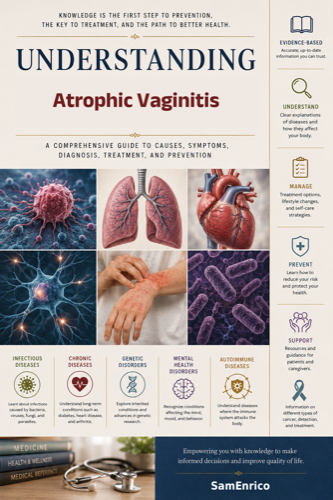
Understanding Atrophic Vaginitis eBook
This disease publication, published by SamEnrico,
This disease publication, published by SamEnrico, covers Understanding Atrophic Vaginitis
Formats
Free sample
Chapter 1: The Sandpaper Secret...--She thought she was losing her mind.For eighteen months, Margaret had been buying expensive moisturizers, switching to cotton underwear, drinking more water, and even trying a "feminine soothing gel" she found on Instagram. Nothing worked. Every morning, wiping after urination felt like sandpaper against raw skin. Every attempt at intimacy with her husband ended in tears—not from emotion, but from the searing, tearing pain that made her gasp and push him away.Her gynecologist had performed a routine exam, declared everything "normal for your age," and suggested more lubricant. Her primary care doctor ran a urine culture, found nothing, and shrugged.
Her friends told her to try coconut oil. Her sister said it was just part of getting older.Margaret was fifty-seven years old. She had raised two children, managed a career as a dental hygienist, and cared for her aging mother. She had survived the death of her own mother, the marriage of her daughter, and the birth of her first grandchild. She had weathered hot flashes, night sweats, and the emotional rollercoaster of perimenopause without complaint.But this—this relentless burning, this humiliation of flinching away from her husband's touch, this secret shame of feeling like her body had betrayed her—was breaking her.She is not alone.The Hidden Epidemic Every day, millions of women like Margaret suffer in silence.
They endure burning, itching, pain with intercourse, urinary urgency, and recurrent infections—all without ever hearing the words "atrophic vaginitis" from a healthcare provider. They are told to use more lube. They are told it's normal aging. They are told, implicitly or explicitly, that their discomfort is simply the price of being a woman past a certain age.They are told wrong.Atrophic vaginitis—a term so clinical and cold that it fails to capture the lived experience of the condition—affects nearly half of all postmenopausal women. Let that number land.
Forty-seven percent of women within three years of their final menstrual period have this condition. That is nearly one in two. In a room of ten women over the age of fifty-five, statistically, four or five of them are experiencing thinning, inflamed, fragile vaginal tissues right now.Yet eighty percent of those women never seek treatment.They do not seek treatment because they are embarrassed. They do not seek treatment because they believe nothing can be done. They do not seek treatment because a doctor has already dismissed their symptoms as "nothing" or "normal." They do not seek treatment because they do not have the vocabulary to name what is happening to their bodies.This book will give you that vocabulary.What This Book Is—And Is Not This is not a dry medical textbook.
You will find no dense paragraphs of jargon here, no impenetrable descriptions of histopathology that require a medical degree to decode. This is a practical, compassionate, evidence-based guide written for the woman who is tired of suffering and ready for answers.This book is for:The woman in her late forties who notices that sex has started to hurt, just a little, just enough to make her hesitate.The woman in her fifties who has stopped having sex entirely because the pain is unbearable.The woman in her sixties who has given up on comfort and accepted chronic burning as her new normal.The breast cancer survivor in her thirties who was plunged into chemical menopause and told to "just use coconut oil."The woman who has seen three doctors, had five urine cultures, and taken fourteen rounds of antibiotics—none of which helped.The partner who wants to understand what is happening and how to help.This book is not a replacement for medical care. You should always consult with a healthcare provider before starting any new treatment. But this book will prepare you to have a different kind of conversation with that provider—one where you arrive informed, armed with the right questions, and ready to advocate for yourself.The Naming Problem Let us begin with language, because language matters.The condition we are discussing has been called many things over the years. The oldest term, still found in some dusty medical textbooks, is "senile vaginitis." Let me be direct about why this term is not merely outdated but actively harmful."Senile" derives from the Latin senilis, meaning "old." In common usage, it has come to imply decline, deterioration, mental and physical decay, the loss of function and dignity.
Calling a woman's condition "senile vaginitis" suggests that her vagina has become old, useless, decayed—that her body is failing as she fails. It carries the weight of ageism and the implicit message that old women's bodies are not worth treating.This term has no place in modern medicine or in any conversation about women's health.The current preferred term in medical literature is "atrophic vaginitis." "Atrophic" refers to the thinning and shrinking of tissue that occurs when cells are no longer receiving the signals they need to maintain themselves. This is a more accurate, less judgmental term. It describes a cellular process, not a personal failure.However, even "atrophic vaginitis" is incomplete. It focuses on the vagina while ignoring the fact that the same estrogen deficiency affects the urethra, the bladder, the pelvic floor, and the vulva.
This is why many experts now prefer the term "genitourinary syndrome of menopause" or GSM. GSM recognizes that the problem extends beyond the vagina to the entire lower urinary and genital tract.For the purposes of this book, we will use these terms with precision:Atrophic vaginitis refers specifically to the vaginal changes.Genitourinary syndrome of menopause (GSM) refers to the broader constellation of symptoms affecting the vagina, vulva, urethra, and bladder.Most women, however, do not wake up thinking, "I wonder if I have genitourinary syndrome of menopause." They wake up thinking, "Why does it burn when I pee?" Or, "Why did I just spot after sex?" Or, "Why does sex hurt so much?"This book will translate between your lived experience and the medical terminology. By the time you finish this chapter, you will have the words to name your suffering—and the knowledge that you are not alone.The Statistics That Should Shock You Let us look more closely at those numbers, because they tell a story about medical neglect and internalized shame.According to the North American Menopause Society, approximately fifty to seventy percent of postmenopausal women will experience symptoms of atrophic vaginitis or GSM. The forty-seven percent figure cited earlier refers specifically to women within three years of menopause. As women age deeper into the postmenopausal years, the prevalence rises.Yet studies consistently show that only twenty percent of affected women ever discuss their symptoms with a healthcare provider.
Eighty percent suffer in silence.Why?The research identifies several barriers:Embarrassment: Women are uncomfortable discussing vaginal symptoms, even with their doctors. The vagina remains a zone of privacy and, for many, shame.Normalization: Women believe that vaginal discomfort is simply part of aging and that nothing can be done about it.Dismissal: When women do bring up their symptoms, they are often told to use lubricant or that everything "looks fine."Lack of knowledge: Many women…
This is the end of the free sample. Get the eBook to keep going. Buy now
About this book
Details
- Author
- Beebe Clarice
- Publisher
- SamEnrico
- Language
- English
- Genre
- Non-Fiction, Informative, Educational
- Released
- 2026-05-09
- Pages (approx.)
- 146
- Available as
- eBook, Audiobook

Read better in the ZLOADR app
Your eBooks on your phone or tablet. Sign in with your SamEnrico account and start reading.
More by Beebe Clarice
 Einstein Zionist ComplexBeebe Clarice$11.99
 Uber vs Lyft Dual StrategyBeebe Clarice$11.99
 The Rancher Overdose StoryBeebe Clarice$11.99
 Step Twelve Daily Service IdeasBeebe Clarice$11.99
 Remote Client Communication GuideBeebe Clarice$11.99
 Twin in Dysfunctional FamilyBeebe Clarice$11.99
 Murdoch The SunBeebe Clarice$11.99
 Pregnancy Safe Stretching RoutinesBeebe Clarice$11.99
 Anticipatory Grief and WorkBeebe Clarice$11.99
 The Hammer and the Anvil: Hannibal's Masterstroke at Cannae (216 BC)Beebe Clarice$11.99
 The Deep-Sea Telescope: Japan's Pioneering Quest to Decode the Cosmos from the PacificBeebe Clarice$11.99
 The Silent Revolution: How a Teen Built the First Voice-Controlled Prosthetic ArmBeebe Clarice$11.99
You may also like
 Hong Kong Handover 1997Dunn Johnnie$11.99
 Zumba For Postnatal Recovery CourseNeal Christian$11.99
 Zumba for BeginnersLadner Nikia$11.99
 YouTube Comment Mining GuideHumes Pandora$12.99
 Worry Box MeditationCarlin Rudy$11.99
 Workplace Stress MeditationNguyen Lynn$11.99
 Workplace Stress and Sleep RepairHawley Ivory$11.99
 Workplace Perfectionism CureDelaney Jeffry$11.99
 Workplace Injustice Anger GuideWallen Isabelle$11.99
 Work Addiction and Burnout LinkGreenwood Ester$11.99
 Women in Yoga and WellnessBeattie Galina$11.99
 Women in Stand Up ComedyChun Evangeline$11.99