
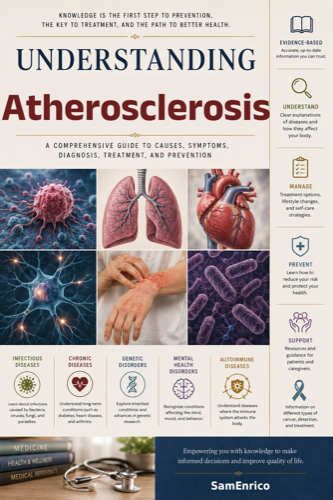
Non-FictionInformativeEducational
Understanding Atherosclerosis eBook
This disease publication, published by SamEnrico,
by Harry Hertha
This disease publication, published by SamEnrico, covers Understanding Atherosclerosis
Formats
Free sample
Chapter 1: The Marathon Lie...--–- He was forty-eight years old, a vegetarian for fifteen years, a marathon runner with a personal best of 3 hours and 12 minutes, and he had never smoked a single cigarette in his life. His name was Michael, and he collapsed at mile twenty-two of the Boston Marathon on a brilliant April morning, right in front of his wife and two teenage daughters. The paramedics reached him in ninety seconds. They shocked his heart three times. They injected epinephrine directly into his bone marrow when they could not find a vein.
By the time they arrived at Massachusetts General Hospital, Michael was gone. The autopsy report would later note three things that haunted every cardiologist who read it: his coronary arteries showed 70 percent stenosis of the left anterior descending artery, his LDL cholesterol had been measured at 112 mg/d L (well within the "normal" range just three months earlier), and his high-sensitivity C-reactive protein – a marker of inflammation that no one had thought to check – was 4.8 mg/L, more than double the threshold for high risk.Michael was not old. Michael was not unhealthy by any conventional measure. Michael should not have died. And yet, he did.
Every year, approximately fifteen million people die from the same disease that killed Michael, making it the single greatest cause of human death on planet Earth. It kills more people than all cancers combined. It kills more people than wars, car accidents, and infectious diseases put together. And the vast majority of its victims – like Michael – never saw it coming.This disease has a name: atherosclerosis. But that clinical term obscures as much as it reveals.
Atherosclerosis is not one thing. It is a process, a decades-long molecular conversation between your blood, your immune system, and the living tissue of your artery walls. It begins in childhood, progresses silently through adulthood, and announces its presence – if it announces it at all – through sudden, catastrophic events that leave families shattered and cardiologists wondering why they did not see it sooner.The purpose of this book is to ensure that you are never surprised by atherosclerosis. Not because you will become paranoid about every twinge in your chest, but because you will understand – truly understand – what is happening inside your arteries, why it happens, and what you can do about it before the marathon, before the collapse, before the shock.The Silent Killer That Speaks Only Once The phrase "silent killer" has been applied to hypertension, to diabetes, to ovarian cancer. But atherosclerosis deserves the title more than any of them.
Consider the numbers: the first detectable evidence of atherosclerosis – a yellow, fatty streak visible only under a microscope – appears in the aortas of nearly all children by the age of ten. By the age of twenty, approximately one in three young adults already has advanced lesions in their coronary arteries, according to the Pathobiological Determinants of Atherosclerosis in Youth (PDAY) study, one of the most sobering autopsy investigations ever conducted. By the age of thirty, one in two. And yet, the average age of a first heart attack in the United States is sixty-four years for men and seventy-two years for women.That means atherosclerosis spends between forty and sixty years building its infrastructure – laying down lipid deposits, recruiting inflammatory cells, forming necrotic cores, constructing and then weakening fibrous caps – before it finally decides to reveal itself. And when it reveals itself, it often does so as a catastrophic event: a heart attack, a stroke, or sudden cardiac death.
In fact, for approximately half of all men and two-thirds of all women who die suddenly from coronary artery disease, the first symptom was the last symptom. They never had angina. They never had shortness of breath. They never knew.This is not a failure of medicine. It is a failure of imagination.
For decades, the medical establishment and the public alike have thought about heart disease in the wrong way. We have thought of it as a plumbing problem – as if arteries were simply pipes that gradually clog with cholesterol sludge, like rust building up in an old water main. We have thought of risk factors as a checklist – cholesterol, blood pressure, smoking, diabetes – and assumed that if those numbers look good, the arteries must be good. We have thought of heart attacks as dramatic, unpredictable events triggered by stress or exertion, like a bomb going off.All of these assumptions are wrong. And the first step toward understanding atherosclerosis is to unlearn them.Arteriosclerosis vs.
Atherosclerosis: A Critical Distinction Before we go any further, we must establish a foundational distinction that even many physicians blur. Arteriosclerosis and atherosclerosis are not the same thing, despite the fact that they are often used interchangeably in casual conversation and even in some medical literature.Arteriosclerosis – from the Greek arteria (artery) and sklerosis (hardening) – refers to the generalized stiffening and loss of elasticity of the arterial wall. This process is largely age-related and is accelerated by hypertension. As you age, the elastin fibers in your tunica media fragment, collagen accumulates, and the artery becomes less compliant – less able to expand during systole and recoil during diastole. This is why blood pressure tends to rise with age, particularly the systolic pressure.
Arteriosclerosis is essentially inevitable. It is part of normal aging, though hypertension can accelerate it dramatically.Atherosclerosis – from athero (porridge or paste, referring to the soft, lipid-rich material within the plaque) and sklerosis (hardening) – is a specific, pathological process. It involves the formation of discrete, raised lesions (plaques) within the innermost layer of the artery, the tunica intima. These plaques contain lipids (cholesterol, triglycerides), inflammatory cells (macrophages, T-lymphocytes), smooth muscle cells, and connective tissue. Over time, they can calcify, rupture, erode, or thrombose.
Atherosclerosis is not inevitable. It is preventable and, to some extent, reversible. And it is the focus of this entire book.You can have arteriosclerosis without atherosclerosis – an elderly person with stiff, but clean, arteries. You cannot have atherosclerosis without some degree of arteriosclerosis, because the plaque itself disrupts the normal architecture of the vessel wall. But the two processes are biologically distinct, driven by different mechanisms, and require different therapeutic approaches.
Throughout this book, when we say "atherosclerosis," we mean the plaque-forming, inflammatory, lesion-driven disease. We do not mean simple age-related stiffening.A Brief History of a Very Old Disease If you believe the popular media, atherosclerosis is a disease of modern affluence – a consequence of fast food, sedentary lifestyles, and the stresses of contemporary life. This is only half true. The lifestyle factors of modernity certainly accelerate the disease, but atherosclerosis itself is ancient.In 2009, a team of cardiologists and Egyptologists performed whole-body computed tomography scans on fifty-two mummies from the Museum of Egyptian Antiquities in Cairo. The mummies dated from approximately 1800 BCE to 500 CE – spanning nearly two millennia of ancient Egyptian civilization.
The results, published in the Journal of the American Medical Association, stunned the medical community. Definite or probable atherosclerosis was found in nearly forty percent of the mummies, including those who had lived as long ago as 1500 BCE. Princess Ahmose-Meryetamun, who lived around 1550 BCE, had calcified plaques in her coronary arteries, her aorta…
This is the end of the free sample. Get the eBook to keep going. Buy now
About this book
Details
- Author
- Harry Hertha
- Publisher
- SamEnrico
- Language
- English
- Genre
- Non-Fiction, Informative, Educational
- Released
- 2026-06-02
- Pages (approx.)
- 154
- Available as
- eBook, Audiobook

Read better in the ZLOADR app
Your eBooks on your phone or tablet. Sign in with your SamEnrico account and start reading.
More by Harry Hertha
 Twelve Step for Workaholics AnonymousHarry Hertha$11.99
 The Status Display CuesHarry Hertha$11.99
 Binge Eating Disorder Self Help GuideHarry Hertha$11.99
 Remote Team Meeting FacilitationHarry Hertha$11.99
 Gambling Addiction HouseholdHarry Hertha$11.99
 The Banker Overdose SurvivorHarry Hertha$11.99
 Vending Machine AvoidanceHarry Hertha$11.99
 Growth Hormone Aging BiomarkersHarry Hertha$11.99
 Anticipatory Grief MeditationHarry Hertha$11.99
 The Great Toilet Paper Heist: When Panic Bought the WorldHarry Hertha$11.99
 Spice Routes Reborn: The Dutch Digital Cartographers of Southeast AsiaHarry Hertha$11.99
 Solaris Rising: The Sun’s Forgotten HeirloomHarry Hertha$11.99
You may also like
 Hong Kong Handover 1997Dunn Johnnie$11.99
 Zumba For Postnatal Recovery CourseNeal Christian$11.99
 Zumba for BeginnersLadner Nikia$11.99
 YouTube Comment Mining GuideHumes Pandora$12.99
 Worry Box MeditationCarlin Rudy$11.99
 Workplace Stress MeditationNguyen Lynn$11.99
 Workplace Stress and Sleep RepairHawley Ivory$11.99
 Workplace Perfectionism CureDelaney Jeffry$11.99
 Workplace Injustice Anger GuideWallen Isabelle$11.99
 Work Addiction and Burnout LinkGreenwood Ester$11.99
 Women in Yoga and WellnessBeattie Galina$11.99
 Women in Stand Up ComedyChun Evangeline$11.99