
Non-FictionInformativeEducational
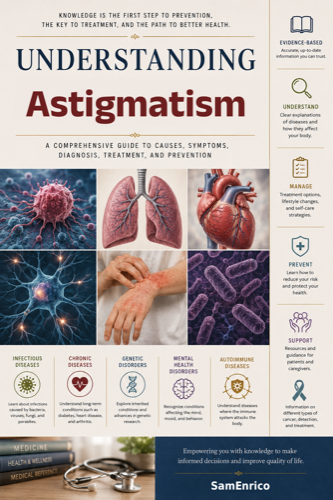
Understanding Astigmatism eBook
This disease publication, published by SamEnrico,
This disease publication, published by SamEnrico, covers Understanding Astigmatism
Formats
Free sample
Chapter 1: The 1-in-3 Secret--–- You have probably lived with astigmatism your entire life without anyone ever explaining what it actually is. The eye doctors used words like “refractive error” and “cylinder” and “axis.” They handed you a prescription printed on thermal paper that looked like a receipt from a gas station. You nodded politely, paid for your glasses or contact lenses, and left feeling vaguely confused but too busy to ask questions. This chapter is going to fix that.If you are reading this book, one of three things is true. First, you have been diagnosed with astigmatism but never fully understood what that means for your daily life.
Second, you suspect something is wrong with your vision—maybe night driving has become stressful, or you get headaches after reading for twenty minutes—but no one has given you a clear answer. Third, someone you love has astigmatism, and you want to help them see better and live more comfortably. Whatever brought you here, you have made the right choice. This chapter will give you something most eye appointments never provide: a complete, honest, useful explanation of what astigmatism is, why it is so common, and why you have probably been suffering more than necessary.Let us start with the most important fact: astigmatism is not a disease. This distinction matters more than you might think.
A disease implies something wrong, something pathological, something that might get worse or spread or require aggressive medical intervention. Astigmatism is none of those things. It is a refractive error, which is a fancy way of saying your eye has a different shape than the theoretical “perfect” eye. That is all. Your eye is not broken.
It is not degenerating. It is just shaped differently. And because it is shaped differently, light bends differently when it enters your eye, which means the images your brain receives are slightly blurry or distorted.The One-in-Three Reality Here is the first number you need to commit to memory: one in three. Approximately one out of every three people on planet Earth has astigmatism. That is over two and a half billion people.
In the United States alone, roughly one hundred million adults have astigmatism to some degree. If you are sitting in a coffee shop right now, look around the room. Statistically, one third of the people in that room have exactly what you have. Some of them know it. Most of them do not.
And that is the real problem with astigmatism—not that it is rare or dangerous, but that it is so common and so poorly understood that millions of people struggle with symptoms they cannot name.Let me share a story that illustrates this perfectly. A woman named Sarah came to see an optometrist after years of worsening headaches. She had been to three different neurologists. She had undergone an MRI. She had tried migraine medications, acupuncture, and a special pillow.
Nothing worked. The optometrist did a routine refraction and discovered that Sarah had 1.25 diopters of astigmatism in both eyes—a moderate amount, easily correctable. The optometrist prescribed glasses. Two weeks later, Sarah’s headaches were gone. She had spent thousands of dollars and years of her life chasing a problem that turned out to be her eye shape.
Sarah is not unusual. She is the rule.The prevalence data tells a clear story. Studies published in ophthalmology journals consistently show that astigmatism is most common in young children, then dips slightly in the teenage years, then rises again in adulthood before peaking in the elderly. Approximately 15 to 20 percent of preschool children have astigmatism that requires correction. Among adults under forty, the number hovers around 30 to 35 percent.
After age sixty, more than half of all people have at least some measurable astigmatism, largely due to age-related changes in the crystalline lens and eyelid tension. What this means for you is simple: if you have astigmatism, you are not an outlier. You are not unusual. You are in the statistical majority.What Astigmatism Actually Is (And Is Not)Let us clear up the confusion once and for all. Your eye works like a camera.
Light enters through the front, passes through a lens, and lands on a sensor at the back. In a perfect eye—what eye doctors call emmetropic—the cornea (the clear front window) and the lens inside your eye are perfectly spherical, like a basketball. When light hits a spherical surface, it bends evenly in all directions and converges to a single, sharp focal point directly on the retina. That is perfect vision.Astigmatism happens when your cornea or your lens is not perfectly spherical. Instead of a basketball, think of a football.
A football has a steep curve on one axis and a shallower curve on the perpendicular axis. When light hits a football-shaped surface, it bends differently depending on which angle it strikes. Some light focuses in front of the retina. Some light focuses behind the retina. Some light might focus directly on the retina.
The result is not simple blur like nearsightedness or farsightedness. It is distortion. A single point of light becomes a line. A circle becomes an oval. A letter like “E” might look shadowed or doubled.This brings us to a crucial distinction that most people never learn: astigmatism blurs vision at all distances, but the severity of that blur varies dramatically depending on the situation.
In bright daylight, your pupil constricts to a small size, blocking out the most distorted peripheral light rays. That is why you might feel fine during a sunny afternoon at the park. At night, your pupil dilates to let in more light, allowing those distorted peripheral rays to reach your retina. That is why headlights suddenly turn into starbursts and taillights stretch into comets. The underlying astigmatism has not changed.
The amount of light entering your eye has changed. Understanding this distinction is the first step toward taking control of your vision rather than feeling like a victim of it.The Three Types of Astigmatism You Need to Know Most books and websites will tell you there are two types of astigmatism: regular and irregular. That is correct, but it leaves out a third category that matters enormously for daily life. Let me give you all three.Corneal astigmatism is the most common form, accounting for approximately 80 percent of all cases. Your cornea—the clear dome at the front of your eye—has a football shape instead of a basketball shape.
This is usually something you are born with, though it can change slowly over time due to eyelid pressure, eye rubbing, or aging. The vast majority of people with astigmatism have the corneal variety, and it is almost always regular astigmatism, which means the two steepest curves of the cornea are perpendicular to each other, like the lines of a plus sign. Regular astigmatism is predictable, stable, and highly correctable with glasses or contacts.Lenticular astigmatism is less common, accounting for the remaining 20 percent of cases. Here, your cornea is perfectly spherical, but the crystalline lens inside your eye—the part that changes shape to focus on near objects—has an irregular curvature. Lenticular astigmatism becomes more common with…
This is the end of the free sample. Get the eBook to keep going. Buy now
About this book
Details
- Author
- Avalos Natalia
- Publisher
- SamEnrico
- Language
- English
- Genre
- Non-Fiction, Informative, Educational
- Released
- 2026-06-02
- Pages (approx.)
- 154
- Available as
- eBook, Audiobook

Read better in the ZLOADR app
Your eBooks on your phone or tablet. Sign in with your SamEnrico account and start reading.
More by Avalos Natalia
 Curie World War One X RayAvalos Natalia$11.99
 The Long Haul Trucker ODAvalos Natalia$11.99
 Relapse Prevention Neurofeedback CourseAvalos Natalia$11.99
 Caregiver in Workplace GuideAvalos Natalia$11.99
 Social Deduction Game AddictionAvalos Natalia$11.99
 Eritrean Camp To StockholmAvalos Natalia$11.99
 Sex Differences in Growth Hormone AgingAvalos Natalia$11.99
 COPD Anticipatory GriefAvalos Natalia$11.99
 Diet Cycle Breaking GuideAvalos Natalia$11.99
 The Quantum Gambit: How a Cold War Spy Race Launched the Quantum RevolutionAvalos Natalia$11.99
 Skies of the Cold War: The Secret Airline That Spied on the WorldAvalos Natalia$11.99
 The Crimson Code: How a Single Color Changed the Course of the American RevolutionAvalos Natalia$11.99
You may also like
 Hong Kong Handover 1997Dunn Johnnie$11.99
 Zumba For Postnatal Recovery CourseNeal Christian$11.99
 Zumba for BeginnersLadner Nikia$11.99
 YouTube Comment Mining GuideHumes Pandora$12.99
 Worry Box MeditationCarlin Rudy$11.99
 Workplace Stress MeditationNguyen Lynn$11.99
 Workplace Stress and Sleep RepairHawley Ivory$11.99
 Workplace Perfectionism CureDelaney Jeffry$11.99
 Workplace Injustice Anger GuideWallen Isabelle$11.99
 Work Addiction and Burnout LinkGreenwood Ester$11.99
 Women in Yoga and WellnessBeattie Galina$11.99
 Women in Stand Up ComedyChun Evangeline$11.99