
Non-FictionInformativeEducational
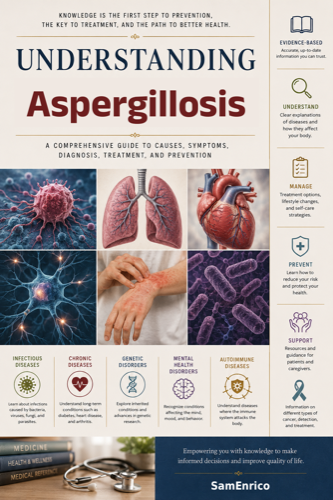
Understanding Aspergillosis eBook
This disease publication, published by SamEnrico,
by Olson Becky
This disease publication, published by SamEnrico, covers Understanding Aspergillosis
Formats
Free sample
Chapter 1: The Invisible Shower...--–- Every morning, before your first sip of coffee, before you check your phone, you inhale. That single breath carries approximately 100 to 1,000 microscopic fungal spores into your lungs. They are invisible, odorless, and utterly indifferent to your existence. Among them, almost always, is Aspergillus—a genus of mold so common that you have likely breathed it in while reading this sentence. By the time you finish this chapter, you will have inhaled several thousand more.The remarkable truth is not that Aspergillus exists everywhere.
The remarkable truth is that almost none of us get sick from it.This chapter answers the foundational question that every patient, every medical student, and every clinician asks when first confronting aspergillosis: What is this organism, why is it everywhere, and why did it make me—or my patient—sick when millions of others breathe it without harm?To understand aspergillosis, you must first understand the silent, ubiquitous organism that causes it. You must understand its biology, its environmental strategy, its evolutionary success, and—most critically—the precise circumstances under which a harmless environmental mold transforms into a life-threatening pathogen. This is not merely an academic exercise. The distinction between harmless exposure and life-threatening disease lies at the very heart of every diagnosis, every treatment decision, and every prognosis discussed in the chapters that follow.The Organism: A Master of Survival Aspergillus is a genus of filamentous fungi (molds) first described in 1729 by the Italian biologist Pier Antonio Micheli. He named it because the microscopic appearance of the spore-forming structure reminded him of an aspergillum—the holy water sprinkler used in Catholic liturgy.
The name stuck, but there is nothing sacred about the organism's ubiquity.There are over 300 described species within the genus Aspergillus, but only a handful cause human disease. The dominant pathogen—responsible for approximately 90% of invasive aspergillosis cases worldwide—is Aspergillus fumigatus. The remaining clinical cases are caused primarily by Aspergillus flavus, Aspergillus niger, and Aspergillus terreus, each with slightly different clinical predilections and antifungal susceptibility profiles that will be discussed in Chapter 9.Why is A. fumigatus so successful as a pathogen? The answer lies in a remarkable set of biological adaptations that make it ideally suited to both environmental survival and human infection.The Spore: A Perfect Delivery System The infectious particle of Aspergillus is the conidium (plural: conidia), often called a spore.
These structures are the organism's primary means of dispersal and survival, and their design is nothing short of evolutionary genius.Size is the first advantage. A. fumigatus conidia measure 2 to 3 microns in diameter—smaller than the average human red blood cell. At this size, they remain suspended in air for hours and, when inhaled, bypass the upper respiratory tract's filtering mechanisms to deposit directly into the alveoli, the microscopic air sacs where gas exchange occurs. Larger particles—pollen grains, dust mites, most other fungal spores—are trapped in the nose, throat, or large airways and cleared by coughing or sneezing.
Aspergillus conidia slip past these defenses entirely.Surface properties provide the second advantage. The conidial surface is hydrophobic—water-repellent—due to a protein called hydrophobin (Rod A). This property not only keeps the spore dry in the environment but also resists mucociliary clearance in the lungs. The mucus that normally traps and transports inhaled debris cannot effectively grab these water-repellent spores. They slide right through.Pigmentation offers a third layer of protection.
The conidia contain melanin, the same pigment that colors human skin and hair. In Aspergillus, melanin serves as a potent antioxidant, neutralizing the oxidative burst that human immune cells use to kill pathogens. A conidium that lands in an alveolar macrophage—the immune cell designed to eat and destroy it—can survive because melanin absorbs and quenches the destructive free radicals the macrophage deploys.The fourth adaptation is thermotolerance. A. fumigatus grows optimally at 37 degrees Celsius—exactly the temperature of the human body.
Most environmental molds cannot grow at mammalian body temperature, which is why they cause disease only in the most profoundly immunocompromised patients. A. fumigatus is not only comfortable at human temperature but thrives there.Together, these adaptations make A. fumigatus the perfect opportunistic pathogen. It reaches the alveoli, resists clearance, survives immune attack, and grows rapidly once conditions permit.The Environmental Reservoir: Where Aspergillus Lives Aspergillus is not a hospital pathogen.
It is not a tropical disease. It is not rare or exotic. It is everywhere.The primary environmental reservoir is soil and decaying organic matter. Aspergillus species are saprophytes—organisms that obtain nutrients by breaking down dead or decaying material. In nature, they play an essential role in the carbon cycle, decomposing plant matter, compost, and leaf litter.
A single gram of garden soil can contain thousands of Aspergillus conidia.Compost piles are particularly rich sources, generating heat that selects for thermotolerant species like A. fumigatus. Agricultural activities—plowing, harvesting, hay handling—aerosolize large quantities of conidia. Construction and demolition disturb soil and release spores. Even indoor environments are not safe: heating, ventilation, and air conditioning systems can colonize and distribute spores throughout buildings.The concentration of airborne Aspergillus conidia varies dramatically by setting.
Outdoor air typically contains 1 to 100 colony-forming units per cubic meter, with peaks during dry, windy weather and agricultural activity. Indoor air generally has lower concentrations, but poorly maintained HVAC systems or water-damaged buildings can harbor significant reservoirs. Hospital air, particularly during construction, can reach high concentrations, posing risks to immunocompromised patients—a problem addressed by hospital infection control measures such as high-efficiency particulate air (HEPA) filtration and positive pressure rooms.The global burden of environmental exposure is essentially universal. Serological studies show that virtually all adults have antibodies against Aspergillus, indicating prior exposure. We are all exposed.
We are all inhaling spores continuously. And almost none of us develop disease.The Global Burden of Disease: Numbers That Matter Despite the ubiquity of exposure, the number of people who develop clinically significant aspergillosis is relatively small compared to the exposed population—but still substantial in absolute terms.As of the most recent global estimates (Denning, 2024), approximately 3 million people worldwide suffer from chronic pulmonary aspergillosis (CPA), the slowly progressive form of the disease that typically affects individuals with pre-existing lung damage. An additional 4.8 million people have allergic bronchopulmonary aspergillosis (ABPA), primarily complicating asthma and cystic fibrosis. Invasive aspergillosis, the most severe form, occurs in approximately 200,000 to 300,000 people annually, predominantly among those receiving chemotherapy for hematologic malignancies, hematopoietic stem cell transplant recipients, and solid organ transplant recipients.The regional distribution of disease reflects both population size and the prevalence of underlying risk factors. India and China, with their large populations and high burden of tuberculosis (which leaves residual lung cavities), account for a disproportionate share of CPA cases.
Sub-Saharan Africa, despite high TB prevalence, has lower reported rates due to limited diagnostic capacity—almost certainly an undercount rather than a true lower incidence.Mortality varies dramatically by disease form, as detailed in Chapter 12. Allergic aspergillosis is rarely fatal if properly treated. Chronic pulmonary aspergillosis carries a 50% five-year mortality, often from bleeding or respiratory failure. Invasive aspergillosis kills 30 to 90 percent of those affected, depending on host factors and time to treatment initiation.The Central Paradox: Why…
This is the end of the free sample. Get the eBook to keep going. Buy now
About this book
Details
- Author
- Olson Becky
- Publisher
- SamEnrico
- Language
- English
- Genre
- Non-Fiction, Informative, Educational
- Released
- 2026-05-11
- Pages (approx.)
- 160
- Available as
- eBook, Audiobook

Read better in the ZLOADR app
Your eBooks on your phone or tablet. Sign in with your SamEnrico account and start reading.
More by Olson Becky
 Resettled From Shousha CampOlson Becky$11.99
 The Commuter Student StressOlson Becky$11.99
 Medical Relapse Prevention for Benzodiazepine Use DisorderOlson Becky$11.99
 Anticipatory Grief CourseOlson Becky$11.99
 The Sitting vs StandingOlson Becky$11.99
 Caregiver Anxiety GuideOlson Becky$11.99
 Nitric Oxide Growth Hormone LinkOlson Becky$11.99
 CBT for Binge EatingOlson Becky$11.99
 The Phoenix That Burned Twice: The Unsolved Mystery of the Great Hôtel-Dieu FireOlson Becky$11.99
 The Last Stand: How a Forgotten 1980s Protest Movement Nearly Toppled a DictatorOlson Becky$11.99
 The Lioness of Sheba: The Queen Who Ruled an Empire of GoldOlson Becky$11.99
 Child Care WorkerOlson Becky$11.99
You may also like
 Hong Kong Handover 1997Dunn Johnnie$11.99
 Zumba For Postnatal Recovery CourseNeal Christian$11.99
 Zumba for BeginnersLadner Nikia$11.99
 YouTube Comment Mining GuideHumes Pandora$12.99
 Worry Box MeditationCarlin Rudy$11.99
 Workplace Stress MeditationNguyen Lynn$11.99
 Workplace Stress and Sleep RepairHawley Ivory$11.99
 Workplace Perfectionism CureDelaney Jeffry$11.99
 Workplace Injustice Anger GuideWallen Isabelle$11.99
 Work Addiction and Burnout LinkGreenwood Ester$11.99
 Women in Yoga and WellnessBeattie Galina$11.99
 Women in Stand Up ComedyChun Evangeline$11.99