
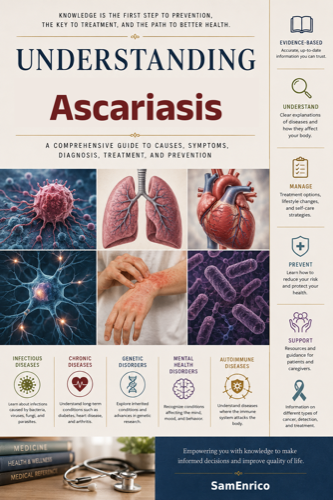
Non-FictionInformativeEducational
Understanding Ascariasis eBook
This disease publication, published by SamEnrico,
This disease publication, published by SamEnrico, covers Understanding Ascariasis
Formats
Free sample
Chapter 1: The Giant Within...--–- It begins silently, invisibly, and almost always without permission. A single microscopic egg, no larger than a speck of dust, lands on unwashed fingers. It transfers to a piece of fruit, then to the lips, then into the warmth of the human mouth. Swallowed without notice, it descends into the dark, churning world of the stomach and small intestine. Inside that egg, a larva waits—not yet a worm, but already programmed with a four-billion-year-old biological imperative: to survive, to migrate, and to reproduce.
Within sixty days, that single larva will mature into an adult female capable of producing two hundred thousand eggs every single day. If left undisturbed, she will live inside her human host for twelve to eighteen months, coiling and uncoiling in the jejunum, stealing nutrients, modulating immune responses, and—in a minority of unlucky cases—wandering into bile ducts, pancreatic passages, or the appendix, where she can kill.This is the story of Ascaris lumbricoides, the giant intestinal roundworm of humans. It is the most common helminth infection of mankind, infecting an estimated 772 to 892 million people at any given time—more than the populations of the United States, Brazil, Russia, and Japan combined. It is a disease of poverty, of broken sanitation systems, of bare feet on contaminated soil, and of children who cannot resist putting dirt in their mouths. But it is also a disease of extraordinary biological complexity, of immune evasion strategies that make pharmaceutical companies envious, and of eggs so resilient that they can remain infectious in the soil for a decade or more, waiting patiently for an unsuspecting host.This chapter unveils the giant within: its ancient relationship with humanity, its astonishing anatomy and physiology, the ongoing scientific debate about whether the human roundworm is truly a separate species from its porcine cousin, and—most importantly—why this neglected tropical disease continues to impose a staggering global burden of disability, malnutrition, and lost human potential.
Understanding Ascaris begins here, with the worm itself.The Ancient Intimate: A History of Coexistence Humans and Ascaris have lived together longer than most written records can document. The evidence lies buried in archaeological sites, preserved in ancient medical texts, and written into our very genomes through millennia of coevolution. The relationship is not accidental—it is a legacy of our species' transition from nomadic foraging to settled agriculture, a transition that created the perfect ecological niche for a fecal-orally transmitted parasite.The earliest direct evidence comes from coprolites—fossilized human feces—recovered from archaeological sites in the Americas, Europe, and Asia. Pre-Columbian mummies from the Andean highlands, dating to 2000 BCE, have yielded Ascaris eggs perfectly preserved in intestinal tissues. Roman latrines in Britain, occupied during the first and second centuries CE, contain thousands of Ascaris eggs mixed with sewage sludge.
Medieval cesspits across Europe tell the same story: wherever humans settled in dense communities, defecated near their water sources, and used human feces as fertilizer—a practice charmingly but dangerously called "night soil"—Ascaris followed.Written records confirm what the archaeological record implies. The Ebers Papyrus, an Egyptian medical document dating to approximately 1550 BCE (but almost certainly copied from much older sources), includes remedies for "worms in the belly." The recommended treatment? A concoction of roasted dates, honey, and the crushed seeds of the sycamore fig—ineffective, certainly, but evidence that our ancestors recognized the presence of intestinal worms and sought to expel them. The Greek physician Hippocrates, writing in the fifth century BCE, described "round worms" that caused abdominal colic and occasionally emerged from the mouth or nose—a terrifying phenomenon that occurs when adult worms migrate retrograde up the esophagus during heavy infections or after certain anthelmintic treatments. The Roman encyclopedist Pliny the Elder, in his Natural History, recommended drinking a mixture of wormwood and wine to expel intestinal parasites—a remedy that, unlike many ancient treatments, actually has some pharmacological basis (wormwood contains artemisinin-related compounds with antiparasitic properties).The taxonomic identification of Ascaris lumbricoides came much later.
In 1758, Carl Linnaeus—the father of modern taxonomy—formally named the species in the tenth edition of his Systema Naturae. The genus name Ascaris derives from the Greek askarís, meaning "intestinal worm" (a term that appears in Aristophanes' plays as a vulgar insult). The species epithet lumbricoides means "resembling an earthworm"—an apt description, though earthworms and roundworms are only distantly related.For centuries, physicians assumed that Ascaris arose spontaneously from putrefying intestinal contents—the theory of spontaneous generation, which held that life could arise from non-living matter. It was not until the mid-nineteenth century that German parasitologists demonstrated the true life cycle. In 1860, Rudolf Leuckart fed embryonated Ascaris eggs to dogs and recovered adult worms at necropsy.
In 1862, Giovanni Battista Grassi—working independently and in what would become a bitter priority dispute—performed similar experiments on humans (using himself as a subject, as was alarmingly common among early parasitologists) and correctly described the hepato-tracheal migration. By 1880, the full life cycle was established: eggs passed in feces, embryonation in soil, ingestion by a new host, larval migration through liver and lungs, maturation in the small intestine. The giant within had been mapped.Morphology and Physiology: The Architecture of a Parasite To understand ascariasis, one must first understand the worm itself. Ascaris lumbricoides is a nematode, belonging to the phylum Nematoda—a vast and diverse group of unsegmented roundworms that includes everything from the microscopic C. elegans (a model organism in developmental biology) to the giant Antarctic nematodes that reach several centimeters in length.
Nematodes are characterized by their cylindrical bodies, complete digestive tracts (mouth, pharynx, intestine, and anus), and tough, collagenous cuticles that provide structural support and protection against host digestive enzymes.Size and Sexual Dimorphism Ascaris is the largest intestinal nematode of humans, and the size difference between the sexes—sexual dimorphism—is striking. Adult females typically measure 20 to 35 centimeters in length, with a diameter of 3 to 6 millimeters. The largest recorded specimen, preserved in the pathology museum of the University of Tokyo, measures 49 centimeters—nearly a foot and a half of coiled nematode. Adult males are considerably smaller, ranging from 15 to 25 centimeters in length, and are immediately recognizable by their curved posterior ends, which bear a pair of copulatory spicules used to grasp the female during mating.This size differential is not merely a curiosity; it reflects the intense reproductive competition among male nematodes. A single female may mate with multiple males, and the male's curved tail and spicules evolved to ensure successful insemination even when multiple males are competing for the same female.
After mating, the female stores sperm in a specialized structure called the seminal receptacle, fertilizing her eggs over a period of months without needing to mate again.The Egg: A Fortress of Resilience The Ascaris egg is a masterpiece of biological engineering. Measuring approximately 50 to 70 micrometers in diameter—just visible under a light microscope—each egg consists of a fertilized ovum surrounded by three distinct layers:The innermost layer is the vitelline membrane, a thin lipoprotein envelope that regulates nutrient and gas exchange. Outside this lies the chitinous layer, composed of chitin fibrils embedded in a protein matrix—the same material that forms the exoskeletons of insects…
This is the end of the free sample. Get the eBook to keep going. Buy now
About this book
Details
- Author
- Holden Elnora
- Publisher
- SamEnrico
- Language
- English
- Genre
- Non-Fiction, Informative, Educational
- Released
- 2026-06-02
- Pages (approx.)
- 160
- Available as
- eBook, Audiobook

Read better in the ZLOADR app
Your eBooks on your phone or tablet. Sign in with your SamEnrico account and start reading.
More by Holden Elnora
 Night Owl Survival GuideHolden Elnora$11.99
 Online Poker AddictionHolden Elnora$11.99
 Resettled After Nakivale CampHolden Elnora$11.99
 Leadership NonverbalsHolden Elnora$11.99
 Cognitive Aging Hormone ProtectionHolden Elnora$11.99
 The ADHD Student StressHolden Elnora$11.99
 Step Twelve Spiritual Awakening JournalHolden Elnora$11.99
 Caregiver Back Injury PreventionHolden Elnora$11.99
 Party Buffet Survival GuideHolden Elnora$11.99
 The Lost Kingdoms of the Indian Ocean: Ptolemy's African CartographersHolden Elnora$11.99
 The Great Chocolate War: Hershey vs. CadburyHolden Elnora$11.99
 Silicon Showdown: The Battle for Yahoo!Holden Elnora$11.99
You may also like
 Hong Kong Handover 1997Dunn Johnnie$11.99
 Zumba For Postnatal Recovery CourseNeal Christian$11.99
 Zumba for BeginnersLadner Nikia$11.99
 YouTube Comment Mining GuideHumes Pandora$12.99
 Worry Box MeditationCarlin Rudy$11.99
 Workplace Stress MeditationNguyen Lynn$11.99
 Workplace Stress and Sleep RepairHawley Ivory$11.99
 Workplace Perfectionism CureDelaney Jeffry$11.99
 Workplace Injustice Anger GuideWallen Isabelle$11.99
 Work Addiction and Burnout LinkGreenwood Ester$11.99
 Women in Yoga and WellnessBeattie Galina$11.99
 Women in Stand Up ComedyChun Evangeline$11.99