
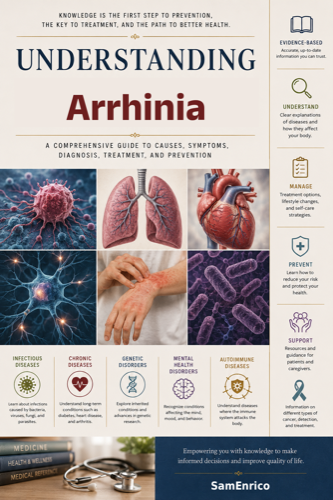
Non-FictionInformativeEducational
Understanding Arrhinia eBook
This disease publication, published by SamEnrico,
by Tyree Odis
This disease publication, published by SamEnrico, covers Understanding Arrhinia
Formats
Free sample
Chapter 1: The Silent Face--The first thing you notice is the quiet.In every hospital delivery room, there is an expected symphony. The mother’s exhausted sobs of relief. The father’s choked laugh. The rhythmic beep of monitors. And above all, the cry—that first, furious, glorious cry of a newborn taking its inaugural breath of open air.
It is a sound so universal, so deeply wired into our expectation of birth, that its absence does not merely register as a medical anomaly. It registers as a violation of the natural order.When a baby with Arrhinia enters the world, that cry never comes.Instead, there is a struggle. A silent, frantic struggle. The infant’s chest heaves. The abdomen contracts.
The mouth opens and closes like a fish pulled from water. But no air moves. No sound emerges. Because the nose—that small, unremarkable structure that most parents never think about until this moment—is simply not there. And without it, the newborn’s body does not know how to breathe.This chapter is about that absence.
It is about understanding what Arrhinia is, what it is not, and why the quiet in that delivery room becomes the first chapter of a story no family ever expected to live. But before we can understand the journey—the surgeries, the therapies, the triumphs, and the heartbreaks—we must first understand the condition itself. We must name it. We must define it. And we must do so with the precision that families deserve when they are searching for answers in the dark.What Arrhinia Means: A Definition Rooted in Greek The word Arrhinia comes from two Greek roots: the prefix “a-” meaning “without,” and “rhis” meaning “nose.” Literally translated, it means “without a nose.” Medically, however, the term carries more weight than this simple translation suggests.
Arrhinia is a rare congenital anomaly—a birth defect present from the moment of conception—characterized by the complete or partial absence of the nose. But “nose” itself is a deceptively complex word. When doctors say a child has Arrhinia, they are not merely saying the child lacks the visible, external structure that sits in the middle of the face. They are saying the child lacks an entire organ system: the external nose, the internal nasal passages, the sinuses, and in many cases, the olfactory bulbs that allow the sense of smell.This is not a cosmetic condition. It is a structural one, with life-threatening implications that begin in the first minute of life.To understand why Arrhinia is so dangerous, consider the anatomy of a typical newborn.
Human infants are what physiologists call “obligate nasal breathers.” For the first four to six months of life, before the neurological pathways for mouth breathing fully mature, a baby can only breathe through its nose. This is why a simple cold with nasal congestion can send an otherwise healthy infant to the emergency room: they cannot simply open their mouths and gasp for air the way an adult can. Their bodies have not learned that skill yet. Now imagine that instead of a stuffy nose, there is no nose at all. No nostrils.
No nasal cavity. No pathway for air to enter the lungs. That is the reality of Arrhinia at birth. The baby’s body wants to breathe. The lungs expand and contract.
But the air has no door.This is why the delivery room goes quiet. And this is why every chapter that follows this one—every surgery, every therapy, every sleepless night—begins with that single, terrifying fact.Total Arrhinia Versus Hemi-Arrhinia: The Spectrum of Absence Not every case of Arrhinia looks the same. Medical literature divides the condition into two primary categories, and understanding this distinction is essential for families seeking a prognosis.Total Arrhinia is the more severe and more common form. In Total Arrhinia, the child is born with no external nose whatsoever. The area where the nose should be—the central third of the face—is flat, smooth, and featureless.
There are no nostrils. There is no nasal bridge. There is no columella (the tissue that separates the nostrils). Beneath the skin, the nasal bones are absent, as are the nasal passages, the sinus cavities, and the ethmoid bone that normally separates the nasal cavity from the brain. Most critically, the olfactory bulbs—the neural structures responsible for detecting smell—are also missing.
Children with Total Arrhinia cannot smell. They never will. This is not a loss they will mourn, because they will never know what smell is. But it is a safety consideration that will follow them for life, as we will explore in later chapters.Hemi-Arrhinia is the partial form of the condition. In these cases, one side of the nose develops while the other side does not.
The child may have a single nostril on one side and a flat, absent structure on the other. Hemi-Arrhinia is significantly rarer than Total Arrhinia, accounting for fewer than ten percent of reported cases. The airway implications are less severe, because the single functioning nostril can often provide enough airflow for survival without immediate surgical intervention. However, the asymmetry of the face presents its own challenges, both functional and psychological. Children with Hemi-Arrhinia may still have absent olfactory bulbs on the affected side, though partial smell function can sometimes remain if the intact side’s olfactory structures are preserved.Throughout this book, unless otherwise specified, references to “Arrhinia” should be understood to include both forms.
However, families of children with Hemi-Arrhinia should note that their journey will differ in significant ways from the Total Arrhinia path, particularly in the first hours of life when the airway is established.What Arrhinia Is Not: Differential Diagnosis and Common Confusions When a child is born with a facial difference, the first question every parent asks is, “What is this?” The second question is, “What else could it be?” Medical professionals call this process differential diagnosis—ruling out other conditions that may look similar but have different causes, different treatments, and different prognoses. For Arrhinia, several conditions are commonly confused by non-specialists, and distinguishing between them is critical.Nasal aplasia is the closest mimic to Arrhinia. In nasal aplasia, the external nose is absent, but the internal nasal passages and olfactory bulbs may be partially or fully intact. This distinction matters enormously for breathing and for the sense of smell. A child with nasal aplasia may still have functional airways hidden beneath the skin, whereas a child with true Arrhinia has no airways at all.
The only way to distinguish between these conditions definitively is through imaging—typically a CT scan or MRI performed in the first days of life. Throughout this book, when we discuss surgical reconstruction in Chapter 8 and Chapter 9, we are assuming the more severe Arrhinia anatomy. Families with nasal aplasia should consult their surgical team about modified approaches.Proboscis lateralis is another condition sometimes confused with Arrhinia. In proboscis lateralis, the nose is not missing; rather, it is displaced to one side of the face, often appearing as a tube-like structure attached near the inner corner of the eye. This is a failure of fusion during embryonic development, not an…
This is the end of the free sample. Get the eBook to keep going. Buy now
About this book
Details
- Author
- Tyree Odis
- Publisher
- SamEnrico
- Language
- English
- Genre
- Non-Fiction, Informative, Educational
- Released
- 2026-06-02
- Pages (approx.)
- 155
- Available as
- eBook, Audiobook

Read better in the ZLOADR app
Your eBooks on your phone or tablet. Sign in with your SamEnrico account and start reading.
More by Tyree Odis
 Study Goal Setting GuideTyree Odis$11.99
 Light Therapy for DepressionTyree Odis$11.99
 Poker Addiction Recovery PlanTyree Odis$11.99
 From Buduburam To TexasTyree Odis$11.99
 Wingman StoriesTyree Odis$11.99
 Twelve Step Relapse Prevention PlanTyree Odis$11.99
 Radar Countermeasures: Window and ChaffTyree Odis$11.99
 Benzodiazepine Overdose SurvivorTyree Odis$11.99
 Resentment Toward TeachersTyree Odis$11.99
 The Bitcoin Laundromat: How Crypto Kingpins Outsmarted the FedsTyree Odis$11.99
 The Buzurg ibn Shahriyar Expedition: Mapping the Unknown Heart of AustraliaTyree Odis$11.99
 The Complete Guide to the Serotonin RevolutionTyree Odis$11.99
You may also like
 Hong Kong Handover 1997Dunn Johnnie$11.99
 Zumba For Postnatal Recovery CourseNeal Christian$11.99
 Zumba for BeginnersLadner Nikia$11.99
 YouTube Comment Mining GuideHumes Pandora$12.99
 Worry Box MeditationCarlin Rudy$11.99
 Workplace Stress MeditationNguyen Lynn$11.99
 Workplace Stress and Sleep RepairHawley Ivory$11.99
 Workplace Perfectionism CureDelaney Jeffry$11.99
 Workplace Injustice Anger GuideWallen Isabelle$11.99
 Work Addiction and Burnout LinkGreenwood Ester$11.99
 Women in Yoga and WellnessBeattie Galina$11.99
 Women in Stand Up ComedyChun Evangeline$11.99