
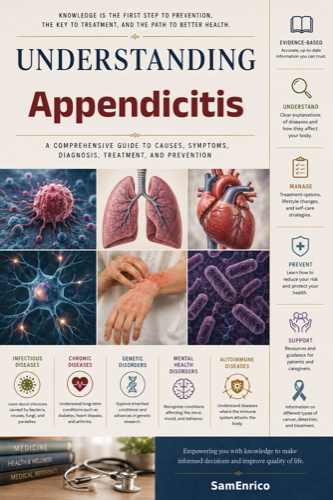
Understanding Appendicitis eBook
This disease publication, published by SamEnrico,
by Russo Alane
This disease publication, published by SamEnrico, covers Understanding Appendicitis
Formats
Free sample
Chapter 1: The Accidental Time Bomb...--Every human being carries inside them a small, pink, finger-shaped pouch that most doctors, until very recently, dismissed as a biological mistake. For over a century, textbooks called it "vestigial"—a leftover from some distant evolutionary past, as useless as the tailbone or wisdom teeth. Surgeons removed it by the millions, often as a precautionary measure during other abdominal operations. Patients signed consent forms barely glancing at the line authorizing appendectomy, thinking, "It's not like I need the thing anyway." And for the most part, no one noticed the difference. People lived normal lives without their appendix.
They ran marathons, had children, grew old, and died of entirely unrelated causes. On the surface, the medical establishment seemed correct. The appendix was, at best, a silent passenger.But silence is not the same as uselessness. And in the case of the appendix, the silence was dangerously misleading.In the early 2000s, a series of discoveries began to unravel the old assumptions. Researchers at Duke University Medical Center made a startling observation: the appendix, far from being a useless relic, appeared to be a carefully designed structure rich in immune tissue and lined with a biofilm that protected beneficial bacteria.
They proposed what became known as the "safe house" theory—that the appendix served as a reservoir for the gut's good bacteria, a biological ark that could repopulate the digestive system after a severe illness like cholera or dysentery that flushed out the intestines. The theory gained traction when studies showed that people without an appendix had a higher risk of recurrent infections with Clostridioides difficile, a dangerous bacterium that thrives when the normal gut flora is disrupted. The appendix, it turned out, was not a mistake. It was an insurance policy.Yet this same structure, designed to protect us, can turn into a time bomb with terrifying speed. The appendix's narrow lumen—its inner opening—is only about one to two millimeters wide in adults, roughly the diameter of a thick mechanical pencil lead.
This narrow passageway is exquisitely vulnerable to blockage. When something obstructs it, the appendix becomes a closed loop, a sealed pouch with no outlet. Bacteria that normally live harmlessly inside multiply explosively. The appendix swells. Pressure builds.
Blood flow to the walls diminishes. And within hours, what began as a minor blockage can become a surgical emergency.This chapter is about that transformation—from silent organ to acute crisis. It will give you a complete understanding of what the appendix is, what it does, why it gets sick, and most importantly, the precise timeline of how a healthy appendix becomes a life-threatening infection. By the end of this chapter, you will understand why appendicitis is not a random event but a predictable biological process, and why recognizing the clock can mean the difference between a simple laparoscopic procedure and a surgical catastrophe.The Anatomy of a Forgotten Organ To understand appendicitis, you must first understand the appendix's place in the human body. The appendix is a hollow, finger-shaped tube that projects from the cecum, which is the first part of the large intestine, located in the lower right quadrant of the abdomen.
In most people, the appendix hangs down like a small tail, but it can vary dramatically in position. In some individuals, it curls behind the cecum (retrocecal), hiding from view. In others, it dips into the pelvis (pelvic appendix). In rare cases of situs inversus, where the internal organs are mirrored, the appendix lies on the left side. These anatomical variations are not just trivia—they matter enormously for diagnosis, as we will see in later chapters.The appendix is typically five to ten centimeters long (about two to four inches) and about five to seven millimeters in diameter.
Its wall contains layers familiar to any student of the digestive tract: an inner mucosal layer, a submucosa rich in immune cells, a muscular layer, and an outer serosal covering. But the appendix has one feature that distinguishes it from the rest of the intestine: an extraordinary concentration of lymphoid tissue. In fact, the appendix contains more immune cells per square centimeter than almost any other organ in the body, rivaling the tonsils and the lymph nodes.This lymphoid tissue is not randomly distributed. It forms distinct follicles, organized clusters of B-cells, T-cells, and other immune warriors that stand ready to respond to invaders. During childhood and adolescence, these follicles are large and active, reaching their peak development between the ages of ten and twenty.
After that, they gradually shrink, which is why appendicitis becomes less common after age thirty. The appendix, in essence, is a training ground for the immune system, a place where the body learns to distinguish friend from foe in the complex ecosystem of the gut.The Safe House Theory The most compelling explanation for why we have an appendix comes from the work of Dr. William Parker and his colleagues at Duke University. Their "safe house" theory posits that the appendix serves as a refuge for beneficial gut bacteria during times of gastrointestinal crisis. Consider what happens during a severe bout of cholera or a bad case of food poisoning.
The body responds by flushing the entire digestive tract with massive amounts of fluid, sweeping everything—good bacteria and bad—out into the toilet. Under normal circumstances, repopulating the gut from scratch would take weeks, leaving the person vulnerable to secondary infections and digestive problems.But the appendix, Parker proposed, offers a solution. Its narrow lumen and protected position mean that while the main flow of intestinal contents rushes past, the appendix itself remains relatively undisturbed. The biofilm lining its inner surface—a sticky matrix of sugars and proteins—harbors a concentrated colony of beneficial bacteria. When the crisis passes, these bacteria can migrate back into the large intestine, reseeding the gut with the necessary microbial inhabitants.
The appendix acts as a biological ark, preserving the microbiome through the flood.Evidence supporting this theory has accumulated over the past two decades. Studies comparing people with and without their appendix have found that those who have undergone appendectomy have less diverse gut microbiomes, meaning they harbor fewer species of beneficial bacteria. They also have higher rates of recurrent Clostridioides difficile infection, a devastating diarrheal illness that typically strikes after antibiotic use disrupts the normal gut flora. In one study, patients without an appendix were nearly three times more likely to have a recurrence of C. diff compared to those with an intact appendix.
The appendix, it seems, was not dispensable after all.What Is the Appendix's Purpose in Infants and Children The safe house theory explains the appendix's function in industrialized societies where sanitation and antibiotics are readily available. But the appendix evolved long before modern medicine, under conditions of much higher infectious pressure. For infants and young children, the appendix plays an additional role as part of the developing immune system. At birth, a baby's gut is sterile. Over the first months and years of life, it becomes colonized by trillions of bacteria, many of them acquired from the mother during vaginal delivery and from the environment through breast milk, food, and even the simple act of…
This is the end of the free sample. Get the eBook to keep going. Buy now
About this book
Details
- Author
- Russo Alane
- Publisher
- SamEnrico
- Language
- English
- Genre
- Non-Fiction, Informative, Educational
- Released
- 2026-05-11
- Pages (approx.)
- 160
- Available as
- eBook, Audiobook

Read better in the ZLOADR app
Your eBooks on your phone or tablet. Sign in with your SamEnrico account and start reading.
More by Russo Alane
 Upwork Freelance Business PlanRusso Alane$11.99
 Ketamine for Depression GuideRusso Alane$11.99
 Career Transition for Tech WorkersRusso Alane$11.99
 Child Star Complete AnthologyRusso Alane$11.99
 Iraq War F18 PilotRusso Alane$11.99
 Seasonal Energy PlanningRusso Alane$11.99
 Luftwaffe Radar CountermeasuresRusso Alane$11.99
 Citation Rules for Editions and VolumesRusso Alane$11.99
 Resentment Toward SiblingsRusso Alane$11.99
 The Silk and the Spy: A Forbidden Love in the Age of ImperialismRusso Alane$11.99
 The Last Voyage of the Mary Celeste: A Ghost Ship's Memory MapRusso Alane$11.99
 The Last Oracle of the Andes: The Hidden Prophecies of the ChasquiRusso Alane$11.99