
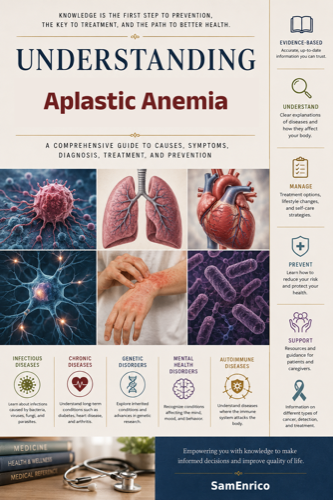
Non-FictionInformativeEducational
Understanding Aplastic Anemia eBook
This disease publication, published by SamEnrico,
This disease publication, published by SamEnrico, covers Understanding Aplastic Anemia
Formats
Free sample
Chapter 1: The Vanishing Factory...--The human body runs on blood. Every organ, every muscle, every thought depends on the continuous delivery of oxygen carried by red cells, the defense mounted by white cells, and the sealing power of platelets. Most people never think about this silent, miraculous system. They wake up, shower, drive to work, make dinner, and sleep without ever considering the bone marrow laboring deep inside their bones—a factory producing billions of blood cells every single day, hour after hour, year after year, without rest.Then one day, without warning, the factory begins to slow down.At first, the signs are so subtle that even the most vigilant person might dismiss them. You feel a little more tired than usual, but you tell yourself it's just stress, just poor sleep, just getting older.
You notice a few unexplained bruises on your legs, but you assume you bumped into something and forgot. You get a cold that lingers for two weeks instead of two days, but everyone at work is sick, so it must be going around. These are the quiet deceptions of aplastic anemia—a disease that does not announce itself with fanfare or dramatic pain but instead whispers, gradually, that something is profoundly wrong.This book exists because that whisper too often goes unheard until the factory is nearly silent. Understanding Aplastic Anemia is written for the patient who hears the words for the first time and feels the floor drop away. It is written for the parent holding a child's hand in a hospital room, for the spouse suddenly thrust into the role of caregiver, for the adult child researching desperately on a smartphone in a waiting room.
It is written to transform terror into knowledge, confusion into clarity, and isolation into connection.The Story of Sarah: A Window into the Diagnosis Sarah Connors was thirty-four years old when she first noticed that something was off. A high school English teacher in Portland, Oregon, she had always prided herself on her energy. She ran half-marathons, gardened on weekends, and kept up with a classroom of sixteen-year-olds who seemed to generate their own gravitational fields of chaos. But by March of that year, she found herself skipping her afternoon runs. By April, she was napping after school.
By May, she was falling asleep while grading essays at her kitchen table."It's just burnout," she told her husband, Mark. "End of the school year. It happens every year."He nodded, but he noticed other things too. The bruises on her shins that seemed to appear from nowhere. The tiny red dots—petechiae, she would later learn—that clustered on her ankles like a rash that didn't itch.
The way her gums bled when she brushed her teeth, leaving pink foam in the sink. He mentioned it once, gently. She waved it away. "I'm low on iron," she said. "My mom always had low iron."Then came the fever.
One hundred and two degrees, unrelenting, with no cough, no sore throat, no runny nose. Just fever and exhaustion so complete that she could barely lift her head from the pillow. Mark drove her to the emergency room. The triage nurse ran a complete blood count—a routine test that takes minutes but reveals worlds. When the results came back, the emergency physician's face changed.
The easy confidence drained away, replaced by something more guarded."Your counts are very low," the doctor said. "All of them. Your hemoglobin is 7.2. Your white count is 1,100. Your platelets are 19,000."Sarah didn't understand what those numbers meant.
She only understood the doctor's tone, which said: something is very wrong.That night, Sarah was admitted to the hospital. Over the following days, she underwent a bone marrow biopsy—a needle into the back of her hip, a sensation of pressure and crunching that she would later describe as "the sound of my life changing." The results took a week. When they came back, the hematologist sat down on the edge of Sarah's hospital bed and said three words that would redefine everything: aplastic anemia."What does that mean?" Sarah asked.The doctor explained: Your bone marrow has stopped making blood cells. Not just one kind—all of them. Red cells, white cells, platelets.
The factory is shutting down."What caused it?" Sarah asked."We don't know," the doctor said. "We may never know. About seventy-five percent of cases are idiopathic—no identifiable cause."Sarah cried. Mark held her hand. And then, because she was a teacher and a runner and a woman who had never backed down from anything in her life, she asked the question that would drive her through the months ahead: "What do we do next?"Sarah's story is not unique.
It is the story of nearly every patient diagnosed with aplastic anemia—the confusion, the fear, the gradual recognition that the body has betrayed itself. But Sarah's story also illustrates something essential about this disease: it is survivable. With the right treatment, with the right information, with the right support, patients can and do recover. Sarah, as you will see throughout this book, is now five years post-transplant, teaching again, running again, gardening again. Her factory was rebuilt.
Yours can be too.But first, you need to understand what you're fighting.Defining the Enemy: What Is Aplastic Anemia?Let us begin with precision. Aplastic anemia is a rare, non-cancerous disorder in which the bone marrow fails to produce sufficient numbers of all three major types of blood cells. The name itself tells a story: "anemia" refers to low red blood cells, but the Greek prefix "a-" means "without," and "plasia" means "formation." Aplastic anemia is, literally, a condition of without formation of blood. The marrow is empty. The factory has stopped production.The diagnostic criteria for aplastic anemia rest on two pillars.
The first is pancytopenia—a simultaneous deficiency of red blood cells (anemia), white blood cells (leukopenia, specifically neutropenia when neutrophils are low), and platelets (thrombocytopenia). The second is hypocellular bone marrow—meaning that when a pathologist examines a biopsy sample under the microscope, they see fat cells where blood-forming cells should be. In a healthy person, the marrow might be 50% cellular at age thirty, meaning half the space is filled with active blood-forming cells. In aplastic anemia, that number drops below 20%. In severe cases, it drops below 5%.To understand why this matters, imagine your bone marrow as a garden.
The stem cells are the seeds. The growth factors are the sunlight and water. The blood cells are the flowers, fruits, and vegetables. In aplastic anemia, the seeds are still present—the stem cells haven't been destroyed entirely—but they cannot grow because the soil has been poisoned. In acquired aplastic anemia (the focus of most of this book), the poison is your own immune system.
Your T-cells, normally the soldiers that protect you from viruses and bacteria, have turned their weapons against your bone marrow. They infiltrate the garden, release inflammatory chemicals called cytokines, and trigger programmed cell death (apoptosis) in the developing blood cells. The seeds remain viable, but they cannot sprout.This immune-mediated destruction is the crucial insight that transformed aplastic anemia from a uniformly fatal disease…
This is the end of the free sample. Get the eBook to keep going. Buy now
About this book
Details
- Author
- Beaulieu Vernice
- Publisher
- SamEnrico
- Language
- English
- Genre
- Non-Fiction, Informative, Educational
- Released
- 2026-05-11
- Pages (approx.)
- 160
- Available as
- eBook, Audiobook

Read better in the ZLOADR app
Your eBooks on your phone or tablet. Sign in with your SamEnrico account and start reading.
More by Beaulieu Vernice
 Career Transition Podcast GuideBeaulieu Vernice$11.99
 Genetics of Depression GuideBeaulieu Vernice$11.99
 Teaching Others Study MethodBeaulieu Vernice$11.99
 Fiverr Order Revision GuideBeaulieu Vernice$11.99
 Citation Rules for Literature Reviews GuideBeaulieu Vernice$11.99
 Zero Pilot MemoirBeaulieu Vernice$11.99
 Flow State Without CrashBeaulieu Vernice$11.99
 H2S Radar and Night Bombing AccuracyBeaulieu Vernice$11.99
 Dealing With Failed DreamsBeaulieu Vernice$11.99
 The Navigator's Muse: John Cabot and the Birth of the Atlantic CrossingBeaulieu Vernice$11.99
 The Girl Who Planted a Forest: The Untold Story of Jadav PayengBeaulieu Vernice$11.99
 Sales Finance AnalystBeaulieu Vernice$11.99
You may also like
 Hong Kong Handover 1997Dunn Johnnie$11.99
 Zumba For Postnatal Recovery CourseNeal Christian$11.99
 Zumba for BeginnersLadner Nikia$11.99
 YouTube Comment Mining GuideHumes Pandora$12.99
 Worry Box MeditationCarlin Rudy$11.99
 Workplace Stress MeditationNguyen Lynn$11.99
 Workplace Stress and Sleep RepairHawley Ivory$11.99
 Workplace Perfectionism CureDelaney Jeffry$11.99
 Workplace Injustice Anger GuideWallen Isabelle$11.99
 Work Addiction and Burnout LinkGreenwood Ester$11.99
 Women in Yoga and WellnessBeattie Galina$11.99
 Women in Stand Up ComedyChun Evangeline$11.99