
Non-FictionInformativeEducational
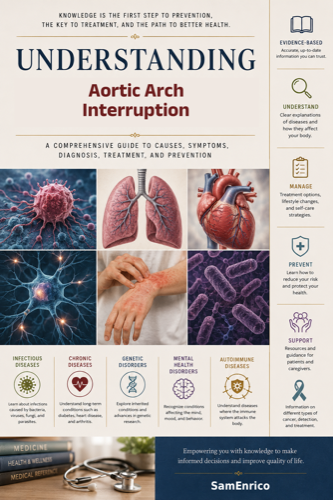
Understanding Aortic Arch Interruption eBook
This disease publication, published by SamEnrico,
This disease publication, published by SamEnrico, covers Understanding Aortic Arch Interruption
Formats
Free sample
Chapter 1: The Broken Highway...–- The first time a parent watches their newborn’s lips turn gray, time stops. The machines begin screaming. A team of strangers descends like a swarm, speaking a language of abbreviations and urgency. In that moment, nothing else exists—not the carefully decorated nursery waiting at home, not the baby shower gifts still wrapped, not the birth announcements left unsent. There is only the terrifying arithmetic of survival: the heart rate dropping, the oxygen saturation falling, the seconds ticking toward an unknown threshold.This book is about what happens before that moment, during it, and decades after it.
It is about a rare congenital heart defect called Aortic Arch Interruption—a condition so uncommon that most general pediatricians will never see a case in their entire careers, yet so surgically survivable that the majority of affected babies now grow up to live full, meaningful lives. The gap between those two statements—rare but survivable—is the story this book tells.To understand Aortic Arch Interruption, one must first understand the highway system of the human body. The aorta is the largest artery, a curved vessel that arches out of the heart’s left ventricle like a question mark, then descends through the chest and abdomen, delivering oxygen-rich blood to every organ and limb. In a healthy heart, this arch is continuous—a smooth, unobstructed pipeline from the heart to the toes. In Aortic Arch Interruption (IAA), that pipeline has a gap.
The arch stops. It does not connect. Somewhere between the vessels that feed the arms and those that feed the legs, the aorta simply... ends.The body, however, is a remarkably resourceful system. Before birth, a temporary blood vessel called the ductus arteriosus acts as a natural detour, shunting blood around the non-functioning fetal lungs and allowing the lower body to receive flow despite the interruption.
This is why IAA is not lethal in utero. The fetus grows normally, the pregnancy progresses uneventfully, and the baby is born looking perfectly healthy—pink, crying, seemingly whole.But biology is unforgiving. The ductus arteriosus is designed to close after birth. When a baby takes its first breath, oxygen levels in the blood rise sharply, triggering the ductus to constrict. In most newborns, this is a welcome change—the transition from fetal to neonatal circulation.
In a baby with IAA, ductal closure is a catastrophe. The detour collapses. Blood can no longer reach the lower body. The kidneys, the intestines, the legs, the spinal cord—all are suddenly starved of oxygen. This is the “ductal crash,” a cardiovascular emergency that demands immediate recognition and intervention.The numbers tell a stark story.
IAA occurs in approximately 3 to 20 per million live births, representing less than 1.5% of all congenital heart defects. In the United States, this translates to roughly 12 to 80 babies each year. The condition is often associated with a ventricular septal defect (VSD)—a hole between the heart’s lower chambers—which is present in more than 99% of cases. Without treatment, the mortality rate approaches 100% within the first weeks of life. But with modern surgical techniques, the outlook has transformed dramatically.
Today, 85 to 95% of babies born with IAA survive to discharge and go on to thrive.This transformation did not happen overnight. It required decades of surgical innovation, pharmacological discovery, and a fundamental reimagining of what was possible in the smallest, sickest patients. The first successful repair of IAA was reported in 1954 by Dr. C. Walton Lillehei, a pioneer of open-heart surgery.
The operation was performed under direct vision using cross-circulation—a technique in which a parent served as the baby’s “heart-lung machine” while the surgeon worked. It was audacious, dangerous, and groundbreaking. The baby survived. A new era had begun.In the decades that followed, surgical techniques evolved. The introduction of the heart-lung machine in the 1960s eliminated the need for cross-circulation.
The discovery of prostaglandin E1 (PGE1) in the 1970s gave surgeons a pharmacological tool to keep the ductus open, stabilizing babies before surgery and dramatically improving outcomes. The refinement of deep hypothermic circulatory arrest—cooling the body to 18°C and stopping blood flow entirely—allowed surgeons to work on a still, bloodless field with unprecedented precision.By the 1980s, single-stage repair had become the gold standard. Instead of performing a palliative procedure to buy time followed by a definitive repair months later, surgeons began fixing the entire problem in a single operation during the first weeks of life. The results were stunning. Mortality rates that had hovered around 50% fell to 15%, then 10%, then 5% in the most experienced centers.Today, a baby born with IAA has an excellent chance of surviving to adulthood.
But survival is not the same as cure. IAA is a lifelong condition that requires continuous surveillance, careful management of residual lesions, and attention to the neurodevelopmental consequences of both the underlying anatomy and the surgical repair. This book is structured to guide readers through every stage of that journey.The Scope of This Book Understanding Aortic Arch Interruption is designed for multiple audiences: parents and families navigating a new diagnosis, healthcare professionals seeking a comprehensive reference, and adult survivors looking for guidance on lifelong management. The content is clinically rigorous but accessible, blending the precision of a medical textbook with the narrative depth of a patient guide.The book is divided into four parts. Part I establishes the foundational knowledge: the history, epidemiology, embryology, and anatomical classification of IAA.
Part II covers diagnosis, from the subtle signs of the honeymoon period to the advanced imaging techniques that guide surgical planning, including the critical genetic link to 22q11.2 deletion. Part III details treatment protocols, from stabilization with PGE1 to the surgical options of single-stage and staged repair. Part IV addresses long-term management: life in the cardiac ICU, growing up with IAA, exercise and pregnancy considerations, and the psychological support that families need.Throughout, the book emphasizes a central truth: IAA is not just a surgical event but a lifelong journey. The arch was interrupted; the journey was not.A Note on Language and Terminology Medical terminology can be intimidating, especially for families facing a new diagnosis. This book defines all terms at first use and includes a comprehensive glossary in the appendix.
Whenever possible, clinical language is paired with plain-language explanations. Abbreviations are used consistently: IAA for Aortic Arch Interruption, VSD for ventricular septal defect, PGE1 for prostaglandin E1, DHCA for deep hypothermic circulatory arrest, and ACHD for adult congenital heart disease.The book uses the pronoun “they” when referring to patients of unspecified gender and defaults to “the baby” or “the child” rather than “the patient” to humanize the clinical content. When composite narratives are used to illustrate clinical scenarios, they are clearly identified as such.What This Book Is Not This book is not a substitute for medical advice. Every patient is unique, and treatment decisions must be made by qualified healthcare professionals familiar with the individual case. The outcomes data presented are population averages; individual results may vary.
This book does not provide legal or financial advice, though it does include resources for navigating insurance and disability benefits.This book is also not a comprehensive textbook of congenital heart disease. It focuses…
This is the end of the free sample. Get the eBook to keep going. Buy now
About this book
Details
- Author
- Rendon Kymberly
- Publisher
- SamEnrico
- Language
- English
- Genre
- Non-Fiction, Informative, Educational
- Released
- 2026-06-02
- Pages (approx.)
- 122
- Available as
- eBook, Audiobook

Read better in the ZLOADR app
Your eBooks on your phone or tablet. Sign in with your SamEnrico account and start reading.
More by Rendon Kymberly
 Self Explanation Study TechniqueRendon Kymberly$11.99
 DoorDash Red Card ManagementRendon Kymberly$11.99
 Assertive Communication for Remote TeamsRendon Kymberly$11.99
 Citation Rules for AMA Medical GuideRendon Kymberly$11.99
 UK VAT Correction and Adjustment ManualRendon Kymberly$11.99
 Scott Peterson Interview AnalysisRendon Kymberly$11.99
 Fighter Pilot MemoirRendon Kymberly$11.99
 Purpose Driven Success GuideRendon Kymberly$11.99
 Disappointment At WorkRendon Kymberly$11.99
 The Diamond Heist of the Century: The Untold Story of the 1959 Great Train RobberyRendon Kymberly$11.99
 Frozen Alchemy: The Arctic Quest for Synthetic RubberRendon Kymberly$11.99
 Echoes of the Silent Skies: The Drone War That Changed EverythingRendon Kymberly$11.99
You may also like
 Hong Kong Handover 1997Dunn Johnnie$11.99
 Zumba For Postnatal Recovery CourseNeal Christian$11.99
 Zumba for BeginnersLadner Nikia$11.99
 YouTube Comment Mining GuideHumes Pandora$12.99
 Worry Box MeditationCarlin Rudy$11.99
 Workplace Stress MeditationNguyen Lynn$11.99
 Workplace Stress and Sleep RepairHawley Ivory$11.99
 Workplace Perfectionism CureDelaney Jeffry$11.99
 Workplace Injustice Anger GuideWallen Isabelle$11.99
 Work Addiction and Burnout LinkGreenwood Ester$11.99
 Women in Yoga and WellnessBeattie Galina$11.99
 Women in Stand Up ComedyChun Evangeline$11.99