
Non-FictionInformativeEducational
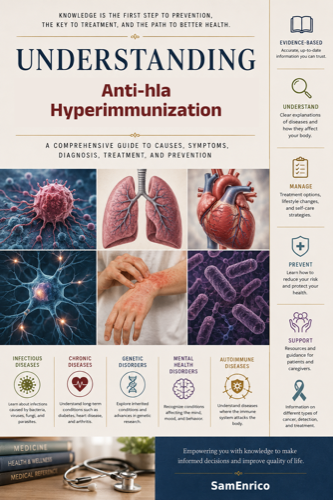
Understanding Anti-hla Hyperimmunization eBook
This disease publication, published by SamEnrico,
by Skelton Reda
This disease publication, published by SamEnrico, covers Understanding Anti-hla Hyperimmunization
Formats
Free sample
Chapter 1: The Silent Saboteur--–- The human body is a masterpiece of biological engineering, but it has a fatal flaw. The same immune system that can destroy a deadly virus within hours can also destroy a life-saving organ transplant with equal efficiency. For millions of patients worldwide awaiting kidney, heart, liver, or lung transplants, this internal contradiction is not an abstract scientific curiosity. It is the difference between life and death.Meet Sarah Cunningham. She is forty-one years old, a former high school biology teacher from Ohio, and the mother of twin sixteen-year-old daughters.
She has been on dialysis for seven years. Her skin has the grayish pallor that chronic kidney disease patients develop after years of blood filtration by machine instead of by organ. Her arms bear the scars of hundreds of needle insertions. She has been listed for a kidney transplant at three different centers across the Midwest. She has received twenty-three organ offers.
All twenty-three have been declined.The reason sits in a laboratory report that Sarah has learned to read with the fluency of a transplant immunologist. Her Calculated Panel Reactive Antibody, or c PRA, is 99.9 percent. This number means that 99.9 percent of the population carries at least one human leukocyte antigen—an HLA molecule—against which Sarah's immune system has already manufactured weapons. Of the approximately 120 million registered organ donors in the United States, fewer than 120,000 are theoretically compatible with Sarah. When geography, blood type, organ size, and timing are factored in, her annual chance of receiving a deceased donor kidney is less than one percent.Sarah is hyperimmunized.
And until very recently, she would have been told there was nothing to be done.This chapter explains why Sarah's body became her own worst enemy. It introduces the fundamental concepts of HLA immunology, the mechanisms of sensitization, the cellular drivers of persistent antibody production, and the clinical reality of living with a c PRA above 99 percent. By the end of this chapter, you will understand not only what hyperimmunization is but why it has been so difficult to treat—and why that is finally changing.The Body's Barcode System Every nucleated cell in the human body displays a set of proteins on its surface that function like a molecular barcode. These proteins are called Human Leukocyte Antigens, or HLA. They are the most polymorphic proteins in the human genome, meaning they vary enormously from person to person.
This diversity is evolutionarily advantageous because it allows the human population as a whole to survive new pathogens. No single pathogen can evolve to evade the immune systems of all humans when those immune systems all see the world through slightly different HLA lenses.But this diversity creates a catastrophic problem for transplantation. When a donor organ is placed into a recipient, the recipient's immune system immediately scans the HLA barcodes on the cells of that organ. If those barcodes look foreign—if they are not an exact match to the recipient's own HLA—the immune system launches an attack. In the case of a kidney transplant, this attack can destroy the organ within minutes, hours, days, or years, depending on the strength of the immune response and the effectiveness of immunosuppressive medications.HLA molecules come in two major classes, and understanding the distinction between them is essential for grasping why some antibodies are more dangerous than others.HLA Class I molecules are present on virtually every cell in the body.
They include the HLA-A, HLA-B, and HLA-C genes. Each person inherits two alleles of each gene—one from each parent—meaning that a complete Class I typing includes six distinct HLA molecules. Class I molecules present small protein fragments, or peptides, that come from inside the cell. If a virus has infected the cell, the Class I molecule displays a viral peptide, alerting CD8-positive T-cells—the so-called killer T-cells—to destroy the infected cell. In transplantation, recipient CD8 T-cells recognize donor Class I molecules as foreign and attack the graft directly.
This is the mechanism of acute cellular rejection.HLA Class II molecules have a more restricted distribution. They are found primarily on professional antigen-presenting cells: dendritic cells, macrophages, and B-cells themselves. The Class II genes are HLA-DR, HLA-DQ, and HLA-DP. Class II molecules present peptides that come from outside the cell, such as bacterial proteins that have been engulfed and broken down. They present these peptides to CD4-positive T-cells, the helper T-cells that orchestrate the entire immune response.
In transplantation, the interaction between recipient CD4 T-cells and donor Class II molecules is the critical event that triggers antibody production. Without CD4 T-cell help, B-cells cannot class-switch from making Ig M to making the more dangerous Ig G antibodies that cause antibody-mediated rejection.For Sarah Cunningham, the problematic mismatches were at multiple loci. Her own HLA typing revealed A01:01, A24:02; B08:01, B44:03; C07:01, C07:02; DRB1*03:01, DRB1*15:01; DQB1*02:01, DQB1*06:02. Her first kidney donor, her late husband Michael, was A01:01, A02:01; B08:01, B57:01; C06:02, C07:01; DRB1*03:01, DRB1*07:01; DQB1*02:01, DQB1*03:03. The mismatches at A2, B57, C6, DR7, and DQ3 were sufficient to generate a robust immune response.
But the mismatch at DQB1*03:03 proved to be the most immunogenic. Within three years of her transplant, Sarah had developed high-titer antibodies not only to DQ3 but also, through epitope spreading, to multiple other HLA antigens she had never been directly exposed to.The Three Pathways of Recognition How does the immune system recognize a transplanted organ as foreign? The answer involves three distinct pathways, each with different cellular players, different kinetics, and different implications for treatment.The Direct Pathway is the most immediate and the most potent. Donor dendritic cells—specialized immune cells that reside in all tissues, including the transplanted organ—migrate out of the graft and travel to the recipient's lymph nodes and spleen. These donor dendritic cells present intact donor HLA molecules on their surface.
Recipient T-cells, encountering these donor cells, see the donor HLA directly. No processing is required. This direct recognition activates recipient T-cells within hours to days, triggering acute cellular rejection. Standard immunosuppressive drugs like tacrolimus and cyclosporine are designed primarily to block the direct pathway, which is why acute rejection rates have fallen dramatically in the modern era.The Indirect Pathway is slower but more insidious. Recipient dendritic cells pick up donor HLA molecules that have been shed from the graft, either as intact proteins or as cellular debris.
These recipient cells process the donor HLA into smaller peptides and present those peptides on the recipient's own HLA molecules. Recipient T-cells then see the donor peptides presented in the context of self HLA. This indirect recognition does not cause acute cellular rejection as rapidly as the direct pathway, but it drives chronic rejection and, critically, provides the CD4 T-cell help necessary for B-cells to produce anti-HLA antibodies. Sarah's antibodies to her husband's DQ3 antigen were generated through the indirect pathway.The Semi-Direct Pathway is the most recently discovered and the least understood. Recipient antigen-presenting cells can acquire intact donor HLA molecules directly from donor cells through a process called trogocytosis—from the Greek trogo, meaning "to nibble." The recipient cell literally nibbles off pieces of the donor cell's membrane, incorporating intact donor HLA into its…
This is the end of the free sample. Get the eBook to keep going. Buy now
About this book
Details
- Author
- Skelton Reda
- Publisher
- SamEnrico
- Language
- English
- Genre
- Non-Fiction, Informative, Educational
- Released
- 2026-06-02
- Pages (approx.)
- 148
- Available as
- eBook, Audiobook

Read better in the ZLOADR app
Your eBooks on your phone or tablet. Sign in with your SamEnrico account and start reading.
More by Skelton Reda
 Romance Scandals Child StarsSkelton Reda$11.99
 Scheduling for Single ParentsSkelton Reda$11.99
 Citation Rules Cheat Sheet WorkbookSkelton Reda$11.99
 Temp Work During Career TransitionSkelton Reda$11.99
 Upwork Long Term Client GuideSkelton Reda$11.99
 The Monroe Motivated SequenceSkelton Reda$11.99
 Buffett DuracellSkelton Reda$11.99
 UK VAT Registration for Limited Companies CourseSkelton Reda$11.99
 Interspersal TechniqueSkelton Reda$11.99
 The Golden Tongue of the Nile: The Philosophical Pirates of Ancient EgyptSkelton Reda$11.99
 Love Letters from the Pacific: The Secret Correspondence of a WWII Pilot and His Pen PalSkelton Reda$11.99
 The Lost Symphony of the Ice QueenSkelton Reda$11.99
You may also like
 Hong Kong Handover 1997Dunn Johnnie$11.99
 Zumba For Postnatal Recovery CourseNeal Christian$11.99
 Zumba for BeginnersLadner Nikia$11.99
 YouTube Comment Mining GuideHumes Pandora$12.99
 Worry Box MeditationCarlin Rudy$11.99
 Workplace Stress MeditationNguyen Lynn$11.99
 Workplace Stress and Sleep RepairHawley Ivory$11.99
 Workplace Perfectionism CureDelaney Jeffry$11.99
 Workplace Injustice Anger GuideWallen Isabelle$11.99
 Work Addiction and Burnout LinkGreenwood Ester$11.99
 Women in Yoga and WellnessBeattie Galina$11.99
 Women in Stand Up ComedyChun Evangeline$11.99