
Non-FictionInformativeEducational
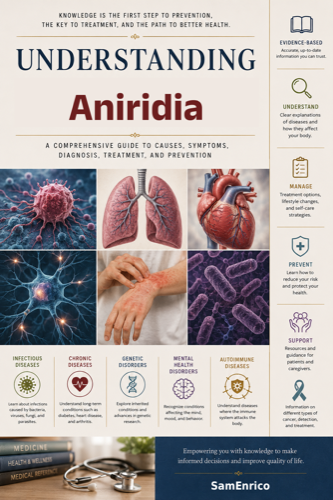
Understanding Aniridia eBook
This disease publication, published by SamEnrico,
This disease publication, published by SamEnrico, covers Understanding Aniridia
Formats
Free sample
Chapter 1: Beyond the Missing Iris...--You have just heard a word you cannot pronounce, attached to a condition you have never seen, describing a future you did not plan for. Perhaps you are a parent holding your newborn, watching doctors exchange glances that say more than their words. Perhaps you are an adult sitting in an ophthalmology clinic, hearing for the first time why your vision has always been different. Or perhaps you are the one with aniridia, finally searching for answers after decades of fragmented explanations and unanswered questions.Whatever brought you here, you need to know one thing immediately: aniridia is not what you think it is.The name itself is misleading. "Aniridia" comes from Latin and Greek roots meaning "without iris." But here is the truth that changes everything—you almost certainly have an iris.
It is not missing. It is underdeveloped, present as a tiny rudimentary stump that most people, including many general ophthalmologists, cannot see without a specialized lens called a gonioscopy lens. That stump matters because it explains why you have photophobia (light sensitivity), why your pupil looks abnormally large, and why standard iris implants or cosmetic contact lenses require such careful planning. But more importantly, the name "aniridia" focuses attention on the iris—the one part of your eye that matters least for actual vision.This is the single most important concept you will learn in this entire book: aniridia is a panocular disorder. "Panocular" means "whole eye." Your cornea is affected.
Your anterior chamber drainage angle is affected. Your lens is affected. Your retina is affected. Your optic nerve is affected. The iris is just the visible clue that something much larger is happening across your entire visual system.If you take away only one thing from this chapter, let it be this: your visual potential is not determined by your iris.
It is determined by your cornea, your lens, and most critically, your retina. And each of those structures requires its own specific management strategy.The Epidemiology: How Rare Is Rare?Let us start with numbers, because numbers ground us in reality when emotions threaten to overwhelm.Aniridia affects approximately 1 in every 40,000 to 1 in every 100,000 live births. If we take the midpoint of 1 in 70,000, that means about 100 to 120 babies are born with aniridia each year in the United States, and roughly 1,000 to 1,200 worldwide. The condition affects males and females equally. There is no known racial, ethnic, or geographic predilection, though prevalence estimates vary slightly based on how thoroughly cases are ascertained in different healthcare systems.What does this mean for you?
If you have aniridia, you are rare. You may go your entire life without meeting another person who shares your condition. Your primary care doctor may never have seen a case. Your general ophthalmologist may have read about aniridia in medical school but never treated it. This rarity is both a curse and a context.
The curse is obvious: less research funding, fewer specialists, fewer peer support networks. The context is this: when you encounter medical professionals who do not understand aniridia, you are not dealing with incompetence. You are dealing with rarity. And rarity can be managed with the right education—which is exactly what this book provides.The 98 Percent Rule Here is another number that shapes everything: 98 percent of aniridia cases are bilateral. Both eyes are affected.
There is no "good eye" in the way that someone with a traumatic injury to one eye might have a completely normal other eye. Both of your eyes share the same genetic mutation, the same developmental arrest, the same structural vulnerabilities. This does not mean both eyes are equally affected—variable expressivity, which we will explore in Chapter 2, means there can be significant differences between your right and left eyes. But you cannot rely on one eye as a complete backup for the other. Your management strategy must protect both eyes simultaneously.For parents in particular, this bilateral nature is a heavy burden.
You cannot hope that your child's "better eye" will escape the condition. Both eyes will require lifelong monitoring. But here is the counterbalancing truth: because aniridia is bilateral, the visual system adapts in ways that unilateral conditions do not. Your child's brain has never known a different visual world. There is no "loss" of normal vision to mourn in the same way that a person who loses one eye to trauma mourns a former ability.
Your child will develop a visual processing system built around the capabilities they have, not around capabilities they lack. This is not to minimize the challenges. It is to reframe them.The Iris Is the Least of It Let me be direct with you because you deserve honesty more than comfort. The iris has exactly three jobs. First, it controls the amount of light entering the eye by constricting in bright light and dilating in dim light.
Second, it blocks scattered light from entering the eye outside the central visual axis. Third, it contributes to depth of field (the range of distances that appear in focus) by constricting to a small pinhole. That is it. The iris does not see. The iris does not focus.
The iris does not transmit visual information to the brain.In aniridia, your iris stump retains some—but not all—of these functions. The most significant consequence of iris hypoplasia is photophobia: bright light causes discomfort because too much light enters the eye and scatters inside before reaching the retina. This is real and debilitating. It can cause squinting, eye pain, headaches, and avoidance of outdoor activities. But photophobia can be managed.
Tinted lenses, transition lenses, iris reconstruction surgery, and even simply wearing a hat with a brim can dramatically reduce symptoms. Photophobia is a quality-of-life issue, not a vision-threatening issue.What actually threatens your vision? The cornea. The drainage angle. The lens.
The retina.Let me introduce each of these briefly because the rest of this book is organized around them.The Cornea: Your Front Line Your cornea is the clear dome at the front of your eye. It is responsible for about two-thirds of your eye's focusing power. In aniridia, your cornea is under threat from a condition called aniridic keratopathy, which we will cover in depth in Chapter 3. The problem begins with limbal stem cell deficiency. The limbus is the border between your cornea and the white of your eye.
It contains stem cells that constantly regenerate your corneal surface. In aniridia, these stem cells are insufficient from birth. Over time—sometimes decades, sometimes much faster—the cornea loses its clarity. Blood vessels grow where they should not. The surface becomes irregular.
Vision blurs. Pain can develop.This is the leading cause of vision loss in aniridia. Not the iris. The cornea.The Drainage Angle: The Silent Threat Inside your eye, between the iris stump and the cornea, is a microscopic structure called the trabecular meshwork. It is the drain for your aqueous humor, the fluid that fills the front of your eye.
In aniridia, this drain is often malformed from birth—a condition called angle dysgenesis. The result is glaucoma, which we will cover in Chapter 5. Glaucoma is called the "silent thief of sight"…
This is the end of the free sample. Get the eBook to keep going. Buy now
About this book
Details
- Author
- Biddle Clarissa
- Publisher
- SamEnrico
- Language
- English
- Genre
- Non-Fiction, Informative, Educational
- Released
- 2026-06-02
- Pages (approx.)
- 159
- Available as
- eBook, Audiobook

Read better in the ZLOADR app
Your eBooks on your phone or tablet. Sign in with your SamEnrico account and start reading.
More by Biddle Clarissa
 Anxiety Hypnosis ScriptsBiddle Clarissa$11.99
 Pomodoro Against Interruptions CourseBiddle Clarissa$11.99
 Talking About Organ Donation WishesBiddle Clarissa$11.99
 IBS Dairy Sensitivity GuideBiddle Clarissa$11.99
 Anger Affirmation Audio GuideBiddle Clarissa$11.99
 The Family Time Block GuideBiddle Clarissa$11.99
 Plantar Fasciitis Stretching ProtocolBiddle Clarissa$11.99
 Bicycle Road Sharing CalmBiddle Clarissa$11.99
 Shadows of the Last Shogun: The Fall of TokugawaBiddle Clarissa$11.99
 The Outback Pioneers: Taming the Red FrontierBiddle Clarissa$11.99
 The Toba Catastrophe: Survivors of the SupervolcanoBiddle Clarissa$11.99
 Yottaversal TheologianBiddle Clarissa$11.99
You may also like
 Hong Kong Handover 1997Dunn Johnnie$11.99
 Zumba For Postnatal Recovery CourseNeal Christian$11.99
 Zumba for BeginnersLadner Nikia$11.99
 YouTube Comment Mining GuideHumes Pandora$12.99
 Worry Box MeditationCarlin Rudy$11.99
 Workplace Stress MeditationNguyen Lynn$11.99
 Workplace Stress and Sleep RepairHawley Ivory$11.99
 Workplace Perfectionism CureDelaney Jeffry$11.99
 Workplace Injustice Anger GuideWallen Isabelle$11.99
 Work Addiction and Burnout LinkGreenwood Ester$11.99
 Women in Yoga and WellnessBeattie Galina$11.99
 Women in Stand Up ComedyChun Evangeline$11.99