
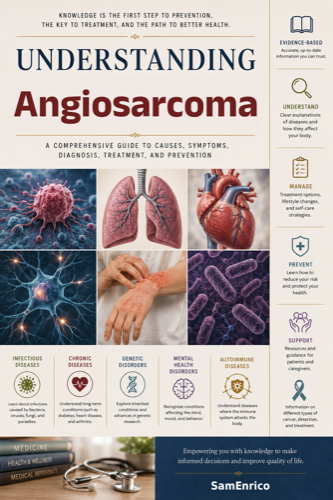
Understanding Angiosarcoma eBook
This disease publication, published by SamEnrico,
This disease publication, published by SamEnrico, covers Understanding Angiosarcoma
Formats
Free sample
Chapter 1: The Great Pretender...--–- The bruise appeared on Margaret’s scalp in late spring. She was seventy-two, active, healthy, and not the kind of woman who worried about bruises. She had bumped her head on a kitchen cabinet door last week, she told herself. It would fade. But three weeks passed, and the bruise did not fade.
It grew. What started as a dime-sized purple smudge became a quarter-sized patch, then a half-dollar. The edges turned from purple to yellow to a strange, mottled brown. Her hairdresser noticed it first. “That’s an odd bruise, Margaret.
Have you shown anyone?” Margaret shrugged it off. Her primary care doctor looked at it during her annual physical, pressed on it gently, and pronounced it “probably a senile purpura”—a harmless bruising condition common in older adults with thin skin. “Nothing to worry about,” the doctor said. “These things happen.”Six months later, the bruise had become a raised, fleshy nodule the size of a grape. It itched.
Sometimes it bled onto her pillowcase. A dermatologist biopsied it and called Margaret three days later. The call came at 4:47 PM on a Friday—never a good sign. “Mrs. Davis, I’m so sorry.
The pathology came back. You have angiosarcoma.” Margaret had never heard the word before. Neither had her husband, her children, or her neighbor who was a retired nurse. When she searched online, the results were terrifying and contradictory. Some websites called it “aggressive” and “poor prognosis.” Others mentioned cutting-edge immunotherapy and long-term survivors.
No one could tell her which category she fell into. She spent the weekend in a fog of fear, misinformation, and sleepless nights.Margaret’s story is not unique. It is, in fact, the typical story of angiosarcoma. The bruise that isn’t a bruise. The misdiagnosis.
The delayed biopsy. The terrifying search for information that yields more questions than answers. And the overwhelming sense of isolation that comes from facing a cancer so rare that most doctors will never see a single case in their entire careers.This chapter is written for every patient who has heard the word “angiosarcoma” for the first time and felt the floor fall away beneath them. It is written for every family member who has stayed up late, scrolling through medical journals they barely understand, looking for a shred of hope. It is written for every person who has been told “it’s probably nothing” and wondered, in the quiet hours of the night, whether the doctor was wrong.Let us begin at the beginning.
Let us understand what angiosarcoma actually is, why it has earned the nickname “the great pretender,” why it is so frequently misdiagnosed, and why—despite the fear and confusion—there are reasons to believe that knowledge, specialized care, and emerging treatments can change the outcome of this disease. This book will not lie to you. It will not promise miracle cures or hide difficult truths. It will give you the best information available, the most effective strategies, and the most honest assessment of what works—and what does not. Hope without honesty is cruelty.
Honesty without hope is despair. This book offers both.What Is Angiosarcoma, Exactly?At its most basic level, angiosarcoma is a cancer of blood vessels. But that simple description does not capture the complexity or the strangeness of this disease. To understand angiosarcoma, you need to understand what blood vessels are, what they do, and what happens when the cells that line them begin to grow without control.Blood vessels are the body’s plumbing system. Arteries carry oxygen-rich blood from the heart to the tissues.
Veins carry oxygen-poor blood back to the heart and lungs. Capillaries—the tiniest vessels—connect arteries to veins and exchange oxygen, nutrients, and waste products with the body’s cells. All of these vessels, from the largest artery to the smallest capillary, are lined by a single layer of cells called endothelial cells. These endothelial cells form the inner wall of every blood vessel and every lymphatic vessel (the separate network that drains fluid from tissues and plays a key role in immune function).Angiosarcoma arises when endothelial cells undergo malignant transformation—meaning they stop behaving like normal, orderly cells and start behaving like cancer cells. They divide when they should not.
They invade surrounding tissues. They travel through the bloodstream to distant organs. And they form tumors that are often filled with irregular, leaky blood vessels that bleed easily—which explains why angiosarcomas often present as bruises or bleeding lesions.The term “angiosarcoma” comes from Greek roots: “angio” meaning vessel and “sarcoma” meaning fleshy tumor. Sarcomas, as a category, are cancers of connective tissues—bone, muscle, fat, cartilage, and blood vessels. They are distinctly different from carcinomas, which are cancers of epithelial tissues (skin, breast, lung, colon, prostate).
This distinction matters because sarcomas behave differently, spread differently, and are treated differently than carcinomas. And angiosarcoma is one of the rarest of the sarcomas.Let us put the rarity in perspective. In the United States, approximately 1.9 million people are diagnosed with cancer each year. Of those, about 15,000 are diagnosed with soft tissue sarcomas (the category that includes angiosarcoma). Of those 15,000, only 200 to 300 are angiosarcoma.
That means angiosarcoma accounts for approximately 0.01% of all cancers. A typical primary care doctor will see thousands of patients over a thirty-year career and may never encounter a single case. A typical oncologist—even a cancer specialist—might see one case every few years. Only at major academic medical centers, where patients with rare diseases are referred from across the country, do doctors develop real expertise in this disease.This rarity is a double-edged sword. On one hand, it means that angiosarcoma research receives far less funding than common cancers like breast, lung, or prostate cancer.
On the other hand, it means that patients with angiosarcoma who find their way to specialized centers can receive care from doctors who have dedicated their careers to understanding this exact disease. And as you will learn throughout this book, the difference between general care and specialized care can be the difference between life and death.The Great Pretender: Why Angiosarcoma Is So Often Misdiagnosed The single most important thing you need to understand about angiosarcoma is that it does not look like cancer. Not at first. Not to the untrained eye. Not even to many trained eyes.
Angiosarcoma is called “the great pretender” because its early appearance mimics a dozen benign conditions, each of them harmless, each of them common, each of them the first thing a doctor thinks of when a patient walks in with a strange spot on their skin or a mysterious pain in their side.For cutaneous (skin) angiosarcoma—the most common form—the early lesion is almost always a bruise. But not the kind of bruise that results from a dramatic fall or a car accident. A subtle bruise. A faint purple or bluish patch on the scalp, the face, or an area of chronic swelling. It might be painless.
It might be slightly tender. It might come and go. The patient often has no memory of injuring the area. The doctor looks at it and thinks: senile…
This is the end of the free sample. Get the eBook to keep going. Buy now
About this book
Details
- Author
- Grantham Melaine
- Publisher
- SamEnrico
- Language
- English
- Genre
- Non-Fiction, Informative, Educational
- Released
- 2026-06-02
- Pages (approx.)
- 160
- Available as
- eBook, Audiobook

Read better in the ZLOADR app
Your eBooks on your phone or tablet. Sign in with your SamEnrico account and start reading.
More by Grantham Melaine
 The Board Feedback SessionGrantham Melaine$11.99
 Marat Assassination HistoryGrantham Melaine$11.99
 Confronting Family Estrangement GuideGrantham Melaine$11.99
 Opioid Recovery Return To Work ManualGrantham Melaine$11.99
 Postpartum Anxiety Pediatrician VisitsGrantham Melaine$11.99
 Posture Correction for Tension HeadachesGrantham Melaine$11.99
 Athletic Confidence for TeensGrantham Melaine$11.99
 Anger Self Assessment GuideGrantham Melaine$11.99
 Parking Spot Stealing Cool DownGrantham Melaine$11.99
 The Arctic Eclipse: How a Frozen Expedition Redefined the CosmosGrantham Melaine$11.99
 The Luminaries of Constantinople: The Byzantine Academy of WisdomGrantham Melaine$11.99
 Fenrir's Shadow: The Wolf That Shaped the WorldGrantham Melaine$11.99