
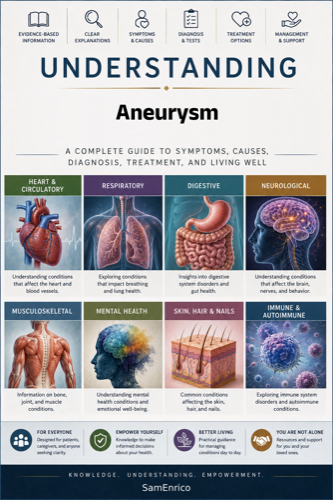
Non-FictionInformativeEducational
Understanding Aneurysm eBook
This condition publication, published by SamEnrico
by Bolen Shante
This condition publication, published by SamEnrico, covers Understanding Aneurysm
Formats
Free sample
Chapter 1: The Crack Before the Fall...--The human brain does not scream. When a heart fails, the chest seizes in a recognizable clench. When a lung collapses, the breath rasps with an audible urgency. But the brain – three pounds of electrified jelly suspended in fluid, wrapped in bone, and fed by a network of vessels so fine that most are invisible to the naked eye – the brain announces its dying in ways we have been trained to ignore.This is the central tragedy of the cerebral aneurysm. It is not that the disease is rare.
It is not even that the treatment is dangerous, though it is. The tragedy is that the most common warning sign of an impending catastrophe is a headache, and we live in a culture that has taught us to push through headaches. Take a pill. Drink water. Blame the screens.
Go to bed.And so, every year, approximately 30,000 people in the United States alone experience the rupture of a cerebral aneurysm, and of those, nearly 40% will die before reaching a hospital. Another 15% will survive with devastating neurological deficits. The remaining 45% will walk out of the hospital – changed, scarred, but alive – and spend the rest of their lives knowing that something inside their head tried to kill them without warning.But that is not the whole truth. The whole truth is more complicated, and more hopeful, than the statistics suggest.This chapter is about the moment before the moment – the subtle architecture of an aneurysm, the quiet biology of its formation, and the critical distinction between a silent time bomb and a leaking warning shot. It is about why most people do not know they have an aneurysm until it is too late, and why a small minority receive the gift of a warning.
And it is about the one question that will haunt every reader of this book: Could this be happening to me right now?Part One: The Anatomy of a Time Bomb To understand what an aneurysm is, you must first understand what an artery is – not in the abstract, textbook sense, but as a living, breathing structure inside your head.The arteries of the brain are masterpieces of evolutionary engineering. Unlike the rigid pipes of a plumbing system, cerebral arteries are dynamic, responsive, and exquisitely sensitive to the forces that move through them. Each artery is composed of three concentric layers. The innermost layer, the intima, is a single sheet of endothelial cells so smooth that blood slides across it without friction. The middle layer, the media, is a dense weave of smooth muscle and elastic fibers – this is the artery's engine, constantly contracting and relaxing to regulate blood flow and pressure.
The outermost layer, the adventitia, is a tough sheath of connective tissue that anchors the artery to the surrounding brain.A healthy artery is a marvel of redundancy. It can stretch, twist, and pulse for decades without failing. But like any engineered structure, it has limits.A cerebral aneurysm is a localized weakening of this arterial wall. Think of it as a bulge – a spot where the media layer has thinned or disappeared entirely, leaving only the intima and adventitia to contain the full force of arterial blood pressure. The analogy of a balloon is useful but incomplete.
A balloon weakens evenly as it expands. An aneurysm weakens at a single point, creating a sac that protrudes outward from the parent artery like a berry on a stem.This is why the most common type – accounting for approximately 90% of all cerebral aneurysms – is called a saccular or berry aneurysm. It looks exactly like what it sounds like: a small, round sac attached to the side of an artery by a narrow neck.But there are other shapes, each with its own behavior and risks.A fusiform aneurysm involves the entire circumference of the artery, creating a spindle-shaped widening that resembles a snake that has swallowed a rat. These are less common – perhaps 5-10% of all cerebral aneurysms – and are typically found in the vertebrobasilar system at the back of the brain. They are also harder to treat because there is no discrete neck to clip or coil.
The entire vessel is diseased.A dissecting aneurysm begins with a tear in the intima. Blood slips through this tear and travels between the layers of the arterial wall, creating a false lumen that can expand, clot, or rupture. These are often associated with trauma or connective tissue disorders, but they can also occur spontaneously. They are the most unpredictable of all because the dissection can extend along the artery, causing not just rupture but also ischemic stroke by compressing the true lumen.And then there is the blister aneurysm – a special category that deserves its own attention. Unlike the saccular aneurysm with its discrete neck and dome, a blister aneurysm is a small, shapeless bulge with an extremely thin, translucent wall.
It is not a true aneurysm in the pathological sense because it lacks all three arterial layers. It is, instead, a focal defect covered only by a wisp of adventitia and a clot. Blister aneurysms are rare – less than 1% of all cerebral aneurysms – but they are disproportionately dangerous because they rupture unpredictably and are notoriously difficult to treat. A clip that works perfectly on a saccular aneurysm will tear right through a blister.Part Two: The Circle of Willis – Where Aneurysms Live Not all arteries are created equal. Some branch points in the brain are predestined for aneurysms, and to understand why, you need to meet the most important anatomical structure you have never heard of: the Circle of Willis.Named after the 17th-century English physician Thomas Willis, this ring-shaped arterial network sits at the base of the brain, just above the pituitary gland and behind the eyes.
It is the brain's central roundabout, where the four major arteries that supply blood to the brain – two internal carotid arteries and two vertebral arteries – connect through a series of communicating vessels.The Circle of Willis is an evolutionary backup system. If one of the major feeding arteries becomes blocked, blood can flow from the other side of the circle, bypassing the obstruction. This is called collateral circulation, and it is the reason that some people survive a carotid artery occlusion without a stroke while others do not.But the Circle of Willis has a fatal flaw. Its branching points – particularly the anterior communicating artery (ACom) and the posterior communicating arteries (PComs) – are subjected to hemodynamic forces that no arterial wall was designed to withstand.Here is what happens: When blood flows through a straight artery, the force is relatively uniform. But when blood reaches a branch point, it must divide.
The stream splits, creating areas of high-velocity flow and areas of relative stagnation. The point where the stream hits the opposite wall – called the apex or the flow divider – receives the full force of the oncoming column of blood. Over decades, this focused jet erodes the arterial wall. The media thins. The elastic fibers fray.
And eventually, the intima bulges outward.This is not a random process. Approximately 85% of all cerebral aneurysms occur at just five locations on the Circle of Willis:Anterior…
This is the end of the free sample. Get the eBook to keep going. Buy now
About this book
Details
- Author
- Bolen Shante
- Publisher
- SamEnrico
- Language
- English
- Genre
- Non-Fiction, Informative, Educational
- Released
- 2026-06-02
- Pages (approx.)
- 137
- Available as
- eBook, Audiobook

Read better in the ZLOADR app
Your eBooks on your phone or tablet. Sign in with your SamEnrico account and start reading.
More by Bolen Shante
 Scholarship in MemoryBolen Shante$11.99
 Self Esteem for Port Wine StainsBolen Shante$11.99
 Nicotine Detox Diet GuideBolen Shante$11.99
 F1 Wet Weather MasteryBolen Shante$11.99
 Executive Name Memory GuideBolen Shante$11.99
 Pauling Resonance ConceptBolen Shante$11.99
 Medical Persuasion EthicsBolen Shante$11.99
 Happy Divorce GuideBolen Shante$11.99
 The Silk Road Heist: How a 13th-Century Merger Changed the WorldBolen Shante$11.99
 The Moonlight Serenade: Chopin and the Heart of EuropeBolen Shante$11.99
 How to Become a Hook TenderBolen Shante$11.99
 How to Produce Shipping CasesBolen Shante$11.99
You may also like
 Hong Kong Handover 1997Dunn Johnnie$11.99
 Zumba For Postnatal Recovery CourseNeal Christian$11.99
 Zumba for BeginnersLadner Nikia$11.99
 YouTube Comment Mining GuideHumes Pandora$12.99
 Worry Box MeditationCarlin Rudy$11.99
 Workplace Stress MeditationNguyen Lynn$11.99
 Workplace Stress and Sleep RepairHawley Ivory$11.99
 Workplace Perfectionism CureDelaney Jeffry$11.99
 Workplace Injustice Anger GuideWallen Isabelle$11.99
 Work Addiction and Burnout LinkGreenwood Ester$11.99
 Women in Yoga and WellnessBeattie Galina$11.99
 Women in Stand Up ComedyChun Evangeline$11.99