
Non-FictionInformativeEducational
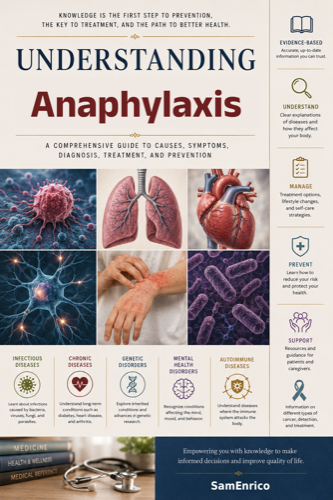
Understanding Anaphylaxis eBook
This disease publication, published by SamEnrico,
This disease publication, published by SamEnrico, covers Understanding Anaphylaxis
Formats
Free sample
Chapter 1: The Immune Betrayal--–- Imagine for a moment that your body’s most sophisticated defense system—the same network that has fought off countless viruses, healed broken bones, and kept you alive since birth—suddenly turns against you over a peanut, a bee sting, or a single dose of penicillin. This is not science fiction. This is anaphylaxis, and it represents one of medicine’s most puzzling and frightening paradoxes: the immune system, designed to protect, can kill you in minutes because it mistakes a harmless substance for a mortal threat.For the person living with severe allergies, this betrayal is not abstract. It is the quiet dread before every meal, the careful scan of ingredient labels, the practiced explanation to waitstaff and friends, and the constant awareness that a single mistake could trigger a cascade of physiological chaos. Anaphylaxis does not announce itself with trumpets.
It whispers, then screams, and in the worst cases, it silences forever. Yet despite its severity, anaphylaxis remains profoundly misunderstood—by the general public, by some healthcare professionals, and even by those who carry epinephrine auto-injectors every single day.This chapter lays the foundation for everything that follows in this book. Here, you will learn what anaphylaxis actually is—not the Hollywood version, not the myths passed down through families, but the biological, epidemiological, and clinical reality. You will understand why past reactions do not predict future ones, why “mild” allergies can suddenly become deadly, and why the term “anaphylactic shock” is both overused and dangerously misleading. Most importantly, you will begin the journey from fear to preparation, from confusion to clarity, from passive patient to empowered advocate.The Definition: More Than Just a Bad Allergy Let us start with precision.
Anaphylaxis is a severe, life-threatening, systemic hypersensitivity reaction characterized by rapid onset and the potential to involve multiple organ systems simultaneously or sequentially. That is the clinical definition. In plain language: anaphylaxis is not a “bad allergy.” It is not a worse case of hives. It is not a panic attack with wheezing. It is a distinct medical emergency that requires immediate recognition and treatment with epinephrine—not antihistamines, not inhalers, not waiting to see what happens.The word itself comes from the Greek “ana” (against, backward) and “phylaxis” (protection).
Coined by French physiologist Charles Richet in 1902, who later won a Nobel Prize for his work, the term literally means “the opposite of protection.” Richet discovered that instead of building immunity to a toxin through repeated exposure, some dogs developed catastrophic reactions. He had stumbled upon the dark mirror of vaccination: where immunization saves, anaphylaxis kills. Today, we understand this process through the lens of immunology, but the central irony remains unchanged. The same immune machinery that neutralizes influenza and heals surgical wounds can, in a matter of minutes, cause blood pressure to crash, airways to constrict, and the body to enter a state of shock.The Two Pathways: Ig E and Beyond To understand anaphylaxis, you must understand the immune system’s messengers and weapons. In the vast majority of cases—approximately 90 to 95 percent—anaphylaxis is driven by Immunoglobulin E, or Ig E.
These are specialized antibodies that the immune system produces in response to an allergen, whether that is peanut protein, penicillin, or wasp venom. On first exposure, the body becomes “sensitized.” No reaction occurs, but Ig E antibodies attach themselves to mast cells and basophils, two types of immune cells loaded with chemical mediators like histamine, leukotrienes, and prostaglandins. These cells are essentially landmines, primed and waiting.On second exposure, the allergen binds to the Ig E on those cells. The landmine detonates. Within seconds to minutes, mast cells degranulate, releasing a flood of inflammatory chemicals throughout the body.
Histamine causes blood vessels to dilate and become leaky, leading to hives, swelling, and falling blood pressure. Leukotrienes constrict the smooth muscle of the lungs, producing wheezing and difficulty breathing. Prostaglandins amplify pain and inflammation. The result is a cascade that can affect the skin, respiratory tract, gastrointestinal system, and cardiovascular system—often simultaneously.But Ig E is not the only path. A smaller subset of anaphylaxis occurs through non-Ig E mechanisms.
These include direct mast cell activation by certain medications (opioids, vancomycin), complement-mediated reactions (blood products, radiocontrast dyes), and physical triggers like cold temperature or exercise. There is also a category that fits neither pathway neatly: idiopathic anaphylaxis. This diagnosis of exclusion applies when no trigger can be identified despite extensive testing. In idiopathic anaphylaxis, the mechanism itself may be Ig E-mediated, non-Ig E-mediated, or something else entirely—by definition, no one knows. What matters is that the clinical presentation, the emergency treatment, and the long-term management are identical to triggered anaphylaxis.
Up to one-third of adults with anaphylaxis fall into this category, a sobering statistic that underscores how much remains unknown.Why Past Reactions Do Not Predict Future Severity One of the most dangerous misconceptions in allergy medicine is the belief that “it happened before and I was fine, so it will be fine again.” This is false. False in a way that has killed people. Anaphylaxis is inherently unpredictable. A person who has experienced only mild hives from peanuts for twenty years can suddenly go into cardiovascular collapse on the twenty-first exposure. Conversely, someone who has had a severe reaction may have subsequent milder episodes.
There is no mathematical formula, no blood test, no algorithm that can tell you with certainty what will happen the next time you encounter your trigger.Why? Because the severity of an allergic reaction depends on a complex and dynamic interplay of factors. The dose of the allergen matters: a trace amount may cause minimal symptoms, while a full serving could be catastrophic. The route of exposure also influences outcome: ingested allergens (food) typically cause gastrointestinal symptoms first, while injected allergens (venom, drugs) can produce more rapid cardiovascular collapse. Co-factors play an enormous role.
Exercise, alcohol, non-steroidal anti-inflammatory drugs (NSAIDs like ibuprofen or aspirin), infection, stress, sleep deprivation, and even the time of day can lower the threshold for a reaction or amplify its severity. A person who eats shrimp with no problem on a calm Tuesday morning might go into anaphylaxis after eating shrimp following a vigorous workout on a hot, stressful Friday afternoon—a phenomenon known as food-dependent exercise-induced anaphylaxis, which we will explore in detail in Chapter 2.Even the same person, with the same trigger, on two different days, can have two completely different reactions. This unpredictability is why every allergic reaction, no matter how mild it appears initially, must be taken seriously. It is why the standard of care is to treat with epinephrine at the first sign of a systemic reaction, not to “wait and see.” Waiting is gambling, and the stakes are a human life.Debunking “Anaphylactic Shock”You have heard the term. It appears in news reports, television dramas, and even some medical notes: “patient went into anaphylactic shock.” The phrase is so common that most people assume it is synonymous with anaphylaxis itself.
This is incorrect, and the misunderstanding has dangerous consequences.Anaphylactic shock refers specifically to the cardiovascular collapse phase of a severe reaction. It is characterized by profound hypotension (very low blood pressure)…
This is the end of the free sample. Get the eBook to keep going. Buy now
About this book
Details
- Author
- Gunther Adolfo
- Publisher
- SamEnrico
- Language
- English
- Genre
- Non-Fiction, Informative, Educational
- Released
- 2026-06-02
- Pages (approx.)
- 143
- Available as
- eBook, Audiobook

Read better in the ZLOADR app
Your eBooks on your phone or tablet. Sign in with your SamEnrico account and start reading.
More by Gunther Adolfo
 Opioid Recovery For Chronic Pain Patients WorkbookGunther Adolfo$11.99
 Anger in Borderline DynamicsGunther Adolfo$11.99
 18 Brumaire Coup AnalysisGunther Adolfo$11.99
 Brazil Living Abroad EconomicsGunther Adolfo$11.99
 The Only Sane One ManualGunther Adolfo$11.99
 Saying No With GraceGunther Adolfo$11.99
 Postpartum Depression Self Care ManualGunther Adolfo$11.99
 Pelvic Floor PodcastsGunther Adolfo$11.99
 Body Image For Wheelchair UsersGunther Adolfo$11.99
 Pharaoh's Shadow: The Curse That Never WasGunther Adolfo$11.99
 Frozen Depths: The Arctic Cave Explorers of the 1700sGunther Adolfo$11.99
 How to Start a Records Management Consulting Service BusinessGunther Adolfo$11.99
You may also like
 Hong Kong Handover 1997Dunn Johnnie$11.99
 Zumba For Postnatal Recovery CourseNeal Christian$11.99
 Zumba for BeginnersLadner Nikia$11.99
 YouTube Comment Mining GuideHumes Pandora$12.99
 Worry Box MeditationCarlin Rudy$11.99
 Workplace Stress MeditationNguyen Lynn$11.99
 Workplace Stress and Sleep RepairHawley Ivory$11.99
 Workplace Perfectionism CureDelaney Jeffry$11.99
 Workplace Injustice Anger GuideWallen Isabelle$11.99
 Work Addiction and Burnout LinkGreenwood Ester$11.99
 Women in Yoga and WellnessBeattie Galina$11.99
 Women in Stand Up ComedyChun Evangeline$11.99