

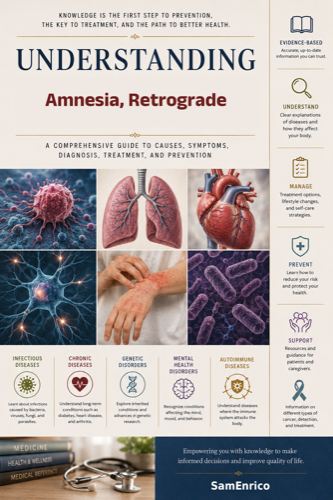
Non-FictionInformativeEducational
Understanding Amnesia, Retrograde eBook
This disease publication, published by SamEnrico,
This disease publication, published by SamEnrico, covers Understanding Amnesia, Retrograde
Formats
Free sample
Chapter 1: The Vanished Years...--The first time I met Sarah, she was crying over a photograph of a wedding she didn't remember. The woman in the white dress was unmistakably her—same auburn curls, same small hands clasped around a bouquet of lilies—but Sarah shook her head with the quiet certainty of someone being shown a forgery. "That's not me," she whispered. "I've never been married. I'm twenty-two years old." Sarah was forty-seven.
Her husband of twenty-five years sat beside her, holding the photograph with the careful tenderness of a man who had learned, over six months, not to argue. He simply said, "That's okay, sweetheart. You don't have to remember." And that was the moment I understood what this book needed to be about.Not the biology of forgetting. Not the list of brain structures or the chemical cascades or the elegant mathematical models of memory consolidation. Those things matter—they will fill many pages of this book—but they are not where understanding begins.
Understanding begins with Sarah, and with the millions of people like her, and with the families who love them, who wake up every day next to a person who has somehow become a stranger. This book is about retrograde amnesia: the loss of memories that were already stored, the erasure of the personal past. It is different from the more famous anterograde amnesia (made famous by movies like Memento), where a person cannot form new memories. Anterograde amnesia steals the future. Retrograde amnesia steals the past.
And of the two, which is worse? Ask Sarah. Ask her husband. Ask yourself: would you rather lose the ability to learn or the person you have already become?The answer, for most people, is that they would rather lose neither. But the brain does not ask permission.
In the chapters ahead, we will explore the anatomy of memory—where the past lives in the physical tissue of the brain. We will examine the causes of retrograde amnesia: the sudden erasure of trauma and stroke, the slow theft of neurodegeneration, the strange cases of psychogenic fugue where people walk away from their own lives. We will learn how doctors test for memory loss, how rehabilitation can sometimes bring the past back, and how families learn to live with a person who has forgotten them. And finally, in the last chapter, we will ask the question that has haunted philosophers for centuries: if you lose your memories, are you still you?But first, we must understand what we are talking about. Because "amnesia" is a word we use casually—"I completely forgot where I put my keys, I must have amnesia"—but the clinical reality is something else entirely.
Let us begin, then, with definitions.What Retrograde Amnesia Actually Is Retrograde amnesia is the loss of access to memories that were formed before a brain injury or disease process began. The word "retrograde" comes from the Latin retro (backward) and gradi (to go)—literally, going backward into the past. The amnesia is a gap, a hole in the timeline of a person's life. Sometimes the gap is small: a patient might lose the thirty minutes before a car accident and remember everything else perfectly. Sometimes the gap is enormous: a patient with advanced Alzheimer's disease may lose virtually all autobiographical memory, unable to recognize their own children or recall a single moment from eighty years of living.Crucially, retrograde amnesia is not about forgetting in the normal sense.
You and I forget where we put our keys, or the name of an actor we saw in a movie last week, or what we ate for breakfast on Tuesday. That is not amnesia. That is the brain's healthy, adaptive process of pruning irrelevant information. Normal forgetting is selective and gradual, and it does not erase the emotional texture of a life. Retrograde amnesia is different.
It is dense (covering large swaths of experience), permanent (in many cases), and specific to a period of time. The person with retrograde amnesia does not simply have trouble recalling their wedding day; they may insist, with complete sincerity, that the wedding never happened. They are not being stubborn. They are not in denial. They are telling the truth as their brain knows it.There is one more distinction that matters, and it is the source of endless confusion in both clinical settings and popular culture.
Some patients with retrograde amnesia also have anterograde amnesia—the inability to form new memories. This combination is common in severe traumatic brain injury, in Wernicke-Korsakoff syndrome, and in the aftermath of certain strokes. But the two deficits are neurologically separate. They involve different brain structures and can occur independently. A patient can have pure retrograde amnesia (remembering nothing from the past but able to learn new things normally) or pure anterograde amnesia (unable to form new memories but remembering the past perfectly).
The famous patient Henry Molaison (known for decades only as H.M., whose case we will examine in Chapter 3 and again in Chapter 12) had both. That is why he became so famous. But his case is not the only pattern.For the remainder of this book, we will focus on retrograde amnesia. We will mention anterograde amnesia when it overlaps—and it often does—but our primary concern is the past. The question we are asking is not "Can you learn?" but "What have you lost?"The Temporal Gradient: Ribot's Law Here is the single most important fact about retrograde amnesia, and it will appear in almost every chapter that follows.
Write it down. Remember it. Recent memories are more vulnerable than remote memories.This is called Ribot's Law, after the French psychologist Théodule Ribot, who first described it in 1881. Ribot observed that when the brain is damaged, the most recently formed memories are the first to disappear, while older, more established memories tend to survive. The pattern is so consistent that neurologists use it as a diagnostic clue.
A patient who has lost the last two years of memory but remembers their childhood is following Ribot's Law. A patient who has lost their childhood but remembers last week is not—that pattern suggests something unusual, perhaps a psychogenic cause or a very specific lesion.Why does Ribot's Law hold? The answer lies in how memories are stored. When a memory is first formed, it is fragile. It depends on the hippocampus, a seahorse-shaped structure deep in the brain, to bind together all the different sensory pieces of the experience—the sights, sounds, smells, emotions, and context.
Over time, through a process called consolidation, the memory becomes independent of the hippocampus. It is gradually transferred to the neocortex, the outer layer of the brain, where it is stored in a distributed network of connections. This process takes years. Some researchers believe that consolidation continues for decades, which is why very old memories are the most stable. They have had the most time to become entrenched in the neocortex.
They no longer need the hippocampus as a crutch.So when the hippocampus is damaged—by a stroke, a blow to the head, a lack of oxygen—recent memories are lost because they had not yet completed consolidation. Remote…
This is the end of the free sample. Get the eBook to keep going. Buy now
About this book
Details
- Author
- Boykin Rosalind
- Publisher
- SamEnrico
- Language
- English
- Genre
- Non-Fiction, Informative, Educational
- Released
- 2026-05-11
- Pages (approx.)
- 158
- Available as
- eBook, Audiobook

Read better in the ZLOADR app
Your eBooks on your phone or tablet. Sign in with your SamEnrico account and start reading.
More by Boykin Rosalind
 Committee Of Public Safety GuideBoykin Rosalind$11.99
 Postpartum Depression Support Group GuideBoykin Rosalind$11.99
 Distraction Proof Teaching GuideBoykin Rosalind$11.99
 Czech Republic Remote Work GuideBoykin Rosalind$11.99
 Anger in Polyamorous SystemsBoykin Rosalind$11.99
 Pelvic Floor ChecklistBoykin Rosalind$11.99
 The Crucial Conversations GuideBoykin Rosalind$11.99
 The Adopted Child in DysfunctionBoykin Rosalind$11.99
 Body Image For AlopeciaBoykin Rosalind$11.99
 The Stanford Prison Experiment: When Good Men Go BadBoykin Rosalind$11.99
 The Stanford Prison Experiment: Behind the Bars of MadnessBoykin Rosalind$11.99
 The Unseen Empire: How a Forgotten Broadcast War Shaped the Modern Media LandscapeBoykin Rosalind$11.99
You may also like
 Hong Kong Handover 1997Dunn Johnnie$11.99
 Zumba For Postnatal Recovery CourseNeal Christian$11.99
 Zumba for BeginnersLadner Nikia$11.99
 YouTube Comment Mining GuideHumes Pandora$12.99
 Worry Box MeditationCarlin Rudy$11.99
 Workplace Stress MeditationNguyen Lynn$11.99
 Workplace Stress and Sleep RepairHawley Ivory$11.99
 Workplace Perfectionism CureDelaney Jeffry$11.99
 Workplace Injustice Anger GuideWallen Isabelle$11.99
 Work Addiction and Burnout LinkGreenwood Ester$11.99
 Women in Yoga and WellnessBeattie Galina$11.99
 Women in Stand Up ComedyChun Evangeline$11.99