
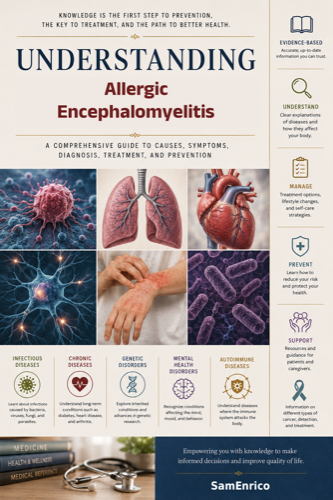
Non-FictionInformativeEducational
Understanding Allergic Encephalomyelitis eBook
This disease publication, published by SamEnrico,
by Wingate Flo
This disease publication, published by SamEnrico, covers Understanding Allergic Encephalomyelitis
Formats
Free sample
Chapter 1: The Brain’s Betrayal...–- The first time I saw a woman with multiple sclerosis lose the ability to walk, I was twenty-two years old and entirely unprepared for what the immune system could do. She was thirty-four, a former competitive swimmer with a wall full of medals and a two-year-old daughter. Over the course of six months, she had gone from running marathons to using a cane to needing a wheelchair. Her MRI looked like a night sky filled with white spots—each one a scar where her own immune system had torn the insulation off her nerves. She asked me, a medical student with no answers, “Why is my body attacking itself?” I told her I didn’t know.
Two decades later, that honest answer still haunts me—and this book is my attempt to finally give her, and millions like her, the explanation she deserved.This is not a textbook, though it contains everything a textbook would. This is not a memoir, though it carries the weight of countless patient stories. This is a work of narrative science, written for the intelligent general reader who wants to understand one of medicine’s most terrifying paradoxes: how the system designed to protect us can become our most dangerous enemy. The disease model at the center of this story is called Experimental Autoimmune Encephalomyelitis, or EAE—a name that sounds like alphabet soup but represents one of the most powerful tools ever developed in the fight against brain inflammation. To understand EAE is to understand multiple sclerosis, long COVID brain fog, and a host of other conditions where the immune system declares war on the central nervous system.
To misunderstand EAE is to miss the single most important scientific bridge between animal research and human neurological disease.The Landscape of Neuroinflammation Let us begin with a fundamental question: what does it mean for the brain to become inflamed? We all understand inflammation in a scraped knee—the redness, swelling, heat, and pain that signal the immune system rushing to repair damaged tissue. That same process, when it occurs inside the skull or spinal cord, is called neuroinflammation. But unlike a scraped knee, the brain cannot swell without consequences. It is encased in a rigid skull.
When immune cells flood into the central nervous system (CNS), they cause pressure, damage delicate neural circuits, and strip away the myelin sheath that allows nerve signals to travel at speeds up to two hundred miles per hour. Without myelin, signals slow to a crawl or stop entirely. That is why MS patients experience numbness, weakness, blindness, and paralysis—not because their nerves are dead, but because their nerves are uninsulated.Multiple sclerosis affects approximately 2.8 million people worldwide, with nearly one million of them in the United States alone. It is the most common neurological disease to strike young adults, typically appearing between ages twenty and forty. Women are three times more likely to develop MS than men—a sex bias that mirrors what we see in other autoimmune diseases like lupus and rheumatoid arthritis but remains incompletely understood.
The disease is not directly inherited, but having a first-degree relative with MS increases your risk from 0.1 percent in the general population to about 3 percent. Identical twins share nearly one hundred percent of their DNA, yet if one twin has MS, the other has only a 25 to 30 percent chance of developing it. This tells us that genetics loads the gun, but environment pulls the trigger.The clinical course of MS varies dramatically from person to person. The most common form, relapsing-remitting MS (RRMS), affects about eighty-five percent of patients at diagnosis. In RRMS, the disease announces itself with sudden attacks—called relapses, flares, or exacerbations—that last days to weeks and then partially or completely resolve.
A typical relapse might involve optic neuritis (blurred vision or pain with eye movement in one eye), numbness spreading up the legs (the so-called “MS hug”), or vertigo so severe that standing is impossible. Between relapses, patients may feel completely normal, as if the disease has vanished. But beneath the surface, something sinister is accumulating. Over time—usually ten to twenty years—most RRMS patients transition to secondary progressive MS (SPMS), where the relapses become less distinct and disability steadily worsens without recovery. A smaller group, ten to fifteen percent, have primary progressive MS (PPMS) from the very first symptom: no relapses, no remissions, just a slow, unrelenting decline in function.
The rarest form, progressive-relapsing MS (PRMS), combines steady progression with occasional acute attacks.What causes these different patterns? The honest answer is that we do not fully know, but EAE has given us powerful clues. Different strains of mice and rats develop different forms of EAE that mirror human MS subtypes. Some strains develop a single acute episode of paralysis and then recover completely—like a monophasic version of the disease. Others develop a chronic progressive illness with no recovery, resembling PPMS.
Still others develop relapses and remissions that can be tracked for months, providing a platform to test drugs that might prevent attacks in human MS. The existence of these different EAE phenotypes tells us that the pattern of disease is not random; it is determined by genetics, the specific myelin protein used to induce the disease, and the immune response that follows.The Global Burden of Neuroinflammatory Disease Numbers can be numbing, so let me give you a single fact that should shock you: the average lifetime cost of treating a single MS patient in the United States exceeds four million dollars. That includes medications, hospitalizations, rehabilitation, assistive devices, home modifications, and lost wages. The annual cost of MS in the United States alone is estimated at thirty billion dollars. Globally, the burden exceeds one hundred billion dollars annually.
And MS is just one of dozens of neuroinflammatory conditions.Consider acute disseminated encephalomyelitis (ADEM), a rare but devastating condition that typically follows a viral infection or vaccination. Children with ADEM can go from healthy to comatose in forty-eight hours as their immune system attacks the brain and spinal cord. Consider neuromyelitis optica (NMO), once thought to be a severe form of MS but now known to be a distinct disease caused by autoantibodies against a protein called aquaporin-4 on astrocytes. NMO preferentially attacks the optic nerves and spinal cord, often causing permanent blindness or paralysis in a single attack. Consider anti-NMDA receptor encephalitis, the disease made famous by the memoir Brain on Fire, where young women develop psychosis, seizures, and catatonia because their immune system has attacked a receptor critical for learning and memory.
Consider long COVID, which has affected tens of millions of people worldwide, with many experiencing persistent brain fog, fatigue, headache, and cognitive impairment that bears striking similarities to post-infectious neuroinflammation described decades ago in EAE research.What all these conditions share is the central paradox of neuroimmunology: the immune system, which evolved to protect us from pathogens, sometimes mistakes our own brain tissue for an invader. Understanding why this happens—and how to stop it—requires an animal model that allows us to watch the disease unfold from the very first aberrant immune cell to the final paralytic lesion. That animal model is EAE.What…
This is the end of the free sample. Get the eBook to keep going. Buy now
About this book
Details
- Author
- Wingate Flo
- Publisher
- SamEnrico
- Language
- English
- Genre
- Non-Fiction, Informative, Educational
- Released
- 2026-06-02
- Pages (approx.)
- 154
- Available as
- eBook, Audiobook

Read better in the ZLOADR app
Your eBooks on your phone or tablet. Sign in with your SamEnrico account and start reading.
More by Wingate Flo
 Metta for an Online ConnectionWingate Flo$11.99
 Estranged Family Death GuideWingate Flo$11.99
 Depreciation of Medical EquipmentWingate Flo$11.99
 CRE Due Diligence ChecklistWingate Flo$11.99
 Email Interruption Control GuideWingate Flo$11.99
 Rainy Window Seat CalmWingate Flo$11.99
 Iraq War Medic FallujahWingate Flo$11.99
 Memory for LawWingate Flo$11.99
 Project Launch Time BoxingWingate Flo$11.99
 The Last Stand: The Impossible Comeback of Eric MoussambaniWingate Flo$11.99
 The Iron Spider: How a Victorian Engineer Unlocked the Secrets of the CanopyWingate Flo$11.99
 Ares' Gambit: The Divine Chessboard of TroyWingate Flo$11.99
You may also like
 Hong Kong Handover 1997Dunn Johnnie$11.99
 Zumba For Postnatal Recovery CourseNeal Christian$11.99
 Zumba for BeginnersLadner Nikia$11.99
 YouTube Comment Mining GuideHumes Pandora$12.99
 Worry Box MeditationCarlin Rudy$11.99
 Workplace Stress MeditationNguyen Lynn$11.99
 Workplace Stress and Sleep RepairHawley Ivory$11.99
 Workplace Perfectionism CureDelaney Jeffry$11.99
 Workplace Injustice Anger GuideWallen Isabelle$11.99
 Work Addiction and Burnout LinkGreenwood Ester$11.99
 Women in Yoga and WellnessBeattie Galina$11.99
 Women in Stand Up ComedyChun Evangeline$11.99