
Non-FictionInformativeEducational
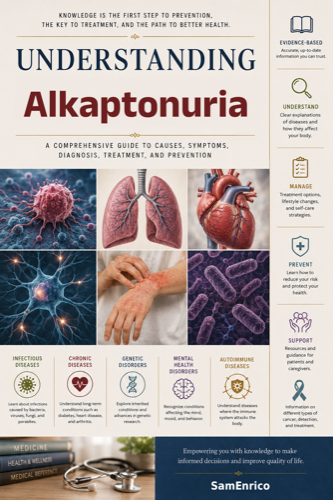
Understanding Alkaptonuria eBook
This disease publication, published by SamEnrico,
This disease publication, published by SamEnrico, covers Understanding Alkaptonuria
Formats
Free sample
Chapter 1: The Urine Test...-- In a modest laboratory at St. Bartholomew's Hospital in London, during the spring of 1901, a young physician named Archibald Garrod performed an experiment so simple that it could be repeated by any medical student with a vial of urine and a bottle of household bleach. He took a sample from a patient whose urine had been described in medical records as "turning black upon standing." He added a few drops of alkali. Within seconds, the pale yellow liquid transformed into a deep, ink-black solution. Garrod did not gasp or call for witnesses.
He simply noted the reaction, recorded it in his leather-bound journal, and moved on to the next patient. He had no way of knowing that this tiny chemical transformation would eventually overturn centuries of medical dogma, launch the field of biochemical genetics, and change how doctors understood the relationship between inheritance, metabolism, and disease.The patient whose urine darkened so dramatically was not particularly remarkable by the standards of the day. He was a middle-aged man with complaints of back pain and stiff joints, symptoms so common in Edwardian London that they barely warranted a second glance. But something about his case gnawed at Garrod. The man's urine was not merely dark; it contained a substance that defied easy classification.
Other physicians had dismissed it as a curiosity, a quirk of the patient's diet or digestion. Garrod suspected otherwise. He had seen similar cases before, scattered across the hospital's admission logs like breadcrumbs leading somewhere important. Over the following seven years, he would collect every scrap of information he could find about patients with this strange condition, from their family trees to their autopsy reports. He would write letters to physicians across Europe, requesting urine samples and medical histories.
He would fill notebooks with chemical analyses, family pedigrees, and clinical observations. And in 1908, he would stand before the Royal College of Physicians in London and deliver a series of lectures that would fundamentally reshape medicine.This book is about what Garrod discovered. It is about a disease called alkaptonuria, or AKU, a rare genetic disorder that affects approximately one in every 250,000 to one million people worldwide. It is a condition that most physicians will never encounter in their entire careers, yet it holds lessons that matter for every single person alive today. AKU is the first described inborn error of metabolism—a term Garrod coined to describe diseases caused by a single defective enzyme.
In the case of AKU, the body lacks a functional copy of an enzyme called homogentisate 1,2-dioxygenase (HGD). Without this enzyme, a metabolic intermediate called homogentisic acid (HGA) accumulates in the blood and urine. Over time, HGA oxidizes and polymerizes into a dark pigment that binds to collagen throughout the body. This pigment, called ochronotic pigment, slowly turns connective tissues—cartilage, tendons, skin, and even the whites of the eyes—a striking bluish-black color. The joints become brittle and arthritic.
The heart valves stiffen. The kidneys develop stones. The ears and nose darken visibly. And the urine, when exposed to air or alkali, turns black.But this book is not merely a catalog of symptoms and biochemical pathways. It is a story about the human body's remarkable complexity, about the hidden chemistry that runs every aspect of our existence, and about what happens when a single, tiny component of that chemistry goes wrong.
It is also a story about hope. In the century since Garrod's lectures, AKU has transformed from an untreatable curiosity to a manageable condition with a specific pharmacological therapy. Nitisinone, a drug originally developed as a herbicide, now offers patients the ability to dramatically reduce HGA production and slow the progression of ochronosis. Gene therapy trials are underway. Patient registries are collecting data that will guide future treatments.
And a global community of researchers, clinicians, and affected families is working together to change the trajectory of this disease.Before we dive into the biochemistry of tyrosine metabolism, before we examine the intricate genetics of the HGD gene, before we explore the clinical manifestations of ochronosis from the spine to the heart to the kidneys, we must first understand how Garrod arrived at his revolutionary insights. His story is not merely historical background; it is a case study in how careful observation, intellectual courage, and interdisciplinary thinking can transform medicine. Garrod worked at a time when the very concept of "inborn errors of metabolism" did not exist. The prevailing theory of inheritance was a muddle of blended traits and acquired characteristics. Most physicians believed that diseases were caused by external agents—bacteria, toxins, poor diet, or moral failing—rather than by inherited biochemical defects.
Garrod's proposal that a disease could be caused by a single missing enzyme, passed down through families according to predictable Mendelian ratios, was met with skepticism, indifference, and sometimes outright hostility. His lectures were published, reviewed, and largely forgotten for nearly fifty years.They were rediscovered only when a new generation of scientists, armed with new tools and new questions, recognized that Garrod had been asking the right questions all along. By then, Garrod was an old man, retired from clinical practice, watching from the sidelines as younger researchers validated his ideas using techniques he could never have imagined. His story is a reminder that scientific progress is not always linear, that the most important discoveries are not always celebrated in their own time, and that the foundation of modern medicine rests on the shoulders of physicians who were willing to look more closely at the patients in front of them.The Urine That Turned Black The earliest known description of dark urine consistent with alkaptonuria appears in the writings of Scribonius Largus, a Roman physician who lived during the reign of the Emperor Claudius in the first century AD. In his compilation of medical remedies, Largus noted that some patients passed urine that "became black as ink when left to stand." He had no explanation for this phenomenon and offered no treatment.
He simply recorded it as an observation, one of hundreds of curious medical facts collected in his text. Over the following centuries, scattered case reports appeared in European medical literature. Physicians in France, Germany, and England noted patients whose urine darkened inexplicably, sometimes in childhood, sometimes in adulthood. These reports were treated as medical oddities, suitable for publication in collections of unusual cases but not worthy of serious investigation. The urine was black; that was all anyone knew, and all anyone seemed to care about.The first physician to systematically study the condition was a German named Karl Rudolf Boedeker, who in 1859 isolated the dark pigment from a patient's urine and gave it a name.
He called it "alkapton," from the Arabic word for alkali, because the pigment reacted with alkaline solutions to produce a characteristic color change. Boedeker identified the substance as a phenolic compound related to hydroquinone, but he could not determine its precise chemical structure. That task fell to the British chemist William Henry Perkin, who had already made his fortune by synthesizing the first artificial dye, mauveine, and who turned his attention to alkaptonuria in the 1860s. Perkin isolated the compound, determined its molecular formula, and…
This is the end of the free sample. Get the eBook to keep going. Buy now
About this book
Details
- Author
- Thomason Adelia
- Publisher
- SamEnrico
- Language
- English
- Genre
- Non-Fiction, Informative, Educational
- Released
- 2026-06-02
- Pages (approx.)
- 158
- Available as
- eBook, Audiobook

Read better in the ZLOADR app
Your eBooks on your phone or tablet. Sign in with your SamEnrico account and start reading.
More by Thomason Adelia
 Opioid Recovery Nutrition GuideThomason Adelia$11.99
 Letting Go of Family EstrangementThomason Adelia$11.99
 Cal Newport Time BlockingThomason Adelia$11.99
 Interruption Proof Your Workday GuideThomason Adelia$11.99
 Immigrant Roofing Business EmpireThomason Adelia$11.99
 Metta for a Former LoverThomason Adelia$11.99
 Hammock Between TreesThomason Adelia$11.99
 NVC For Prison SettingsThomason Adelia$11.99
 Memory for CodingThomason Adelia$11.99
 The Last Trial of Hypatia: Mathematics vs. MythThomason Adelia$11.99
 The Great Bitcoin Bet: How a Billionaire Lost It All in 24 HoursThomason Adelia$11.99
 The Complete Guide to the Grapefruit DietThomason Adelia$11.99
You may also like
 Hong Kong Handover 1997Dunn Johnnie$11.99
 Zumba For Postnatal Recovery CourseNeal Christian$11.99
 Zumba for BeginnersLadner Nikia$11.99
 YouTube Comment Mining GuideHumes Pandora$12.99
 Worry Box MeditationCarlin Rudy$11.99
 Workplace Stress MeditationNguyen Lynn$11.99
 Workplace Stress and Sleep RepairHawley Ivory$11.99
 Workplace Perfectionism CureDelaney Jeffry$11.99
 Workplace Injustice Anger GuideWallen Isabelle$11.99
 Work Addiction and Burnout LinkGreenwood Ester$11.99
 Women in Yoga and WellnessBeattie Galina$11.99
 Women in Stand Up ComedyChun Evangeline$11.99