
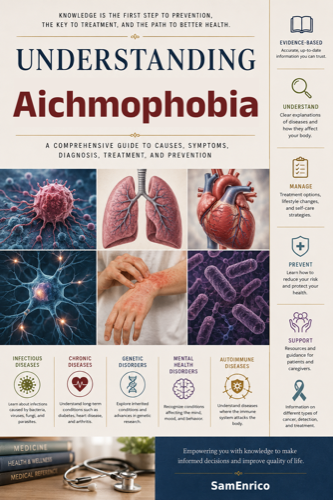
Non-FictionInformativeEducational
Understanding Aichmophobia eBook
This disease publication, published by SamEnrico,
This disease publication, published by SamEnrico, covers Understanding Aichmophobia
Formats
Free sample
Chapter 1: The Point of No Return--The first time Maya fainted, she was seven years old, sitting in a pediatrician's exam room while her older brother received a routine vaccination. She did not receive a needle herself. She only watched. The nurse swabbed alcohol on his arm, uncapped the syringe, and before the needle touched skin, Maya's vision tunneled to a small, distant circle. She heard her mother's voice as if from underwater.
Then nothing. She woke on the floor with a cold compress on her forehead and a lollipop in her hand, confused and embarrassed.For the next twenty years, Maya would construct an entire life around that moment. She declined summer camp because camp required immunization records. She chose a career in freelance writing—working from home, no office health screenings—specifically because it never required blood work. She postponed pregnancy three times, telling her husband she "wasn't ready," when the truth was simpler and more shameful: she could not face the prenatal blood draws.
At thirty-seven, with her biological clock running out, Maya finally searched the internet for answers. She typed: Why do I faint at the sight of needles?She was not crazy. She was not weak. She had aichmophobia.What This Chapter Will Do For You If you are reading this book, you likely share something with Maya. Perhaps you have skipped a dental cleaning for five years.
Perhaps you left a half-eaten meal at a restaurant because the steak knife touched your plate. Perhaps you have lied to a doctor—"I already had my blood work done elsewhere"—or felt a wave of nausea when a child brought home safety scissors from school. You may have searched for explanations and found only clinical jargon: specific phobia, blood-injection-injury subtype, vasovagal response. These terms are accurate, but they do not capture the lived experience. They do not capture the shame.This chapter has three purposes.
First, to give you a clear, usable definition of aichmophobia that distinguishes it from related conditions. Second, to help you understand who develops this phobia and why it affects approximately three to five percent of the population. Third, to introduce you to the central paradox of aichmophobia: the same instinct that kept your ancestors safe from sharp predators now prevents you from receiving life-saving medical care. By the end of this chapter, you will have a framework for understanding your own experience, and you will know where this book will take you.Let us begin with language. Because the first step out of a phobia is naming it correctly.The Problem with Precision: Aichmophobia, Trypanophobia, and Belonephobia The English language has an embarrassing abundance of words for the fear of sharp things.
This is not because the fears are different in any meaningful psychological way. It is because nineteenth-century physicians enjoyed coining Greek-derived terms, and because the internet age has rewarded hyper-specific diagnostic labels. You may have encountered some or all of these terms in your own searching. Let me clarify them once, so you never have to wonder again.Aichmophobia (pronounced ike-mo-FO-bee-ah) comes from the Greek aichmē, meaning "point of a spear," and phobos, meaning "fear." In contemporary usage, aichmophobia refers to the fear of all sharp objects: knives, scissors, needles, pins, broken glass, even the pointed tip of a pencil or the sharp corner of a table. This is the broadest term and the correct diagnosis for most people reading this book.
If the sight of any pointed or bladed object triggers anxiety, avoidance, or fainting, you likely have aichmophobia.Trypanophobia comes from the Greek trypanon, meaning "auger" or "borer" (a tool for drilling holes), and phobos. This is the fear of medical needles specifically: hypodermic needles, blood draw needles, IV catheters, and sometimes acupuncture needles. Trypanophobia is actually a subset of aichmophobia, but it is the subset that causes the most real-world harm. People with trypanophobia avoid vaccines, blood tests, dental injections, and medical procedures. They are the reason this book devotes an entire chapter (Chapter 10) to navigating medical settings.Belonephobia comes from the Greek belonē, meaning "needle" (specifically a sewing needle), and phobos.
This is the fear of pins and needles, often in the context of sewing, knitting, or crafting. Belonephobia is the rarest of the three and usually does not interfere with medical care. A person with belonephobia might avoid sewing kits but have no trouble with blood draws.Here is the practical takeaway: if you are reading this book, you almost certainly have aichmophobia, and you probably have trypanophobia as its most disabling feature. Throughout this book, I will use aichmophobia as the umbrella term, but I will give special attention to medical needles because they pose the greatest threat to your health and longevity. Kitchen knives, scissors, and other household sharps are addressed in Chapter 9 and Appendix B.
The distinction matters less for treatment than you might think. Whether you faint at the sight of a scalpel or simply feel your heart race when your child picks up scissors, the underlying mechanism is the same, and the solution follows the same structure.The Evolutionary Paradox: Why Your Brain Has Not Caught Up to Modern Life To understand aichmophobia, you must understand a uncomfortable truth: your brain is running software that is approximately two hundred thousand years old. The human nervous system evolved on the African savanna, where sharp objects meant one thing: danger. A pointed stick could be a predator's tooth. A jagged rock could be a weapon in another human's hand.
A thorn could carry infection. The hominids who paid attention to sharp things—who felt a spike of fear at the sight of a point—survived longer and reproduced more than their oblivious cousins. Their vigilance was wired into our DNA.This is the evolutionary paradox of aichmophobia. The fear of sharp objects was adaptive for our ancestors. It kept them alive.
But modern life has radically changed the context while leaving our nervous systems largely unchanged. Today, sharp objects are everywhere, and almost none of them are threats. The knife in your kitchen drawer is not going to attack you. The scissors in your office desk are not lying in ambush. The needle in your doctor's office is sterile, single-use, and operated by a trained professional whose goal is to minimize your discomfort.
From a rational standpoint, these objects are safe.But your amygdala—the ancient part of your brain responsible for threat detection—does not know the difference between a spear and a syringe. It sees a point and sounds the alarm. By the time your prefrontal cortex (the rational, thinking part of your brain) realizes there is no danger, the alarm is already ringing. This is not a failure of character. It is a failure of evolutionary timing.
Your brain is doing exactly what it evolved to do. It is just doing it in the wrong environment.This paradox explains why aichmophobia is so resistant to logic. You can tell yourself "This needle is sterile and safe" a hundred times, and your amygdala will still fire. You cannot argue your way out of a physiological response that evolved before language. The good news—and the entire premise of this book—is that you…
This is the end of the free sample. Get the eBook to keep going. Buy now
About this book
Details
- Author
- Rountree Jude
- Publisher
- SamEnrico
- Language
- English
- Genre
- Non-Fiction, Informative, Educational
- Released
- 2026-05-23
- Pages (approx.)
- 150
- Available as
- eBook, Audiobook

Read better in the ZLOADR app
Your eBooks on your phone or tablet. Sign in with your SamEnrico account and start reading.
More by Rountree Jude
 NVC Four Step FrameworkRountree Jude$11.99
 Valium Dependence Taper GuideRountree Jude$11.99
 Ayurvedic Stress GuideRountree Jude$11.99
 Road Rage and TailgatingRountree Jude$11.99
 CEO Sleep Optimization GuideRountree Jude$11.99
 The Stress Fatigue LinkRountree Jude$11.99
 Martin Luther KingRountree Jude$11.99
 Working Memory WorkbookRountree Jude$11.99
 Diaspora Network Business Building GuideRountree Jude$11.99
 Wings Over the World: The Arctic Tern’s 44,000-Mile OdysseyRountree Jude$11.99
 Sand and Shadow: The Lost Caravans of the Silk RoadRountree Jude$11.99
 The First Song: How the World Was Born in HarmonyRountree Jude$11.99
You may also like
 Hong Kong Handover 1997Dunn Johnnie$11.99
 Zumba For Postnatal Recovery CourseNeal Christian$11.99
 Zumba for BeginnersLadner Nikia$11.99
 YouTube Comment Mining GuideHumes Pandora$12.99
 Worry Box MeditationCarlin Rudy$11.99
 Workplace Stress MeditationNguyen Lynn$11.99
 Workplace Stress and Sleep RepairHawley Ivory$11.99
 Workplace Perfectionism CureDelaney Jeffry$11.99
 Workplace Injustice Anger GuideWallen Isabelle$11.99
 Work Addiction and Burnout LinkGreenwood Ester$11.99
 Women in Yoga and WellnessBeattie Galina$11.99
 Women in Stand Up ComedyChun Evangeline$11.99