
Non-FictionInformativeEducational
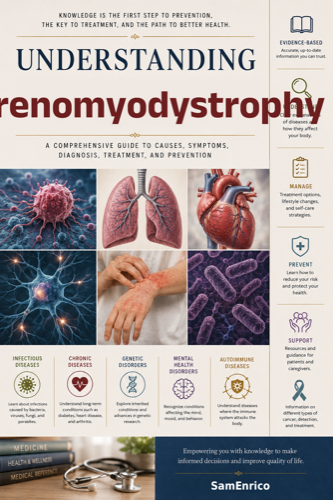
Understanding Adrenomyodystrophy eBook
This disease publication, published by SamEnrico,
This disease publication, published by SamEnrico, covers Understanding Adrenomyodystrophy
Formats
Free sample
Chapter 1: The Vanished Laughter...--The photograph sat on the nightstand for three years before anyone dared to move it. In the image, a six-month-old boy with enormous brown eyes and a dimpled chin stared directly at the camera, his mouth open in the middle of a laugh that no one had managed to capture on video. His name was Jacob, and by the time his parents finally packed away that photograph, they had already buried him.Jacob died not because his heart stopped suddenly or because of a tragic accident. He died because his adrenal glands forgot how to scream for help. He died because the doctors in the emergency room that Tuesday morning did not recognize the constellation of symptoms that had been building since his fourth month of life.
He died because Adrenomyodystrophy—a disease so rare that it does not appear in most pediatric textbooks—had been slowly dismantling his body while everyone looked in the wrong direction.This book exists because of Jacob and children like him. It exists because there are currently fewer than two hundred known cases of Adrenomyodystrophy worldwide, which means that when a child begins to show symptoms, the medical system is almost guaranteed to fail them at least once. Sometimes twice. In Jacob's case, it failed seven times across four hospitals before someone finally ran the right test. By then, irreversible neurological damage had already occurred, and his parents had spent ninety-three days watching their son disappear in slow motion.Before we dive into the biochemistry, the genetic inheritance patterns, and the clinical management protocols, we must first understand what Adrenomyodystrophy actually is—not as a list of symptoms, but as a lived experience.
We must understand how this disease was discovered, why it remains so poorly understood, and why the current state of medical knowledge is both a tragedy and an opportunity. This chapter serves as the foundation for everything that follows: the history, the nomenclature, the epidemiology, and the human cost of medical rarity.The Name That Took Forty Years to Get Right Adrenomyodystrophy is a mouthful of a word, and that is part of the problem. Medical nomenclature often prioritizes precision over accessibility, and in the case of AMD—the abbreviation we will use throughout this book—the name itself tells a story. Let us break it down."Adreno" refers to the adrenal glands, two small triangular organs perched atop each kidney like tiny crowns. These glands produce hormones that regulate everything from blood pressure and salt balance to the body's ability to handle stress.
In AMD, the adrenal glands fail. Not gradually, not partially, but catastrophically. The result is a condition called primary adrenal insufficiency, also known as Addison's disease, which is fatal if untreated."Myo" comes from the Greek word for muscle. In AMD, the muscles degenerate. Children who learn to crawl may lose that ability.
Children who learn to stand may never take a step. The muscle tissue itself becomes infiltrated with fibrous scar tissue, losing its elasticity and strength. Unlike other muscular dystrophies that progress slowly over decades, the myopathy in AMD moves alongside the adrenal failure, creating a dual attack on the body's most basic survival systems."Dystrophy" means abnormal growth or degeneration. It is a suffix that has been attached to a wide range of disorders—muscular dystrophy, lipodystrophy, retinal dystrophy—and it signals that the problem is not simply a chemical imbalance or an infection but a fundamental breakdown of tissue structure. In AMD, the degeneration is progressive, irreversible with current therapies, and ultimately contributes to the shortened life expectancy.The term Adrenomyodystrophy first appeared in the medical literature in the late 1980s, but the condition itself was described earlier under various names.
Some early case reports called it "neonatal Addison's disease with myopathy." Others grouped it under "X-linked adrenocortical hypoplasia with myopathy." It took nearly two decades of case reports, family studies, and biochemical analyses before researchers agreed that this constellation of symptoms represented a distinct disorder rather than a variant of something else.That "something else" is critical to understand. For years, clinicians misdiagnosed AMD as Adrenoleukodystrophy, or ALD, because both conditions involve adrenal failure and affect young boys. The similarity in names—adrenoleukodystrophy versus adrenomyodystrophy—has caused countless diagnostic errors. But the two diseases could not be more different in their pathology.ALD is a peroxisomal disorder that causes the buildup of very long-chain fatty acids in the brain, leading to progressive destruction of the myelin sheath that insulates nerve cells. Boys with ALD typically develop normally for the first four to eight years of life, then rapidly deteriorate with vision loss, hearing loss, seizures, and dementia.
Death usually occurs within two to five years of symptom onset unless the child receives a bone marrow transplant or gene therapy.AMD has no such window of normal development. Children with AMD show signs of trouble in the first year of life, often within the first six months. Their adrenal crises come early and repeatedly. Their muscle weakness is evident from the beginning, not as a later complication. And crucially, their brains show no evidence of demyelination.
The cognitive impairment in AMD is not caused by the destruction of white matter but by a mechanism that researchers are still trying to understand.The 1982 case study that finally distinguished AMD from its look-alikes involved two brothers born to healthy, unrelated parents in the American Midwest. The first brother presented at four months with vomiting, poor feeding, and a bronze-like discoloration of his skin that pediatricians initially dismissed as jaundice. By six months, he had failed to gain weight for eight consecutive weeks. By eight months, he could not lift his head when placed on his stomach. He died at thirteen months following a presumed viral illness that triggered an adrenal crisis no one was prepared to treat.The second brother, born two years later, followed an almost identical trajectory.
But this time, a sharp-eyed endocrinology fellow remembered the first case and ordered an ACTH stimulation test at three months of age. The results showed complete adrenal unresponsiveness. A muscle biopsy revealed dystrophic changes that did not match any known muscular dystrophy. And a brain MRI showed no white matter abnormalities whatsoever. The fellow published the case series in a now-obscure journal of pediatric neurology, and in doing so, gave the world its first clear description of what we now call Adrenomyodystrophy.The Epidemiology of Invisibility How many people have AMD?
The honest answer is that no one knows, and that uncertainty is itself a symptom of a larger problem in rare disease medicine.Based on published case reports and data from rare disease registries, the estimated prevalence of AMD is somewhere between one in 500,000 and one in 1,000,000 live male births. For context, that makes AMD approximately ten times rarer than ALD and roughly one hundred times rarer than Duchenne muscular dystrophy. If you gave birth to a son in the United States today, his chance of having AMD would be roughly equivalent to his chance of being struck by lightning before his fifth birthday.But these numbers are almost certainly underestimates. Rare diseases that lack a known genetic marker are systematically…
This is the end of the free sample. Get the eBook to keep going. Buy now
About this book
Details
- Author
- Copley Sharlene
- Publisher
- SamEnrico
- Language
- English
- Genre
- Non-Fiction, Informative, Educational
- Released
- 2026-06-02
- Pages (approx.)
- 158
- Available as
- eBook, Audiobook

Read better in the ZLOADR app
Your eBooks on your phone or tablet. Sign in with your SamEnrico account and start reading.
More by Copley Sharlene
 Scheduling for Remote WorkersCopley Sharlene$11.99
 The 1857 War ChildrenCopley Sharlene$11.99
 Spouse Loss Photography GuideCopley Sharlene$11.99
 Behavioral Weight FAQCopley Sharlene$11.99
 The Stress Stroke RiskCopley Sharlene$11.99
 Yakuza Lost DecadeCopley Sharlene$11.99
 The Software Architecture CreativityCopley Sharlene$11.99
 Yoga For Chronic PainCopley Sharlene$11.99
 Navalny PoisoningCopley Sharlene$11.99
 The Laundromat Heist: How a Small Town Bank Fooled the FBICopley Sharlene$11.99
 The Last Broadcast: How a Pirate Radio Station Defied a DictatorCopley Sharlene$11.99
 The Battle of Pavia: The Fall of a King and the Rise of SpainCopley Sharlene$11.99
You may also like
 Hong Kong Handover 1997Dunn Johnnie$11.99
 Zumba For Postnatal Recovery CourseNeal Christian$11.99
 Zumba for BeginnersLadner Nikia$11.99
 YouTube Comment Mining GuideHumes Pandora$12.99
 Worry Box MeditationCarlin Rudy$11.99
 Workplace Stress MeditationNguyen Lynn$11.99
 Workplace Stress and Sleep RepairHawley Ivory$11.99
 Workplace Perfectionism CureDelaney Jeffry$11.99
 Workplace Injustice Anger GuideWallen Isabelle$11.99
 Work Addiction and Burnout LinkGreenwood Ester$11.99
 Women in Yoga and WellnessBeattie Galina$11.99
 Women in Stand Up ComedyChun Evangeline$11.99