
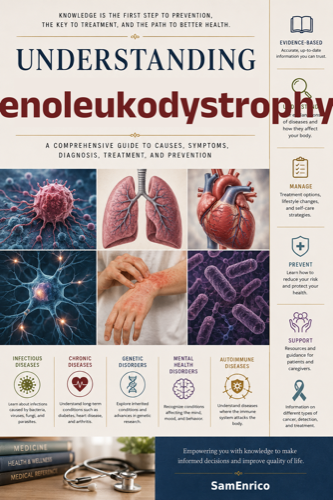
Understanding Adrenoleukodystrophy eBook
This disease publication, published by SamEnrico,
This disease publication, published by SamEnrico, covers Understanding Adrenoleukodystrophy
Formats
Free sample
Chapter 1: The Vanishing Boy...–- Matthew was four years old when he stopped hearing his mother’s voice. Not suddenly—not like a door slamming shut—but as if someone was slowly turning down the volume of the world. First, he stopped responding to his name at the dinner table. Then he complained that his teachers were “mumbling.” His parents, Sarah and David, took him to an audiologist, who found nothing wrong with his ears. The audiologist suggested “selective hearing” or “behavioral issues.” Sarah left the office with a referral to a child psychologist and a feeling in her gut that something was profoundly wrong.This chapter is not about Matthew alone.
It is about every family who has watched a child disappear into a disease most doctors have never heard of. It is about the history of a condition that was misdiagnosed for nearly a century—as schizophrenia, as multiple sclerosis, as “bad parenting”—and the scientists who finally decoded its secrets. This is the story of how adrenoleukodystrophy (ALD) went from a medical mystery to a treatable, screenable condition. And it is a warning: we still have far to go.The Silence Before the Storm In 1910, a German neurologist named Paul Schilder described a puzzling case: a young boy who lost the ability to walk, then to speak, then to see, and died within a year. Schilder called the condition encephalitis periaxialis diffusa, but others would later call it “Schilder’s disease.” For decades, any child with progressive neurological deterioration and white matter changes on autopsy received that label.
What Schilder did not know—could not have known—was that he was looking at a family of diseases, one of which would eventually be named adrenoleukodystrophy.The problem with lumping all white matter diseases together was that it hid crucial distinctions. Some children had adrenal insufficiency. Some had skin darkening. Some had families with affected boys across multiple generations. But because each case was reported in isolation, no one connected the dots.
The medical community saw scattered puzzle pieces and assumed they belonged to different boxes.This pattern of misdiagnosis continued for more than fifty years. Boys with ALD were labeled as having “childhood schizophrenia” when they developed behavioral changes. They were called “ADHD” when they became hyperactive and inattentive. They were referred to psychiatrists when they withdrew from family life. And by the time a neurologist was consulted—often after the boy had lost the ability to walk—the disease was already advanced, irreversible, and fatal.The First Clues: Adrenal Glands and Darkened Skin In 1912, a year after Schilder’s report, another physician made an observation that would prove critical.
A young boy died with what appeared to be Schilder’s disease, but an autopsy revealed something unexpected: his adrenal glands were atrophied, scarred, and nonfunctional. The boy had also shown hyperpigmentation—darkening of the skin in his knuckles, gums, and scars—a classic sign of Addison’s disease (adrenal insufficiency). But no one had connected the neurological decline to the adrenal failure. They were treated as two separate diseases occurring in the same patient by coincidence.That coincidence happened again. And again.
Throughout the 1920s, 1930s, and 1940s, scattered case reports appeared in European medical journals: boys with progressive neurological deterioration and adrenal insufficiency. Some had skin darkening. Some had vomiting and low sodium. But the link remained unrecognized. The prevailing theory was that adrenal damage somehow caused brain damage—a hypothesis that turned out to be backwards but would persist for decades.The name “adrenoleukodystrophy” did not appear until the 1970s.
It was coined by Dr. Michael Blaw and Dr. Hugo Moser, two researchers who finally put the pieces together. Adreno for the adrenal glands. Leuko for the white matter of the brain.
Dystrophy for disordered growth or degeneration. The name itself is a diagnosis: a disease of the adrenal glands and the white matter. But even with a name, the underlying cause remained a mystery.The Moser Era: Building the Foundation Dr. Hugo Moser is the single most important figure in the history of ALD research. In the 1970s, working at the Johns Hopkins Kennedy Krieger Institute, he began collecting families with affected boys.
He noticed something that previous physicians had missed: the disease ran in families in a pattern that suggested X-linked inheritance. Only boys were severely affected. Mothers passed the trait to their sons. Daughters could be carriers.Moser’s next breakthrough came from an unlikely place: biochemistry. He asked a simple question—What is accumulating in the brains and adrenal glands of these children?—and set out to answer it using the tools of lipid chemistry.
In 1981, his laboratory reported that patients with ALD had abnormally high levels of very long-chain fatty acids (VLCFAs) in their blood, brain, and adrenal tissue. For the first time, doctors had a diagnostic test: measure VLCFAs in plasma. If they were elevated, the patient had ALD.This discovery transformed ALD from a post-mortem diagnosis to a living one. Parents no longer had to wait for an autopsy to know what had killed their son. But the test was not yet widely available, and many doctors remained unaware of ALD’s existence.
Throughout the 1980s, Moser and his team traveled the country, training physicians and laboratorians. They built a registry of ALD patients—the first of its kind—and began to map the natural history of the disease.Lorenzo’s Oil: Hope, Hype, and Hard Lessons No history of ALD is complete without the story of Lorenzo Odone. In 1984, Augusto and Michaela Odone’s five-year-old son was diagnosed with ALD. Lorenzo had already lost the ability to walk, speak, and see. His prognosis was death within two years.
But his parents refused to accept this. Augusto, an economist with no medical training, taught himself biochemistry. Michaela, a linguist, became his research partner.Together, they developed a theory: if VLCFAs were accumulating because they could not be broken down, perhaps feeding Lorenzo a specific mixture of oils—erucic acid and oleic acid—would lower his VLCFA levels. The theory had some biochemical plausibility: erucic acid and oleic acid compete with VLCFAs for the same metabolic pathways. In 1989, they reported that Lorenzo’s oil lowered his VLCFA levels significantly.
The media exploded. Lorenzo’s Oil became a film starring Nick Nolte and Susan Sarandon, released in 1992. The film was nominated for two Academy Awards. It raised millions of dollars for ALD research. It brought the disease out of obscurity and into the living rooms of millions.But here is the truth that the film glossed over: Lorenzo’s oil does not stop cerebral ALD.
It lowers VLCFA levels in the blood, but it does not cross the blood-brain barrier in sufficient quantities. For boys who already have brain inflammation—who are already losing skills—Lorenzo’s oil is ineffective. The film’s portrayal of Lorenzo walking at the end was cinematic license. In reality, Lorenzo remained severely disabled, bedridden, and unable to communicate. He died in 2008 at age 30, having survived far longer than expected but never having regained his lost abilities.The lesson of Lorenzo’s oil is a bittersweet one.
It taught the world about ALD. It funded research that led to real treatments. But it also created false hope.…
This is the end of the free sample. Get the eBook to keep going. Buy now
About this book
Details
- Author
- Kirkland Melodi
- Publisher
- SamEnrico
- Language
- English
- Genre
- Non-Fiction, Informative, Educational
- Released
- 2026-05-09
- Pages (approx.)
- 149
- Available as
- eBook, Audiobook

Read better in the ZLOADR app
Your eBooks on your phone or tablet. Sign in with your SamEnrico account and start reading.
More by Kirkland Melodi
 The Debt of Honor 1857Kirkland Melodi$11.99
 Anki For Bird IdentificationKirkland Melodi$11.99
 Loving Kindness for a GaslighterKirkland Melodi$11.99
 Behavioral Weight MythsKirkland Melodi$11.99
 Spouse Loss Memorial GuideKirkland Melodi$11.99
 Infusion Therapy MindfulnessKirkland Melodi$11.99
 The Stress Cholesterol LinkKirkland Melodi$11.99
 The Materials Engineer CreativityKirkland Melodi$11.99
 Yakuza in CambodiaKirkland Melodi$11.99
 The Flame and the Sword: Love and War in the Siege of Chittorgarh (1567)Kirkland Melodi$11.99
 Quetzalcoatl's Song: The Feathered Serpent's HymnKirkland Melodi$11.99
 Ghana English Localization GuideKirkland Melodi$12.99