
Non-FictionInformativeEducational
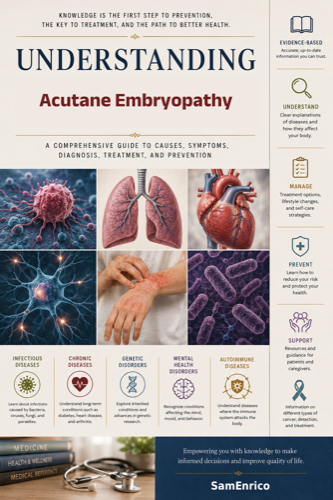
Understanding Acutane Embryopathy eBook
This disease publication, published by SamEnrico,
This disease publication, published by SamEnrico, covers Understanding Acutane Embryopathy
Formats
Free sample
Chapter 1: The Sledgehammer Paradox...--–- Annika was seventeen when she first looked in the mirror and didn't recognize herself. Not because her cystic acne had changed—it had been there for three years, a landscape of inflamed nodules across her cheeks, jawline, and upper back. No, what she didn't recognize was the exhaustion in her own eyes. She had tried everything: benzoyl peroxide washes that bleached her towels, topical retinoids that peeled her skin, oral antibiotics that upset her stomach, even two courses of a different pill her dermatologist promised would work. Nothing did.
On her worst days, she wore a hoodie in August. She skipped her senior prom. She told her mother she was fine, even though she spent hours watching videos of other people's skin clearing on social media, wondering why her body refused to cooperate.Annika's story is not unusual. It is, in fact, the story of hundreds of thousands of patients who have walked into dermatology clinics over the past four decades seeking relief from a condition that is far more than a cosmetic nuisance. Severe nodulocystic acne—the kind that leaves permanent scars, creates sinus tracts beneath the skin, and can cause psychological devastation—is a disease with real physical and emotional consequences.
And for patients like Annika, there is only one medication that reliably works.That medication is isotretinoin, sold under the brand name Accutane and several generics (Amnesteem, Claravis, Sotret). Since its approval by the U.S. Food and Drug Administration in 1982, isotretinoin has remained the undisputed gold standard for severe, treatment-resistant acne. A single four-to-six-month course achieves complete and durable remission in approximately 85% of patients. No other acne therapy comes close.
Not antibiotics, which lose efficacy as bacteria develop resistance. Not hormonal therapies, which work only for a subset of female patients. Not topical agents, which cannot penetrate deeply enough to treat nodular disease.But isotretinoin carries a dark secret, one that has haunted it since the first reports emerged just nine months after its release. When taken during pregnancy—specifically during the narrow window when a developing embryo is forming its face, heart, and brain—isotretinoin is one of the most potent human teratogens ever identified. It causes a recognizable pattern of birth defects known as Accutane embryopathy: microtia (small or absent ears), cleft palate, conotruncal heart defects, hydrocephalus, intellectual disability, and thymic anomalies, among others.
The risk following first-trimester exposure is approximately 25-30% for major malformations, with an additional 20-40% risk of spontaneous abortion.This is the Sledgehammer Paradox: isotretinoin is both irreplaceable and uniquely dangerous. It is a therapeutic sledgehammer that demolishes severe acne with remarkable precision while carrying the potential to cause catastrophic harm if used during a critical window of human development. Understanding both sides of this paradox—the extraordinary benefit and the extraordinary risk—is the essential first step toward comprehending Accutane embryopathy, the subject of this book.The Burden of Severe Nodulocystic Acne To understand why dermatologists continue to prescribe isotretinoin despite its risks, one must first understand the disease it treats. Severe nodulocystic acne is not the occasional pimple or even the persistent whiteheads that trouble many adolescents. It is a distinct clinical entity characterized by large (>5 mm), inflammatory nodules and cysts that involve the deep dermis and subcutaneous tissue.
These lesions are painful, they heal slowly, and when they finally resolve, they often leave behind permanent scars: atrophic ice-pick scars, rolling scars, and hypertrophic or keloidal scars that can distort normal skin architecture.The pathophysiology is complex. Acne vulgaris, in its simpler forms, involves four interrelated factors: increased sebum production, follicular hyperkeratinization (sticky skin cells that block pores), colonization by Cutibacterium acnes bacteria, and inflammation. In severe nodulocystic acne, all four factors are amplified. Sebaceous glands enlarge and produce excessive sebum under androgen stimulation. Follicular keratinocytes hyperproliferate and fail to shed normally, creating a dense plug that traps sebum and bacteria.
The follicle wall distends and eventually ruptures, spilling keratin, bacteria, and inflammatory mediators into the surrounding dermis. The result is a large, painful, deep nodule or cyst that can take weeks or months to resolve.The physical consequences of this process extend beyond immediate discomfort. Sinus tracts—abnormal channels connecting multiple cysts beneath the skin—can form, creating a network of interconnected lesions that are extraordinarily difficult to treat. These tracts may become chronically infected, leading to recurrent flares and persistent drainage. In extreme cases, patients develop acne conglobata, a severe form characterized by widespread nodulocystic lesions, sinuses, and abscesses that can affect the face, chest, back, buttocks, and thighs.But it is the psychosocial consequences that often exceed the physical burden.
The medical literature consistently demonstrates that patients with severe acne experience rates of depression, anxiety, and social isolation comparable to those seen in patients with chronic diseases like epilepsy, diabetes, or asthma. A landmark study published in the British Journal of Dermatology found that patients with acne had higher rates of suicidal ideation than control populations, independent of isotretinoin exposure—suggesting that the disease itself, not just its treatment, carries psychiatric risk.The mechanisms are intuitive. The face is central to social identity; visible skin disease invites unwanted attention, stares, and questions. Adolescents and young adults, the primary populations affected by severe acne, are already navigating the complex terrain of peer relationships, romantic partnerships, and professional identity formation. To carry severe acne through these years is to face daily microaggressions: the sales associate who avoids eye contact, the classmate who asks "what's wrong with your face," the internal voice that says no one will ever find you attractive.Patients report avoiding social situations, declining invitations, and withdrawing from activities they once enjoyed.
Some stop attending school. Others choose careers that minimize face-to-face interaction. Many describe a constant, exhausting hypervigilance—checking mirrors, avoiding bright light, positioning themselves to show their "good side." This is not vanity; it is a psychological adaptation to a visible chronic disease that society frequently dismisses as trivial.Against this backdrop of suffering, isotretinoin emerged as nothing short of revolutionary.The Mechanism of Isotretinoin: Why It Works So Well Isotretinoin (13-cis-retinoic acid) is a naturally occurring derivative of vitamin A. It belongs to the family of retinoids, compounds that regulate gene expression by binding to nuclear receptors—intracellular proteins that, when activated, directly influence which genes are transcribed. This is not a superficial intervention; isotretinoin reaches into the nucleus of cells and changes their fundamental behavior.The drug exerts its therapeutic effects through four primary mechanisms, each of which targets a different component of acne pathophysiology.First, and most fundamentally, isotretinoin profoundly suppresses sebum production.
Sebum is the oily substance produced by sebaceous glands that, in normal amounts, lubricates and protects the skin. In acne, excess sebum provides a nutrient-rich environment for C. acnes and contributes to follicular obstruction. Isotretinoin reduces sebum production by up to 90% within the first four to six weeks of therapy. This effect is dose-dependent and mediated by retinoid-induced apoptosis (programmed cell death) of sebaceous gland cells—the same pathway that, when activated in embryonic neural crest cells, causes Accutane embryopathy.
In the adult sebaceous gland, this apoptosis is therapeutic; in the developing embryo, it is catastrophic. The same molecular mechanism, acting…
This is the end of the free sample. Get the eBook to keep going. Buy now
About this book
Details
- Author
- Lefebvre Rosamaria
- Publisher
- SamEnrico
- Language
- English
- Genre
- Non-Fiction, Informative, Educational
- Released
- 2026-05-11
- Pages (approx.)
- 153
- Available as
- eBook, Audiobook

Read better in the ZLOADR app
Your eBooks on your phone or tablet. Sign in with your SamEnrico account and start reading.
More by Lefebvre Rosamaria
 Dream Journal For Trauma ProcessingLefebvre Rosamaria$11.99
 The Kanpur Massacre HistoryLefebvre Rosamaria$11.99
 Tall Body Esteem GuideLefebvre Rosamaria$11.99
 Engineering Design Thinking GuideLefebvre Rosamaria$11.99
 AI Deck Accessibility GuideLefebvre Rosamaria$11.99
 Recall Software Evaluation GuideLefebvre Rosamaria$11.99
 High Blood Pressure MetabolicLefebvre Rosamaria$11.99
 Croatian Green Hydrogen PotentialLefebvre Rosamaria$11.99
 The Last Shot: How a Vaccine Stopped a PandemicLefebvre Rosamaria$11.99
 Moving House DreamsLefebvre Rosamaria$11.99
 The Last Dive of the *Ming*Lefebvre Rosamaria$11.99
 Blood and Ink: The Last Stand of the Kelmendi WarriorsLefebvre Rosamaria$11.99
You may also like
 Hong Kong Handover 1997Dunn Johnnie$11.99
 Zumba For Postnatal Recovery CourseNeal Christian$11.99
 Zumba for BeginnersLadner Nikia$11.99
 YouTube Comment Mining GuideHumes Pandora$12.99
 Worry Box MeditationCarlin Rudy$11.99
 Workplace Stress MeditationNguyen Lynn$11.99
 Workplace Stress and Sleep RepairHawley Ivory$11.99
 Workplace Perfectionism CureDelaney Jeffry$11.99
 Workplace Injustice Anger GuideWallen Isabelle$11.99
 Work Addiction and Burnout LinkGreenwood Ester$11.99
 Women in Yoga and WellnessBeattie Galina$11.99
 Women in Stand Up ComedyChun Evangeline$11.99