
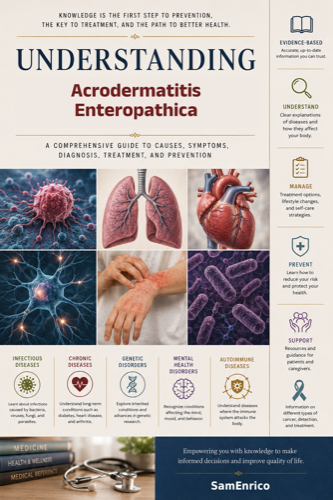
Non-FictionInformativeEducational
Understanding Acrodermatitis Enteropathica eBook
This disease publication, published by SamEnrico,
This disease publication, published by SamEnrico, covers Understanding Acrodermatitis Enteropathica
Formats
Free sample
Chapter 1: The Dying Children--–- In the winter of 1936, a Swedish physician named Dr. Tore Brandt sat across from a mother whose infant had become a medical ghost. The child, once plump and alert, now weighed less than a newborn. His skin had transformed into a weeping, crusted mask around his mouth and eyes. His hands and feet were covered in thick, psoriasiform plaques that cracked and bled with the slightest movement.
His hair had fallen out in clumps, leaving a bald, scaly scalp. His diaper area was a raw, fiery red that defied every barrier cream and antifungal ointment in the hospital’s pharmacy. And his diarrhea—relentless, foul, and voluminous—had reduced him to a skeleton wrapped in inflamed tissue. The mother had already consulted three other physicians. Each had offered a different diagnosis: severe atopic dermatitis, systemic candidiasis, a mysterious metabolic disorder with no name and no treatment.
Each had offered the same prognosis: prepare for the worst.Dr. Brandt had nothing new to offer. The standard therapies of the era—topical boric acid, intravenous fluids, dietary modifications—had failed before he even prescribed them. He watched the infant decline over weeks, then days, then hours. And then, almost as an afterthought, he tried something that made no sense based on the medical knowledge of the time.
He administered oral zinc, a common mineral typically relegated to the treatment of slow-healing wounds and the prevention of growth retardation in malnourished children. There was no theoretical basis for this intervention. No randomized trial. No FDA approval—the agency did not yet exist. There was only desperation and the faint hope that a cheap, harmless supplement might do something, anything, to interrupt the inexorable march toward death.The response was not a gradual improvement.
It was a resurrection.Within forty-eight hours, the diarrhea slowed from a torrent to a trickle. Within seventy-two hours, the weeping skin began to dry. Within one week, the infant who had been given weeks to live was sitting up, reaching for his mother, and demanding food. The rash faded from angry red to pink to normal. Hair began to regrow in fine, colorless wisps that would soon thicken into a full head of hair.
The child who had been preparing to die began, unmistakably, to live.Dr. Brandt published his case report in 1936, describing what he called "acrodermatitis enteropathica"—a name derived from the Greek acroderma (skin of the extremities), the Latin enterica (relating to the intestines), and the Greek pathos (suffering). He did not know why zinc worked. He did not know that he had just described the first treatable genetic disorder of trace element metabolism. He only knew that he had watched a child return from the edge of oblivion, and that the key to that return was a white powder that cost pennies per dose.The Disease Without a Name Before Brandt’s discovery, acrodermatitis enteropathica was a death sentence.
The medical literature of the nineteenth and early twentieth centuries contains scattered descriptions of infants with a peculiar constellation of symptoms: periorificial and acral dermatitis, alopecia, and chronic diarrhea. But these cases were considered curiosities—variant presentations of more common disorders like celiac disease, cystic fibrosis, or severe combined immunodeficiency. Autopsy reports from the era describe emaciated infants with thymic atrophy, fatty livers, and extensive skin ulcerations. The cause of death was typically listed as "marasmus" or "gastroenteritis," vague terms that reflected the depth of physicians’ ignorance.The true burden of the disease is impossible to reconstruct. Without a name, without a diagnostic test, and without any effective treatment, most affected infants died before their first birthday.
Those who survived longer—often children with milder, later-onset forms—were condemned to a life of chronic illness: persistent skin rashes that came and went without explanation, intermittent diarrhea that stunted growth, hair that grew in patches or not at all, and a susceptibility to infections that seemed almost superstitious. These children were labeled "difficult," "sickly," or simply "unlucky." Their parents were told to try different formulas, different creams, different prayers.The second critical observation came six years after Brandt’s report, when Dr. Christian Danbolt and Dr. Kloss in Norway independently described a series of children with the same triad of symptoms. They confirmed Brandt’s finding that oral zinc produced miraculous recoveries, and they added an epidemiological observation that would prove crucial decades later: the disease was far more common in Norway than anywhere else in the world.
In the isolated coastal villages of southern Norway, the incidence of AE approached 1 in 40,000 live births—ten to twenty times higher than the global average. This geographic clustering suggested a genetic cause, though the specific gene would remain hidden for another sixty years.The Danbolt and Closs paper also introduced the name that would stick: acrodermatitis enteropathica. The name was descriptive but incomplete. It captured the skin and the gut but missed the alopecia, the immune dysfunction, the neurological symptoms, and the fundamental metabolic disruption at the disease’s core. Yet the name persisted, a linguistic fossil from an era when physicians classified diseases by what they could see rather than by what they understood.The Pre-Zinc Era: A Dark Age of Misdiagnosis Imagine, for a moment, the experience of a family with an affected child in the 1950s, before zinc therapy became standard.
The child is born healthy, full-term, apparently normal. For the first few months of life—often as long as the child is exclusively breastfed—there are no obvious problems. The infant feeds well, gains weight, meets developmental milestones. Then comes weaning. The mother introduces cow’s milk formula or solid foods, and within two to four weeks, the world collapses.The first sign is often a rash around the mouth.
It looks like severe diaper rash but spreads upward, encircling the lips like a crimson necklace. The parents apply over-the-counter hydrocortisone. It does nothing. They try antifungal creams. The rash worsens.
They switch formulas, thinking the child has a milk allergy. The diarrhea begins—not the mild, self-limited diarrhea of a viral illness, but a relentless, watery, foul-smelling diarrhea that soaks through diapers within hours of changing them. The child stops gaining weight. Then the child starts losing weight.The parents take the child to a pediatrician, who runs standard tests: complete blood count, basic metabolic panel, stool cultures. Everything is normal or nonspecific.
The pediatrician refers to a dermatologist, who biopsies the skin and sees changes consistent with "psoriasiform dermatitis" or "candidal intertrigo." The dermatologist prescribes stronger steroids. The rash improves transiently, then returns with vengeance, this time spreading to the hands, feet, elbows, and knees. The child’s hair begins to fall out. The eyebrows and eyelashes follow.By six months of age, the child is a shadow of the infant born less than a year earlier. The family has seen five specialists.
The medical bills have bankrupted them. The child is hospitalized for failure to thrive, for sepsis from infected skin, for dehydration from diarrhea that will not stop. The physicians discuss rare metabolic disorders: biotinidase deficiency, cystic fibrosis, Hartnup disease. They run tests for each. The results are normal.
The child dies. The death certificate reads "sudden infant death syndrome" or "complications of malnutrition" or, most devastatingly, "unknown causes."This…
This is the end of the free sample. Get the eBook to keep going. Buy now
About this book
Details
- Author
- Thibodeau Bradly
- Publisher
- SamEnrico
- Language
- English
- Genre
- Non-Fiction, Informative, Educational
- Released
- 2026-05-07
- Pages (approx.)
- 158
- Available as
- eBook, Audiobook

Read better in the ZLOADR app
Your eBooks on your phone or tablet. Sign in with your SamEnrico account and start reading.
More by Thibodeau Bradly
 WhatsApp Business AutomationThibodeau Bradly$11.99
 Beautiful AI Templates GuideThibodeau Bradly$11.99
 The Thirty Day Beginner ChallengeThibodeau Bradly$11.99
 The Nun Who Fasted for PeaceThibodeau Bradly$11.99
 Strength Training For Back PainThibodeau Bradly$11.99
 Assertiveness For Job SeekersThibodeau Bradly$11.99
 Appetite Loss Before DeathThibodeau Bradly$11.99
 Growing Up in a Trailer ParkThibodeau Bradly$11.99
 Nightmare and Heart DiseaseThibodeau Bradly$11.99
 Apple Product Launch FeverThibodeau Bradly$11.99
 The Iron Spine of Europe: The Visionaries Behind the Suez and Panama CanalsThibodeau Bradly$11.99
 Frozen in Time: The Lost Expedition of the *USS Polar Star*Thibodeau Bradly$11.99
You may also like
 Hong Kong Handover 1997Dunn Johnnie$11.99
 Zumba For Postnatal Recovery CourseNeal Christian$11.99
 Zumba for BeginnersLadner Nikia$11.99
 YouTube Comment Mining GuideHumes Pandora$12.99
 Worry Box MeditationCarlin Rudy$11.99
 Workplace Stress MeditationNguyen Lynn$11.99
 Workplace Stress and Sleep RepairHawley Ivory$11.99
 Workplace Perfectionism CureDelaney Jeffry$11.99
 Workplace Injustice Anger GuideWallen Isabelle$11.99
 Work Addiction and Burnout LinkGreenwood Ester$11.99
 Women in Yoga and WellnessBeattie Galina$11.99
 Women in Stand Up ComedyChun Evangeline$11.99