
Non-FictionInformativeEducational
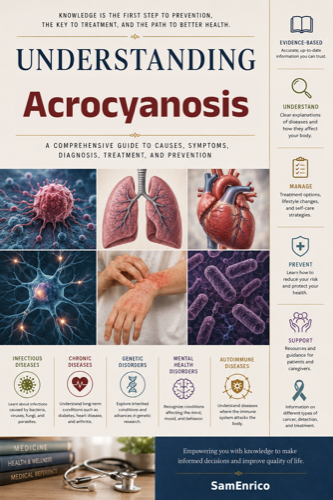
Understanding Acrocyanosis eBook
This disease publication, published by SamEnrico,
This disease publication, published by SamEnrico, covers Understanding Acrocyanosis
Formats
Free sample
Chapter 1: The Persistent Blue...--–- The first time a doctor told Elena that her blue hands were “probably just anxiety,” she laughed. Not because she found it funny, but because she had just spent fifteen minutes explaining, very calmly, that she was not an anxious person. She was a thirty-four-year-old architect who designed earthquake-resistant bridges. She did not have panic attacks. She did not bite her nails.
She did not worry about things that had not happened yet. She worried about things that had already happened and were still happening—like the fact that her fingers had been the color of a faded bruise for as long as she could remember.The doctor—a well-meaning young resident in the dermatology clinic—glanced at her hands, then at her chart, then back at her hands. “It’s probably just a benign vasomotor phenomenon,” he said, which Elena later learned was medical shorthand for “we don’t know what it is but it’s probably not killing you.” He suggested she try taking a warm bath before bed and avoid “emotional triggers.” He did not look at her hands through a dermatoscope. He did not check her pulses. He did not ask whether the discoloration was worse in the winter or whether anyone else in her family had similar symptoms.
He typed a few words into the electronic medical record—she later requested a copy and saw the words “acrocyanosis? rule out Raynaud’s”—and sent her on her way.Elena left the clinic that day with more questions than answers. What was a vasomotor phenomenon? Was it the same as Raynaud’s? If it was benign, why did her hands feel so cold all the time?
And why did no one seem to take it seriously?She spent the next six months becoming an accidental expert. She read every medical journal article she could find—some of them behind paywalls that she circumvented through a friend with university library access. She joined online patient forums where people posted photographs of hands that looked exactly like hers. She learned words like “acral,” “cyanosis,” “vasospasm,” and “nailfold capillaroscopy.” She learned that there was a condition called acrocyanosis that matched her symptoms perfectly: persistent, painless, symmetrical bluish discoloration of the hands, caused by the narrowing of tiny arteries in the skin. She learned that it was most common in young women, that it often began in adolescence, and that it was considered entirely benign.She also learned—and this was the part that frustrated her most—that almost nothing was known about why it happened.
The medical literature on acrocyanosis was sparse. The most comprehensive review article she found was from 2011, more than a decade old. No large clinical trials had been conducted. No medications were approved specifically for acrocyanosis. The condition was, in the words of one textbook, “a clinical curiosity with no known treatment and no significant consequences.”No significant consequences.
Elena thought about those words every time she shook someone’s hand at a professional conference and watched their eyes flick down to her purple fingers. Every time she went on a date and had to decide whether to mention her “weird hands” or just hope her companion didn’t notice. Every time she stood in front of a bathroom mirror, holding her hands under warm water, watching the blue fade slightly but never disappear, wondering if anyone else in the world understood what it felt like to be trapped in a body that looked different for no reason at all.She decided, finally, to write the book she wished already existed. Not a medical textbook—there were already plenty of those, buried in university libraries, gathering dust. But a book for patients.
A book that took the scattered, fragmented, sometimes contradictory information about acrocyanosis and wove it into something clear, useful, and kind. A book that started with the story of a woman with blue hands and ended with practical tools for living well despite them.This is that book.The Patient Who Changed Everything Before we go any further, I want to tell you about a patient I will call Maya. Maya was twenty-seven years old when she first came to my attention—not because I am a doctor (I am not), but because her story appears in dozens of patient forums, reposted and shared by people who felt seen for the first time. Maya had been diagnosed with Raynaud’s phenomenon at age sixteen, after a rheumatologist took one look at her blue hands and wrote a prescription for nifedipine, a medication that relaxes blood vessels. The nifedipine gave her headaches and made her ankles swell, so she stopped taking it after two months.
Her hands remained blue. The rheumatologist shrugged and said, “Some people just have poor circulation.”For the next eleven years, Maya believed her blue hands were a mild, untreatable, slightly embarrassing quirk. She learned to live with the questions, the stares, the well-meaning suggestions (“Have you tried drinking more water?” “Maybe you need more iron.” “My aunt has something like that—she wears compression gloves.”). She built a career as a graphic designer, which meant she spent her days at a computer, her blue fingers clicking and typing, always visible, always there.Then, at twenty-seven, she developed joint pain. It started in her hands—the same hands that were already blue—and spread to her wrists, her knees, her ankles.
She woke up stiff in the morning, unable to make a fist for the first thirty minutes after getting out of bed. She developed a butterfly-shaped rash on her face. Her hair began falling out in clumps.A new rheumatologist—more experienced than the one she had seen at sixteen—ran a battery of blood tests. The results came back positive for antinuclear antibodies, anti-ds DNA antibodies, and low complement levels. The diagnosis was systemic lupus erythematosus, a chronic autoimmune disease that can affect almost any organ system in the body.And here is the part that matters for our story: Maya’s blue hands were not just “poor circulation.” They were not primary acrocyanosis—the benign, idiopathic form of the condition that most patients have.
They were secondary acrocyanosis caused by undiagnosed lupus. The vasospasm, the discoloration, the persistent coldness—all of it was a clue pointing to an underlying disease that had gone untreated for eleven years.Maya is doing well now. Her lupus is managed with hydroxychloroquine and careful monitoring. Her joint pain has improved. Her hair has grown back.
And her hands are still blue—because even with optimal treatment of her lupus, the acrocyanosis has persisted. She likely has two separate conditions: secondary acrocyanosis triggered by lupus, plus primary acrocyanosis that is now independent of her autoimmune disease. The distinction is subtle but important. Treating the lupus improved her pain and fatigue, but it did not cure the blue hands. Those, she has learned to live with.Maya’s story illustrates the most important distinction in this entire book: the difference between primary acrocyanosis (benign, idiopathic, not dangerous) and secondary acrocyanosis (a symptom of an underlying condition that may require treatment).
Most patients have the primary form. But some—like Maya—have the secondary form, and for those patients, the blue hands are…
This is the end of the free sample. Get the eBook to keep going. Buy now
About this book
Details
- Author
- Vetter Samara
- Publisher
- SamEnrico
- Language
- English
- Genre
- Non-Fiction, Informative, Educational
- Released
- 2026-05-09
- Pages (approx.)
- 155
- Available as
- eBook, Audiobook

Read better in the ZLOADR app
Your eBooks on your phone or tablet. Sign in with your SamEnrico account and start reading.
More by Vetter Samara
 Morning Mindfulness Start GuideVetter Samara$11.99
 Independence Self Esteem CoupleVetter Samara$11.99
 ChatGPT Slide Deck MasteryVetter Samara$11.99
 AA Anniversary GuideVetter Samara$11.99
 Assertiveness For NeurodivergentsVetter Samara$11.99
 Netherlands Spanish Fury Massacre CourseVetter Samara$11.99
 Self Care for Anticipatory GriefVetter Samara$11.99
 Nike Sneaker Drop CultureVetter Samara$11.99
 The Red and White Plague: England's Bloody Feud Over Power and PoisonVetter Samara$11.99
 Lost in the Deep: The Mystery of the Titanic's Last SurvivorsVetter Samara$11.99
 The Grand Illusion: How a 19th-Century Hotelier Built a Global Empire on Secrets and SmokeVetter Samara$11.99
 Wellness Brand Content with AI PromptsVetter Samara$11.99
You may also like
 Hong Kong Handover 1997Dunn Johnnie$11.99
 Zumba For Postnatal Recovery CourseNeal Christian$11.99
 Zumba for BeginnersLadner Nikia$11.99
 YouTube Comment Mining GuideHumes Pandora$12.99
 Worry Box MeditationCarlin Rudy$11.99
 Workplace Stress MeditationNguyen Lynn$11.99
 Workplace Stress and Sleep RepairHawley Ivory$11.99
 Workplace Perfectionism CureDelaney Jeffry$11.99
 Workplace Injustice Anger GuideWallen Isabelle$11.99
 Work Addiction and Burnout LinkGreenwood Ester$11.99
 Women in Yoga and WellnessBeattie Galina$11.99
 Women in Stand Up ComedyChun Evangeline$11.99