
Non-FictionInformativeEducational
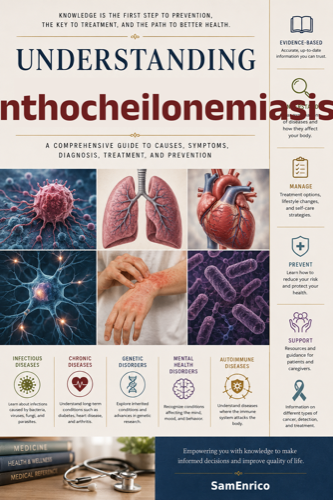
Understanding Acanthocheilonemiasis eBook
This disease publication, published by SamEnrico,
by Cutler Lura
This disease publication, published by SamEnrico, covers Understanding Acanthocheilonemiasis
Formats
Free sample
Chapter 1: The Silent Stowaway...--The farmer from the village of Ikela had not slept properly in three years. Night after night, just as the cooking fires died down and the forest sounds swelled, an unbearable itching would begin—first in the webs of his fingers, then spreading up his arms, across his chest, down his legs. He would scratch until his skin bled, then scratch some more. His wife had long since moved to a separate mat. His neighbors whispered that he had been cursed.
The clinic nurse had given him antihistamines, then scabies cream, then a referral to a traditional healer. Nothing worked. When he finally made the two-day journey to the provincial hospital, his eosinophil count came back at 8,200 cells per microliter—a number so high that the lab technician ran the test twice, certain it was an error. It was not an error. It was the first clue that this man was host to a stowaway: a thread-like worm called Mansonella perstans, invisible to the naked eye but capable of turning a farmer's life into a decade-long ordeal of exhaustion, swelling, and despair.
This is the story of that stowaway—and of the 114 million people who carry it without knowing.The Most Successful Parasite You Have Never Heard Of What makes a parasite successful? By the cold metrics of evolutionary biology, success means transmission: the ability to move from one host to another, generation after generation, without killing so many hosts that you run out of new bodies to infect. By that measure, Mansonella perstans is one of the most successful human parasites on Earth. It has colonized 33 countries across sub-Saharan Africa, from Senegal to Zimbabwe, and established beachheads in six South American nations, including Brazil, Colombia, and Venezuela. In some villages along the Congo River, nearly every adult over the age of forty carries the parasite.
And yet, ask a medical student in London, Boston, or Sydney what they know about Mansonella perstans, and you will likely receive a blank stare. Ask a global health policymaker in Geneva why there is no eradication program for this infection, and you will receive an uncomfortable silence. Success, for a parasite, does not always translate into recognition.Acanthocheilonemiasis—the disease caused by Mansonella perstans—is the great neglected tropical disease (NTD) of our time. The numbers are staggering: 114 million people infected, a burden comparable to that of lymphatic filariasis (elephantiasis) or onchocerciasis (river blindness). Yet while those diseases command hundreds of millions of dollars in annual funding, dedicated research networks, and WHO-backed elimination campaigns, Acanthocheilonemiasis languishes in obscurity.
It is a disease without a lobby, without a celebrity spokesperson, without a colored ribbon. It is also a disease that can ruin lives—not through dramatic death, but through the slow, grinding erosion of health, energy, and dignity that comes from carrying a chronic parasitic infection for decades.This chapter introduces the stowaway. We will explore what Acanthocheilonemiasis is, how it came to have such a bewildering array of names, and why understanding its biology is the first step toward ending its neglect. We will meet the three Mansonella species that infect humans and learn to distinguish them—a skill that can mean the difference between effective treatment and wasted months of failed therapy. We will follow the parasite through its life cycle, from the nearly invisible bite of a Culicoides midge to the decade-long residence of adult worms in the body's hidden cavities.
And we will begin to understand why this infection has flown under the radar for so long—and why the time has come to drag it into the light.A Disease by Any Other Name: The Problem of Taxonomy One reason Acanthocheilonemiasis remains poorly known is that it cannot seem to settle on a name. Open a textbook from 1950, and you will find references to Dipetalonema perstans causing "dipetalonemiasis." Open a textbook from 1990, and you will find Acanthocheilonema perstans causing "acanthocheilonemiasis." Open a modern parasitology reference, and you will likely see Mansonella perstans causing "mansonellosis." These are not different diseases. They are the same parasite, shunted between genera as taxonomists refined their understanding of filarial nematode relationships. The confusion is compounded by the fact that two related species—M. streptocerca and M.
ozzardi—cause similar but distinct clinical syndromes, and all three are sometimes lumped together as "mansonellosis."This book uses Acanthocheilonemiasis as its primary term for infection with Mansonella perstans, while acknowledging that the broader literature uses multiple synonyms. Why stick with such a mouthful? Because precision matters. When a clinician in a travel medicine clinic sees a patient with eosinophilia and angioedema after a trip to Cameroon, they need to know that M. perstans is on the differential—and that it behaves differently from Loa loa or Onchocerca volvulus.
When a researcher designs a drug trial, they need to distinguish M. perstans from M. ozzardi, because the latter responds to ivermectin while the former does not. And when a public health official plans a mass drug administration campaign, they need to know that a program designed for river blindness will have no impact on M. perstans.
Names are not merely labels; they are guides to action.The taxonomic journey of this parasite began in 1890, when Sir Patrick Manson—the same Manson for whom the genus is now named—examined blood from a sailor who had returned from West Africa. Manson saw microfilariae that did not match Wuchereria bancrofti, the only filarial worm then known to infect humans. He called it Filaria sanguinis hominis minor. Over the next century, it would be reclassified multiple times as scientists debated its relationship to other filariae. The current consensus, supported by molecular phylogenetic evidence, places M.
perstans within a clade that includes M. streptocerca and M. ozzardi, distinct from the Wuchereria and Brugia species that cause lymphatic filariasis. This genetic separation is not an academic curiosity; it explains why drugs that work beautifully against W. bancrofti fail against M.
perstans.The Three Sisters: Distinguishing the Mansonella Species Human mansonellosis comes in three flavors, each caused by a different species of Mansonella. Knowing which flavor you are dealing with is the difference between a correct diagnosis and a costly misdiagnosis.Mansonella perstans is the protagonist of this book. It is found across sub-Saharan Africa and in northern South America. Its adult worms reside in the serous cavities—the pleural space around the lungs, the pericardial sac around the heart, and the peritoneal cavity of the abdomen. Its unsheathed microfilariae circulate in the blood with no periodicity, meaning a blood sample drawn at 2:00 AM is just as likely to be positive as one drawn at 2:00 PM.
Clinical manifestations range from asymptomatic carriage (the most common presentation in endemic populations) to a debilitating syndrome of angioedema, pruritus, fatigue, and serositis. Treatment of choice: doxycycline, targeting the Wolbachia endosymbionts that the worm depends upon for fertility and survival.Mansonella streptocerca is the cutaneous sister. Restricted to the rainforest belt of Central and West Africa, this species lives in the dermis rather than the body cavities. Its microfilariae are found in skin snips, not blood. Infection presents with chronic, intensely itchy dermatitis, often affecting the upper trunk, shoulders, and arms.
Over time, hypopigmented macules may develop, creating a appearance that can be mistaken for leprosy or the early stages of…
This is the end of the free sample. Get the eBook to keep going. Buy now
About this book
Details
- Author
- Cutler Lura
- Publisher
- SamEnrico
- Language
- English
- Genre
- Non-Fiction, Informative, Educational
- Released
- 2026-05-08
- Pages (approx.)
- 147
- Available as
- eBook, Audiobook

Read better in the ZLOADR app
Your eBooks on your phone or tablet. Sign in with your SamEnrico account and start reading.
More by Cutler Lura
 The Nun's Ordination StruggleCutler Lura$11.99
 The Trailer Park on Hill StreetCutler Lura$11.99
 Online AA Meeting GuideCutler Lura$11.99
 Ransomware Customer NotificationCutler Lura$11.99
 Elimination Diet GuideCutler Lura$11.99
 TM for Caregivers GuideCutler Lura$11.99
 IT Support BurnoutCutler Lura$11.99
 Counter Reformation Baroque Art WeaponCutler Lura$11.99
 The Iron Lady of Industry: The Extraordinary Life of Emily RoeblingCutler Lura$11.99
 Quarterly Time Block PlanningCutler Lura$12.99
 George ShultzCutler Lura$11.99
 Echoes of the Forgotten: The Lost Tapes of the 1969 Moon LandingCutler Lura$11.99
You may also like
 Hong Kong Handover 1997Dunn Johnnie$11.99
 Zumba For Postnatal Recovery CourseNeal Christian$11.99
 Zumba for BeginnersLadner Nikia$11.99
 YouTube Comment Mining GuideHumes Pandora$12.99
 Worry Box MeditationCarlin Rudy$11.99
 Workplace Stress MeditationNguyen Lynn$11.99
 Workplace Stress and Sleep RepairHawley Ivory$11.99
 Workplace Perfectionism CureDelaney Jeffry$11.99
 Workplace Injustice Anger GuideWallen Isabelle$11.99
 Work Addiction and Burnout LinkGreenwood Ester$11.99
 Women in Yoga and WellnessBeattie Galina$11.99
 Women in Stand Up ComedyChun Evangeline$11.99