
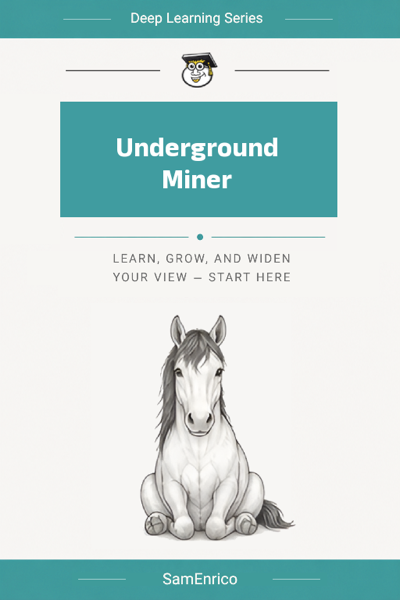
Non-FictionInformativeEducational
Underground Miner eBook
A Coursebook on Underground Miner
by Herman Adele
A Coursebook on Underground Miner
Formats
Free sample
Chapter 1: The $10,000 Rock...--Every day, somewhere in the world, a miner breaks a piece of rock that is worth more than his monthly paycheck. This is not an exaggeration. A single ton of high-grade gold ore can contain $50,000 or more of the metal. A ton of waste rock from the same stope – the three-dimensional excavation where ore is removed – contains nothing but crushing cost. The only difference between profit and bankruptcy, between a bonus and a layoff, is the miner’s ability to tell one rock from the other and to extract it without mixing in the worthless material around it.This book exists because that distinction matters.
It matters to the electric vehicle revolution that needs copper and lithium. It matters to the construction of every building that requires steel from iron ore. It matters to the miner who wants to go home with both lungs intact and both hands attached. Underground mining is not a romantic profession – it is dark, loud, wet, hot, cold, and dangerous. But it is also essential, well-compensated, and increasingly technological.
No green energy transition happens without underground miners. No modern city exists without the metals they extract. No military functions without the rare earth elements that come from deep rock.If you are reading this book, you are likely one of three people: a new miner entering an apprenticeship program, a mining engineering student who needs practical knowledge that textbooks omit, or a career switcher from heavy industry or military engineering who wants to understand what happens below the surface. You have chosen a profession that pays well – experienced underground miners in unionized operations earn 80,000to80,000 to 80,000to120,000 annually, plus benefits and bonuses tied to production and safety. But you have also chosen a profession with a steep learning curve.
The first year underground has the highest injury rate of any mining career stage. Most fatalities occur to miners with less than three years of experience. This book aims to shorten that curve and flatten that risk.Why Underground Mining Still Exists The first question any sensible person asks is: why go underground at all? Surface mining is cheaper, safer, and easier to manage. Surface mines can move hundreds of thousands of tons per day using shovels the size of a house and trucks that cost five million dollars each.
So why does anyone dig a hole, sink a shaft, and crawl into the dark?The answer is economic cut-off grade. A cut-off grade is the minimum concentration of metal or mineral in a rock that makes it profitable to extract. For copper, the cut-off grade might be 0.3 percent – meaning 99.7 percent of the rock is waste. For gold, the cut-off grade might be as low as 1 gram per ton – meaning the gold is barely visible even under a microscope. Surface mines can profitably extract rock at these low grades because they move enormous volumes cheaply.
But surface deposits get exhausted. When the easy rock is gone, the ore body continues downward. At some depth, stripping away the overlying waste rock becomes more expensive than going underground. That depth is different for every mine, but it is typically between 100 and 300 meters for most metals.Once a mine goes underground, it stays underground as long as the ore body remains and the metal price justifies extraction. Some mines have operated continuously for over a century – the Kiruna iron ore mine in Sweden has been underground since 1900 and now reaches depths of over 1,500 meters.
The Lucky Friday silver mine in Idaho has produced ore from depths exceeding 2,000 meters. The deepest mines in the world, the gold mines of South Africa’s Witwatersrand region, extend nearly 4,000 meters below surface – deep enough that the rock temperature at the face exceeds 50 degrees Celsius (120 degrees Fahrenheit), requiring massive refrigeration plants just to keep miners alive.So underground mining persists because that is where the remaining metal lives. It is not a choice. It is an economic necessity.The Language of the Underground Before you can work underground, you must speak the language. The vocabulary of mining is precise because confusion kills.
A miscommunication about a shaft versus a raise can send a crew to the wrong location. A misunderstanding about a stope versus a drift can result in a miner walking into an unsupported void. Learn these terms now. Review them until they become automatic.A shaft is a vertical or steeply inclined excavation that connects the surface to underground levels. Shafts are used primarily for hoisting – lifting ore, personnel, equipment, and supplies.
A typical production shaft is three to eight meters in diameter and can be sunk to depths exceeding 2,000 meters. Shafts are expensive; a new shaft can cost $100 million or more and take three to five years to complete.A decline, also called a ramp, is a sloping tunnel that allows wheeled vehicles to drive in and out. Declines are cheaper than shafts to develop but more expensive to operate over long distances because trucks consume fuel and tires. A typical decline gradient is between 10 and 15 percent – meaning for every 100 meters of horizontal distance, you drop 10 to 15 meters vertically. Steeper than 15 percent, and trucks struggle to brake and climb.
Shallow declines require more total length to reach depth.An adit is a horizontal tunnel driven into a hillside from the side of a mountain. Adits are the cheapest access method because they require no hoisting and minimal pumping – water drains out naturally. Many historic mines were developed entirely by adits driven into hillsides at successive elevations. The Chuquicamata copper mine in Chile, now a surface mine, began as a series of adits driven by indigenous miners centuries before European arrival.A level is a horizontal working horizon, typically spaced every 30 to 100 meters vertically. Levels connect to the shaft or decline and provide access to the stopes where ore is extracted.
Each level has a name or number – Level 100, Level 200, Level 500, or more descriptive names reflecting local geology or mining history. Levels are connected by raises (vertical openings between levels) and winzes (vertical openings from a level down to the next level).A stope is the three-dimensional excavation where ore is removed. Stopecan be large or small, depending on the mining method. A room-and-pillar stope might be 10 meters wide by 30 meters long. A sublevel stopecan be 100 meters tall and 200 meters along strike.
A block caving stope can be hundreds of meters in each dimension – essentially the entire mine becomes a stope. The boundary of the stope is defined by the ore body itself. When you are in a stope, you are inside the ore.A face is the active working end of any excavation – the place where drilling, blasting, or cutting is happening at this moment. The face moves forward as the excavation advances. In development drifting, the face is the end of the tunnel.
In production stoping, the face is the vertical or inclined surface of the ore body being blasted.Hard Rock Versus Soft Rock – A Critical Distinction The mining world divides into two broad categories: hard rock and soft rock. This distinction affects everything – the equipment used, the safety systems required, the training you receive, and the hazards you face.Hard rock mining applies to metals…
This is the end of the free sample. Get the eBook to keep going. Buy now
About this book
Details
- Author
- Herman Adele
- Publisher
- SamEnrico
- Language
- English
- Genre
- Non-Fiction, Informative, Educational
- Released
- 2026-05-09
- Pages (approx.)
- 117
- Available as
- eBook, Audiobook

Read better in the ZLOADR app
Your eBooks on your phone or tablet. Sign in with your SamEnrico account and start reading.
More by Herman Adele
 Mindful Sleep MBSR CourseHerman Adele$11.99
 The Mindful Eating MBSR GuideHerman Adele$11.99
 The European Skilled Migration OutlookHerman Adele$11.99
 Teen Self Esteem and AdoptionHerman Adele$11.99
 Ayurvedic Thyroid Health GuideHerman Adele$11.99
 Port Arthur: The Siege That Shook the TsarHerman Adele$11.99
 A Beginners Guide to Clue Jr.: Case of the Missing Pet (Volume 1)Herman Adele$11.99
 Brazil High Ticket DropshippingHerman Adele$12.99
 Incident Response AutomationHerman Adele$12.99
 Understanding MevalonicaciduriaHerman Adele$17.99
You may also like
 Hong Kong Handover 1997Dunn Johnnie$11.99
 Zumba For Postnatal Recovery CourseNeal Christian$11.99
 Zumba for BeginnersLadner Nikia$11.99
 YouTube Comment Mining GuideHumes Pandora$12.99
 Worry Box MeditationCarlin Rudy$11.99
 Workplace Stress MeditationNguyen Lynn$11.99
 Workplace Stress and Sleep RepairHawley Ivory$11.99
 Workplace Perfectionism CureDelaney Jeffry$11.99
 Workplace Injustice Anger GuideWallen Isabelle$11.99
 Work Addiction and Burnout LinkGreenwood Ester$11.99
 Women in Yoga and WellnessBeattie Galina$11.99
 Women in Stand Up ComedyChun Evangeline$11.99