
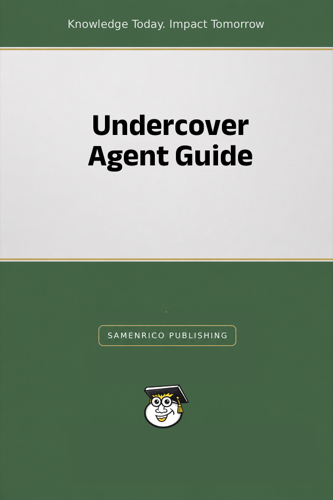
Undercover Agent Guide eBook
Maintain false identity without psychological brea
Maintain false identity without psychological breakdown.
Formats
Free sample
Chapter 1: The Honest Liar...--The first time you say your false name out loud, it feels like a rock in your mouth. Wrong shape. Wrong weight. Your tongue stumbles over the syllables. Your throat tightens around the vowel sounds.
You are aware, with every nerve ending, that you are lying.Six months later, you introduce yourself by that same name to a stranger, and you feel nothing at all. No hesitation. No internal flinch. The name comes out as smoothly as if you were born with it. And that is when the quiet terror begins—not because you lied, but because you no longer feel the lie.This is the paradox that sits at the heart of every undercover operation.
You cannot succeed without becoming someone else. But the moment you succeed, you have already begun to lose track of who you were. The very machinery that makes deep cover possible—the human brain’s astonishing ability to adapt, to believe, to become—is the same machinery that threatens to dissolve the agent into the role.Welcome to the first chapter of The Unbroken Agent. This book is not about surveillance techniques or dead drops. It is not a manual for building a legend or running a source.
Those skills are necessary, but they are also teachable. What no tradecraft manual prepares you for is this: the single greatest threat to an undercover agent is not the target, not the hostile surveillance team, not the moment of operational compromise. It is the slow, silent, utterly normal process by which your own mind forgets which story is true.We begin with a distinction that will carry us through all twelve chapters. It is the difference between two kinds of deception, and understanding it is the difference between coming home whole and never quite finding your way back.Two Kinds of Lies Everyone lies. That is not cynicism; it is neurology.
The average person tells one to two falsehoods per day, most of them trivial and social: “I’m fine,” “That looks great on you,” “I’ll call you tomorrow.” These are what we might call simple deceptions. They are situational, short-lived, and they do not require you to reorganize your sense of self. You know you are lying. The lie is a tool. You use it, and you put it down.Undercover work requires something else entirely.Let us call it identity dissociation.
This is not lying about a fact. It is lying about who you are. And unlike simple deception, identity dissociation does not sit on top of your personality like a coat. It rewires the architecture of the self. It builds a second set of memories, preferences, fears, and loyalties—a second person living inside the same skull, competing for the same neural real estate.Here is the neurological reality that keeps psychologists awake at night: the brain does not naturally distinguish between a real memory and a vividly imagined, repeatedly rehearsed false one.
When you run through your cover story for the hundredth time—your fake childhood, your fake first kiss, your fake reason for being in this city on this night—the same neural circuits fire as if the memory were real. The hippocampus does not check ID. The amygdala does not fact-check. The brain is not a court of law. It is a pattern-matching machine, and the pattern that fires most often becomes the pattern that feels true.This is not a design flaw.
It is the very mechanism that allows us to learn, to adapt, to survive. A child who falls off a bike does not need to remember the fall as “a fictional training exercise.” She needs to remember it as real—the scrape of pavement, the shock of impact, the sharp lesson. The brain consolidates vivid, repeated experiences into truth because that is how we learn not to make the same mistake twice.But the same mechanism that keeps a child safe on a bicycle can dismantle an undercover agent from the inside. Because the agent’s cover story is not a bicycle accident. It is a carefully constructed fiction, repeated thousands of times, until the brain accepts it as truth.
And once the brain accepts it, the agent begins to live inside a question that has no easy answer: Which one is really me?Identity Schema Theory: The Architecture of Self To understand how identity dissociation works, we need a map of how identity works at all. Psychologists use a framework called Identity Schema Theory, and it is worth spending a few minutes with it because it explains everything that follows.A schema is a mental structure—a framework of associations, memories, and expectations—that organizes how we perceive ourselves and the world. You have schemas for everything: how to order coffee, how to behave at a funeral, how to recognize a friend’s face. These schemas operate below conscious awareness. You do not wake up in the morning and think, “Today I will use my restaurant-ordering schema.” You just order.
The schema runs automatically.Your self-schema is the most important framework of all. It contains everything you believe about who you are: your name, your history, your values, your relationships, your fears, your hopes. It is not a single file folder. It is a vast, interconnected web of associations, each one tied to thousands of others. “My name” connects to “my mother’s face” connects to “my childhood home” connects to “the smell of rain on asphalt” connects to “the summer I learned to ride a bike.” A self-schema is not a list.
It is a world.Now imagine building a second self-schema alongside the first.This is what undercover training demands. You do not simply memorize a new name. You construct an entire alternative identity: parents, schools, injuries, accomplishments, failures, tastes, habits, political views, religious beliefs (or the strategic absence of them), fears, desires, and a thousand small preferences that make a person feel like a person. You rehearse this second self until it runs as automatically as the first. You tell its stories so many times that the neural pathways grow thick and myelinated—fast, efficient, invisible.And then you have two self-schemas, competing for the same brain.This is not multiple personality disorder, despite what Hollywood suggests.
That is a different phenomenon entirely, and we will address it in Chapter 9. What happens to undercover agents is more subtle and, in some ways, more disorienting. You do not switch between identities like flipping a light switch. You drift. Over time, the boundary between the two schemas becomes porous.
A memory from the cover story feels as real as a memory from your childhood. A preference you invented for operational reasons becomes a genuine preference. A fear you adopted to sell your legend becomes a fear that keeps you awake at night.And the original self-schema—the one with your real name, your real mother, your real childhood—begins to feel distant. Thin. Like a story you used to tell yourself before you learned the truth.The Undercover Paradox This brings us to the central tension of this book, and the reason most tradecraft manuals are dangerous in their silence.
Let us state it plainly:To succeed operationally, you must emotionally believe your cover story. To survive psychologically, you must cognitively…
This is the end of the free sample. Get the eBook to keep going. Buy now
About this book
Details
- Author
- Callier Annabel
- Publisher
- SamEnrico
- Language
- English
- Genre
- Non-Fiction, Self-Help, Espionage
- Released
- 2026-06-10
- Pages (approx.)
- 150
- Available as
- eBook, Audiobook

Read better in the ZLOADR app
Your eBooks on your phone or tablet. Sign in with your SamEnrico account and start reading.
More by Callier Annabel
 Military Police VeteransCallier Annabel$11.99
 The Church Basement DiscoveryCallier Annabel$11.99
 Spacecraft Mission Control StressCallier Annabel$11.99
 The Great Buenos Aires Gold Robbery: A Heist That Changed ArgentinaCallier Annabel$11.99
 Freemium Storage OptimizationCallier Annabel$12.99
 How to Produce Billiard Table LightsCallier Annabel$11.99
 Accounts Payable TechnicianCallier Annabel$11.99
 Ultimate Handbook Guide to Cockburn Town : (Turks and Caicos Islands) Travel GuideCallier Annabel$11.99
You may also like
 Hong Kong Handover 1997Dunn Johnnie$11.99
 Zumba For Postnatal Recovery CourseNeal Christian$11.99
 Zumba for BeginnersLadner Nikia$11.99
 YouTube Comment Mining GuideHumes Pandora$12.99
 Worry Box MeditationCarlin Rudy$11.99
 Workplace Stress MeditationNguyen Lynn$11.99
 Workplace Stress and Sleep RepairHawley Ivory$11.99
 Workplace Perfectionism CureDelaney Jeffry$11.99
 Workplace Injustice Anger GuideWallen Isabelle$11.99
 Work Addiction and Burnout LinkGreenwood Ester$11.99
 Women in Yoga and WellnessBeattie Galina$11.99
 Women in Stand Up ComedyChun Evangeline$11.99