
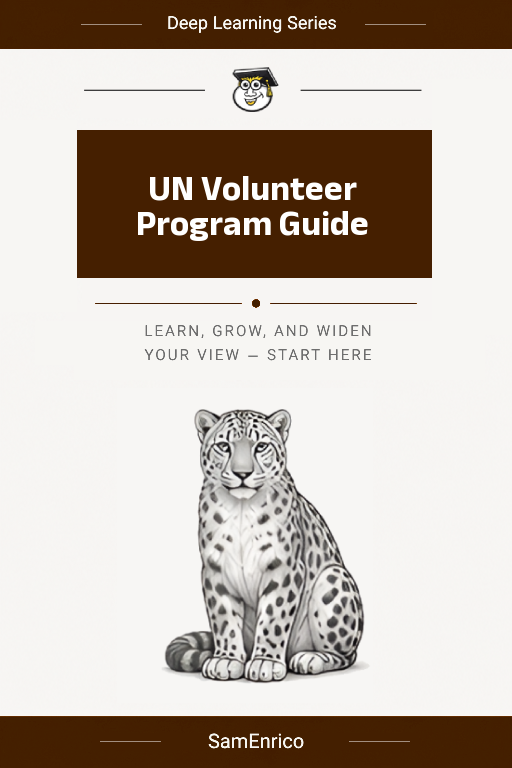
UN Volunteer Program Guide eBook
Serve as a UNV in developing countries as a pathwa
by Irvine Shyla
Serve as a UNV in developing countries as a pathway to UN staff roles.
Formats
Free sample
Chapter 1: The Rejection Pile--–- The email arrived at 11:47 on a Tuesday. You had been staring at your inbox for three hours, refreshing every twenty seconds, willing the universe to deliver something other than silence. When the notification finally pinged, your heart jumped into your throat. You opened it. "Thank you for your application to the Associate Programme Officer position.
After careful review..." You stopped reading. You already knew the rest. "We regret to inform you..." Another rejection. Number forty-seven. Forty-seven applications to the United Nations system.
Zero interviews. Zero explanations. Zero humanity.The problem was not your resume. You had a master's degree from a respectable university. You had two internships, one of them vaguely international.
You had volunteered for a non-profit that worked on something adjacent to development. You had tailored every cover letter. You had learned the difference between UNDP and UNFPA and UNHCR and UNODC. You had memorized the Sustainable Development Goals and could recite them in your sleep. None of it mattered.The problem was not your qualifications.
The problem was that you were playing a game whose rules had been written by people who were already inside. The United Nations receives approximately 400,000 applications every year for roughly 2,000 P-staff positions. That is a 0.5 percent acceptance rate. Harvard Law School accepts 12 percent of its applicants. Y Combinator accepts 1.5 percent of startup applications.
Getting a UN staff job is statistically harder than getting into the most selective law school in the world and harder than getting funded by the most competitive startup accelerator on the planet.And yet, every year, thousands of people do it. They are not all geniuses. They are not all connected to ambassadors or ministers. Many of them started exactly where you are now: staring at a rejection email, wondering what they did wrong, wondering if the dream was dead before it ever really began.This book exists because of one simple truth that the UN does not want you to know. The front door is a myth.
The public job postings, the Inspira portal, the endless competency-based assessments—these are designed to filter out, not to let in. The real pathway to a UN career is hidden in plain sight, buried in the field offices of the world's most difficult countries, disguised as something that most ambitious professionals overlook.That pathway is the United Nations Volunteers programme.Not an internship. Not a consultancy. Not a Junior Professional Officer program (which requires a sponsoring government and a year-long application process). The UNV programme.
A two-year contract that pays a living allowance, provides comprehensive insurance, and places you directly alongside P-staff in the field. A programme that the UN uses as its quiet pipeline for future staff. A programme that most career guides dismiss as "volunteer work" because they do not understand how the system actually works.This chapter will show you why the rejection pile is not a dead end. It is a signpost pointing you toward the back door.The Myth of the Internship-to-Staff Pipeline Let us start with a hard truth that no university career center will tell you. The internship-to-staff pipeline is largely imaginary.
Most UN interns—and there are thousands of them every year—complete their six-month contracts and then leave the system entirely. A small percentage get extended for another six months. A vanishingly small percentage transition into consultancies. Almost none transition directly into P-staff positions.Why? Because the UN has specific cooling-off periods that prevent direct conversion from internship to staff.
For UN Secretariat internships, you cannot become a staff member without leaving the organization for six months. For other agencies, the rules vary, but the effect is the same. The internship is designed as a learning experience, not as a hiring pipeline. Agencies are not allowed to treat it as one.This creates a brutal reality. You spend six months—often unpaid, sometimes barely paid—learning the UN system, building relationships, proving your worth.
Then you are escorted to the door. You are told to stay in touch, to apply for jobs, to keep trying. You do. You get rejected. You watch as people who never interned at all get hired for positions you could have filled.
You wonder what you did wrong.You did nothing wrong. You were just in the wrong contract.The UNV contract is different. It is not a training position. It is a service contract. You are not a student or a trainee.
You are a volunteer, yes, but the word means something specific in UNHR language: you are a worker whose compensation is structured as an allowance rather than a salary, primarily for tax and legal reasons. In practice, you are a field staff member. You have a desk. You have responsibilities. You have a supervisor who expects deliverables.
You have performance evaluations. You have insurance. You have leave days. You have everything except the pension and the title.And most importantly: you have internal status. As a UNV, you are already in the HR system.
You can apply for internal job postings. You are not subject to the cooling-off periods that trap interns. When a P-2 position opens in your host agency, you can apply for it while sitting at your desk, having coffee with the very people who will be on the interview panel.That is the hidden gateway. Not an internship. Not a consultancy.
A UNV contract.The Four Pathways: A Strategic Comparison To understand why UNV is superior to other entry routes, you need a clear map of the terrain. The UN system offers four primary pathways for early-career professionals. Each has different costs, benefits, probabilities, and strategic implications.Pathway One: The Internship Duration: Three to six months, sometimes renewable once.Compensation: Often unpaid. Some agencies offer small stipends (500-1,000 USD per month). A few offer more.Work location: Usually headquarters (New York, Geneva, Vienna, Nairobi) or regional hubs.Staff conversion eligibility: None directly.
Must leave the UN for a cooling-off period (six months for Secretariat) before becoming eligible for staff positions.Advantages: Low barrier to entry. Good for learning the system. Builds a network.Disadvantages: No guarantee of conversion. Unpaid or low-paid. Cooling-off period creates a gap.
Often treated as administrative support rather than professional staff.Probability of reaching P-staff within three years: Low (estimated 5-10 percent).The internship makes sense for one type of candidate: someone who has financial support (family savings, a scholarship, a second job) and wants to learn how the UN works before committing to a longer field deployment. It does not make sense for anyone who needs to earn a living or who wants a clear pathway to staff status.Pathway Two: The Consultancy Duration: Three to twelve months, renewable.Compensation: Variable, often 300-800 USD per day. Can be lucrative in the short term.Work location: Can be headquarters or field, depending on the project.Staff conversion eligibility: None. Consultancies are explicitly not pathways to staff status. Some consultants convert after years of networking, but this is the exception, not the rule.Advantages: High daily rate.
Flexibility. Can lead to specialized expertise.Disadvantages: No benefits (no leave, no insurance, no pension). No job security. No internal status for most job applications.…
This is the end of the free sample. Get the eBook to keep going. Buy now
About this book
Details
- Author
- Irvine Shyla
- Publisher
- SamEnrico
- Language
- English
- Genre
- Non-Fiction, Non-Obvious Career
- Released
- 2026-05-30
- Pages (approx.)
- 147
- Available as
- eBook, Audiobook

Read better in the ZLOADR app
Your eBooks on your phone or tablet. Sign in with your SamEnrico account and start reading.
More by Irvine Shyla
 Rage Journaling for DriversIrvine Shyla$11.99
 Living Abroad for SEO SpecialistsIrvine Shyla$11.99
 IBS Social Life GuideIrvine Shyla$11.99
 Scheduling for New ParentsIrvine Shyla$11.99
 The Freelance Skill Upgrade PathIrvine Shyla$11.99
 Inoculation Theory GuideIrvine Shyla$11.99
 Distraction Proof Your Morning GuideIrvine Shyla$11.99
 Pilates for Spinal Stenosis ReliefIrvine Shyla$11.99
 Teen Self Esteem for GirlsIrvine Shyla$11.99
 The Whalebone Hunters: The Forgotten African Mariners of Madagascar (1680-1750)Irvine Shyla$11.99
 Red Dust Rising: The Forgotten Heroines of Mars Mission ControlIrvine Shyla$11.99
 Gold, Lies, and Tape: The 1988 Seoul Olympics Doping ScandalIrvine Shyla$11.99
You may also like
 World Bank Accreditation GuideVo Theo$12.99
 Heavy Diesel Mechanic MigrationCrutchfield Denna$12.99
 World Bank Salary GuideManson Yuonne$12.99
 World Bank Young Professionals TipsCoker Crissy$12.99
 World Bank Treasury Finance RolesQuinn Opal$12.99
 World Bank Technical Assistance RolesLuster Horacio$12.99
 World Bank Tax GuideJacoby Cherelle$12.99
 World Bank Language Skills GuideFerrell Angeles$12.99
 World Bank IFC Investment OfficerBuckley Saturnina$12.99
 World Bank Environmental SpecialistDodson Darline$12.99
 World Bank Consultant Entry RoutePham Adela$12.99
 World Bank Career Case StudiesCoffman Randee$12.99