
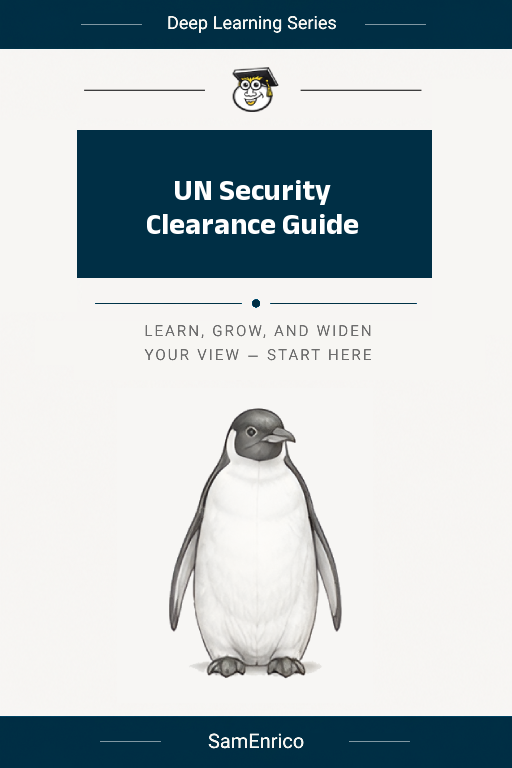
UN Security Clearance Guide eBook
Obtain UN security clearance for high-risk duty st
Obtain UN security clearance for high-risk duty stations.
Formats
Free sample
Chapter 1: The Cost of Chaos--–- The first time Samira Al-Hassan heard the words “your clearance has been denied,” she was standing in the departure lounge of Nairobi’s Jomo Kenyatta International Airport, boarding pass in hand for a flight to Juba, South Sudan. She had spent six weeks preparing for her first UN field mission—vaccinations, cultural training, a mountain of online modules, and three frantic phone calls with HR about her per diem rates. What she had not done was log into the Travel Request Information Process (TRIP) portal to update her passport number after receiving a renewed document the week before. The system still held her expired passport on file. When UNDSS ran the final security check thirty minutes before boarding, the discrepancy flagged.
Her clearance was automatically revoked. She watched the flight push back from the gate without her. Three days later, the plane she would have taken—a UN-chartered flight from Juba to a remote field office—experienced a hard landing on a damaged airstrip. No one died. But Samira never forgot the lesson: in the UN’s security architecture, a single outdated field in an online form can rewrite your entire future.This chapter establishes the moral, legal, and operational imperative behind UN security clearance.
It is not a chapter about paperwork. It is a chapter about survival, accountability, and the quiet machinery that separates a protected UN asset from an unaccountable liability. By the time you finish reading, you will understand why clearance is non-negotiable, what happens when it is ignored, and how the distinction between “high-risk” and “low-risk” duty stations shapes every decision you will make in the field.The UN’s Duty of Care – Your Shield and Your Chain The United Nations operates under a legal and moral doctrine known as the Duty of Care. In plain language, this means that the Organization is obligated to take all reasonable measures to protect the safety, health, and well-being of its personnel—staff, contractors, consultants, UN Volunteers, and in many cases, dependents. This duty is codified in the UN Staff Regulations and Rules, reinforced by the Secretary-General’s Bulletin on Security, and operationalized through the policies of the UN Department of Safety and Security (UNDSS).But the Duty of Care is not a one-way street.
It is a covenant with two signatures. For the UN to fulfill its obligation to protect you, you must fulfill your parallel duty: to submit accurate data, complete mandatory training, follow clearance protocols, and remain within the boundaries of your approved itinerary. Think of it as an invisible contract. The UN promises to track you, rescue you if possible, and cover your medical evacuation if needed. In exchange, you promise to be trackable, reachable, and predictable.
When you break your side of the contract—by traveling without approval, failing to update your TRIP profile, or entering a restricted zone—the UN’s Duty of Care does not disappear overnight. It erodes, case by case, until in some instances it vanishes entirely. The Organization’s insurers have successfully denied claims for personnel who deviated from approved travel routes, and the UN itself has terminated contracts for repeated clearance violations.One former UNDSS security advisor put it bluntly during an internal training session: “We can’t protect you if we don’t know where you are. And we can’t know where you are if you don’t tell us. The system is not magic.
It is a spreadsheet. If you are not on the spreadsheet, you do not exist.”The Four Stories They Don’t Tell You in Orientation Every UN agency runs a security orientation for new personnel. Every orientation includes a Power Point slide titled “Why Clearance Matters.” But the slide rarely includes the human stories—the actual consequences of ignoring clearance. This book includes them. The following case studies are anonymized but real, drawn from UN internal after-action reviews, insurance dispute records, and interviews with field security officers.
They illustrate the four most common ways clearance failures become catastrophes.Case Study One – The Kidnapping in Darfur A UN Volunteer assigned to a humanitarian project in Darfur, Sudan, decided to visit a neighboring village on a weekend to deliver supplies to a community leader who had become a personal friend. She did not file a TRIP request because she considered the visit “unofficial” and “just a short drive.” She did not inform the UNDSS radio room. She drove a non-UN vehicle—a rental—to avoid drawing attention. On the return journey, an armed group stopped her at a false checkpoint. She was taken captive and held for eleven days.
During that time, UNDSS did not know she was missing because her name remained on the Local Security Plan as “present at the duty station.” No search was initiated. No hostage negotiation team was deployed. She was released only after the community leader paid a ransom from his own savings—a payment that violated UN policy and left him indebted. After her release, an internal review found that because she had traveled without clearance and outside UN-approved transport, the UN’s Duty of Care was not triggered. She received no medical evacuation, no psychological support, and was ultimately responsible for her own repatriation flight.
Her contract was not renewed.Case Study Two – The Evacuation Manifest Omission A consultant working for a UN agency in Bangui, Central African Republic, had his TRIP profile set up correctly for his initial deployment. Six months into his assignment, he renewed his passport but never updated the document number in TRIP. The Local Security Plan still listed his expired passport. When a sudden coup attempt triggered a mandatory evacuation of all non-essential personnel, UNDSS generated the evacuation manifest directly from TRIP data. His name appeared, but the passport number did not match the travel document he was carrying.
At the airport, the UN-chartered evacuation flight’s manifest was cross-checked against TRIP. The mismatch flagged him as “unverified.” He was denied boarding. Three subsequent flights left without him. He spent seventy-two hours sheltering in a hotel without UN support, surviving on hotel biscuits and tap water while artillery fire echoed through the city. He eventually bribed a private truck driver to take him to the border—a journey that cost him $4,000 and took two days.
The UN reimbursed nothing. His insurance claim was denied because he was “outside the approved itinerary” due to the passport mismatch.Case Study Three – The Denied Medical Evacuation A UN staff member serving in a Level 4 duty station in the Democratic Republic of Congo developed severe malaria complicated by acute respiratory distress. She was conscious but deteriorating. The UNDSS medical section informed her that because her BSAFE certification had expired three weeks earlier—she had received an automated email reminder but ignored it—her clearance was technically “paused.” She was not eligible for a UN-coordinated medical evacuation (Medevac) under the standard protocol. She could, however, file a new TRIP request manually and then request Medevac.
The problem was that she could barely see her laptop screen. It took her six hours to complete the TRIP request with help from a colleague. By the time approval came through, her oxygen…
This is the end of the free sample. Get the eBook to keep going. Buy now
About this book
Details
- Author
- Bledsoe Leonila
- Publisher
- SamEnrico
- Language
- English
- Genre
- Non-Fiction, Non-Obvious Career
- Released
- 2026-05-29
- Pages (approx.)
- 146
- Available as
- eBook, Audiobook

Read better in the ZLOADR app
Your eBooks on your phone or tablet. Sign in with your SamEnrico account and start reading.
More by Bledsoe Leonila
 The Interruption Reframing WorkbookBledsoe Leonila$11.99
 Unity Persuasion PrincipleBledsoe Leonila$11.99
 The Freelance Job Security RiskBledsoe Leonila$11.99
 Resume Refresh After Job LossBledsoe Leonila$11.99
 Indian GST Application for Freelancers GuideBledsoe Leonila$11.99
 Sitcom Child Curse HandbookBledsoe Leonila$11.99
 Scott Peterson Psych EvaluationBledsoe Leonila$11.99
 Scripting Cheat SheetBledsoe Leonila$11.99
 Walmart InternationalBledsoe Leonila$11.99
 The Corsair Inventor: John Harrison and the Quest for LongitudeBledsoe Leonila$11.99
 The Balloon That Broke the Sky: How a Toy Changed the WorldBledsoe Leonila$11.99
 The Bloodless Plague: The Enigma of the 1840s Irish Cholera OutbreakBledsoe Leonila$11.99
You may also like
 Hong Kong Handover 1997Dunn Johnnie$11.99
 Zumba For Postnatal Recovery CourseNeal Christian$11.99
 Zumba for BeginnersLadner Nikia$11.99
 YouTube Comment Mining GuideHumes Pandora$12.99
 Worry Box MeditationCarlin Rudy$11.99
 Workplace Stress MeditationNguyen Lynn$11.99
 Workplace Stress and Sleep RepairHawley Ivory$11.99
 Workplace Perfectionism CureDelaney Jeffry$11.99
 Workplace Injustice Anger GuideWallen Isabelle$11.99
 Work Addiction and Burnout LinkGreenwood Ester$11.99
 Women in Yoga and WellnessBeattie Galina$11.99
 Women in Stand Up ComedyChun Evangeline$11.99