
Non-FictionBusiness BriefExcess Coverage
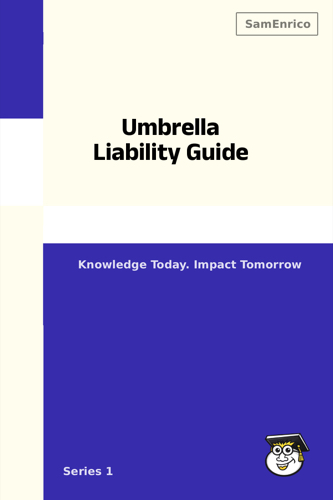
Umbrella Liability Guide eBook
Explains excess liability coverage that kicks in a
Explains excess liability coverage that kicks in after primary policy limits are exhausted.
Formats
Free sample
Chapter 1: The Illusion of Safety...-- Most people believe they are protected. They pay their premiums every month, file away their declarations pages, and sleep soundly assuming that if disaster strikes, their insurance will be there. The homeowner with a $500,000 liability limit thinks that is plenty because they have never been sued. The business owner with a $1 million general liability policy feels secure because that is what their agent recommended. The driver carrying state minimum coverage assumes the law would not allow them to drive with dangerously inadequate protection.
All of them are wrong. And the gap between what they believe and what is actually true has bankrupted thousands of otherwise careful, responsible individuals and business owners.This chapter confronts the uncomfortable reality that standard primary insurance policies—whether for your home, your car, or your business—are rarely sufficient for catastrophic lawsuits. The hard truth is that most liability claims do not exhaust policy limits. Most claims are small, settling for a few thousand dollars or resolving within the primary policy's defense provisions. But it is not the small claims that destroy lives and businesses.
It is the one-in-a-thousand event: the multi-car pileup on the highway, the dog attack that leaves a child with permanent facial scars, the houseguest who dives into a shallow pool and becomes a quadriplegic, the contractor whose defective work causes a building to collapse. Those events do not care about your policy limits. They do not check your declarations page before causing harm. And when the verdict comes in, as it inevitably will in a world of nuclear verdicts and plaintiff-friendly juries, the difference between what your primary policy pays and what you actually owe comes directly out of your pocket—or from your future wages, your home equity, your children's inheritance, and your retirement savings.The concept at the heart of this gap is what insurance professionals call the attachment point. That is a deceptively simple term for a devastating reality.
The attachment point is the specific dollar threshold—typically $500,000, $1 million, or sometimes as low as $250,000—at which an umbrella or excess liability policy begins to pay. Below that threshold, your primary policy is supposed to cover the loss. Above that threshold, your umbrella policy kicks in. But here is the problem that most policyholders never understand until it is too late: if your primary policy limit is $500,000 and a jury awards $1.2 million against you, your primary insurer writes a check for $500,000. Your umbrella policy, if you have one with a $1 million attachment point, does not pay a dime because the award must first exceed $1 million.
The umbrella attaches only after the primary is exhausted. In this scenario, the $200,000 gap between $500,000 and $1 million? That is your responsibility. The $500,000 from the primary plus the $200,000 from your pocket equals the $700,000 you actually pay, assuming you can negotiate a settlement. If you cannot, and the full judgment is enforced, you may face wage garnishment, asset seizure, or bankruptcy.This is the illusion of safety.
Most policyholders assume that because they have insurance, they are fully protected. They confuse having some coverage with having enough coverage. They confuse the peace of mind that comes from paying premiums with the actual mathematical reality of catastrophic risk. And insurance agents, who are often compensated based on volume rather than depth of coverage, rarely push clients to buy umbrella policies because those policies are inexpensive relative to their value and generate low commissions. The agent who sells you a $500,000 homeowners policy might earn $50 in commission.
The agent who sells you a $1 million umbrella policy on top of it might earn an additional $10. There is little financial incentive for the agent to initiate that conversation, and most policyholders do not know enough to ask.The consequences of this knowledge gap are staggering. According to data from the Insurance Information Institute, the average jury award in personal injury cases increased by over 300 percent between 2010 and 2024, adjusted for inflation. Cases that once settled for $500,000 now routinely produce verdicts of $2 million or more. The phenomenon known as "social inflation"—the tendency of juries to award increasingly large sums against corporate and individual defendants—has transformed the liability landscape.
In high-profile jurisdictions like Cook County, Illinois (Chicago), Los Angeles County, California, and Miami-Dade County, Florida, multimillion-dollar verdicts are no longer headline news. They are routine. A standard $500,000 primary auto policy that would have been considered generous twenty years ago is now dangerously inadequate. Yet most drivers continue to carry state minimum limits of $25,000 or $50,000, completely unaware that a single at-fault accident with serious injuries could expose them to personal liability for the rest of their working lives.The Three Catastrophic Scenarios To understand why primary limits are so often insufficient, it helps to walk through three real-world scenarios—each based on actual cases, though names and specific details have been altered. These scenarios illustrate how quickly liability accumulates and why the attachment point of an umbrella policy matters more than most policyholders realize.Scenario One: The Multi-Car Highway Accident A driver named Sarah is commuting home on Interstate 95 during light rain.
She glances down at her phone for approximately three seconds to respond to a text from her spouse. In those three seconds, traffic ahead comes to a sudden stop due to an earlier accident. Sarah rear-ends a sedan at 45 miles per hour, pushing that sedan into the vehicle in front of it. The chain reaction involves five vehicles. The driver of the sedan that received the initial impact suffers a traumatic brain injury requiring two neurosurgeries and a year of cognitive rehabilitation.
Two other drivers suffer herniated discs requiring spinal fusion surgery. Total medical bills exceed $800,000. Lost wages for the brain-injured driver, a software engineer earning $180,000 annually, exceed $1 million over his lifetime. The jury awards $2.4 million in total damages.Sarah has a standard auto policy with $250,000 per person and $500,000 per accident liability limits. Her insurer pays the full $500,000 policy limit.
Sarah does not have an umbrella policy. The remaining $1.9 million is her personal responsibility. Her home equity of $400,000 is seized. Her retirement accounts are garnished. Her wages are attached at 25 percent for the next fifteen years.
She files for Chapter 7 bankruptcy, which discharges the judgment but destroys her credit for a decade.If Sarah had carried a $1 million umbrella policy with a $500,000 attachment point, the outcome would have been dramatically different. Her primary insurer would pay $500,000. The umbrella policy, attaching at exactly the $500,000 threshold, would pay the next $1 million. Sarah would still owe $900,000, but that is far less than $1.9 million. With a $2 million umbrella, the entire judgment would be covered.Scenario Two: The Dog Bite with Lifelong Consequences A family adopts a rescue dog with no known history of aggression.
One afternoon, their twelve-year-old son leaves the gate unlatched. The dog escapes into the neighbor's yard, where a five-year-old child is playing. The dog attacks the child's face, causing severe lacerations, loss of an eye, and permanent facial scarring. The child requires multiple reconstructive surgeries over the next eight years, psychological counseling for post-traumatic stress, and will live with visible facial disfigurement for the rest of her life. A jury awards $3.1 million for medical expenses, future care, pain and suffering, and cosmetic disfigurement.The…
This is the end of the free sample. Get the eBook to keep going. Buy now
About this book
Details
- Author
- Ashford Ashley
- Publisher
- SamEnrico
- Language
- English
- Genre
- Non-Fiction, Business Brief, Excess Coverage
- Released
- 2026-06-06
- Pages (approx.)
- 145
- Available as
- eBook, Audiobook

Read better in the ZLOADR app
Your eBooks on your phone or tablet. Sign in with your SamEnrico account and start reading.
More by Ashford Ashley
 Musk Brand CreationAshford Ashley$11.99
 Meal Prep for Gut HealthAshford Ashley$11.99
 Salary Negotiation TalkAshford Ashley$11.99
 Personal Brand Networking GuideAshford Ashley$11.99
 The Virtual Commute MethodAshford Ashley$11.99
 Memory Training For Language LearningAshford Ashley$11.99
 Alcan Highway Builder AlaskaAshford Ashley$11.99
 The Robben Island Revolution: How Prisoners Shaped a NationAshford Ashley$11.99
 The Poisoner of Montpellier: France's First Serial KillerAshford Ashley$11.99
 A Collector's Handbook to the Aston Martin 15Ashford Ashley$11.99
 How to Produce RugsAshford Ashley$11.99
 JEE Previous Year Paper SolutionsAshford Ashley$12.99
You may also like
 Hong Kong Handover 1997Dunn Johnnie$11.99
 Zumba For Postnatal Recovery CourseNeal Christian$11.99
 Zumba for BeginnersLadner Nikia$11.99
 YouTube Comment Mining GuideHumes Pandora$12.99
 Worry Box MeditationCarlin Rudy$11.99
 Workplace Stress MeditationNguyen Lynn$11.99
 Workplace Stress and Sleep RepairHawley Ivory$11.99
 Workplace Perfectionism CureDelaney Jeffry$11.99
 Workplace Injustice Anger GuideWallen Isabelle$11.99
 Work Addiction and Burnout LinkGreenwood Ester$11.99
 Women in Yoga and WellnessBeattie Galina$11.99
 Women in Stand Up ComedyChun Evangeline$11.99