
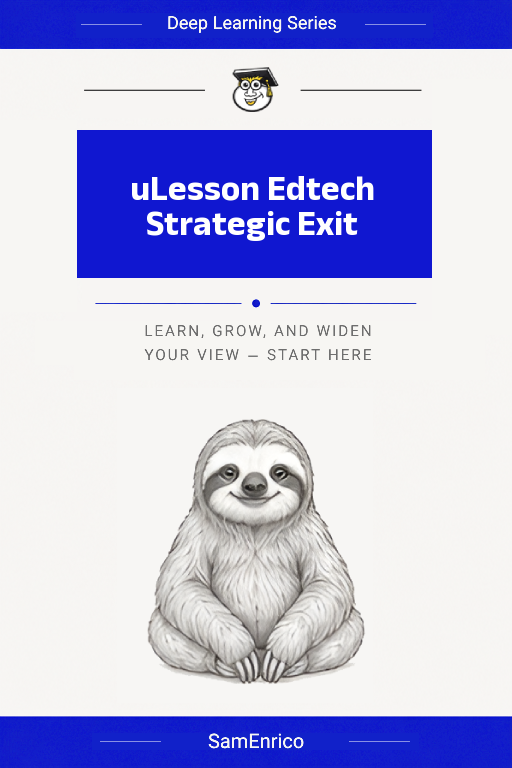
uLesson Edtech Strategic Exit eBook
Plan digital learning platform exits using Nigeria
by Mayes Marina
Plan digital learning platform exits using Nigerian online tutor uLesson's subscriber growth and content library.
Formats
Free sample
Chapter 1: The Funeral Parade--The shutdown party was held on a Tuesday.Not because Tuesday held any particular significance for the Nigerian tech ecosystem, but because the lease for Apt Learn's office in Yaba expired on Wednesday, and the co-founders had calculated—with the same precision they once applied to their growth forecasts—that they could not afford another month's rent. So they gathered the forty-seven remaining employees, ordered six trays of jollof rice from a nearby buka, and opened three bottles of non-alcoholic wine because half the team was observing a fast.The mood was not somber. It was worse. It was confused.I watched a twenty-four-year-old backend engineer named Chioma stand by the window, her laptop bag still slung over her shoulder, staring at the eviction notice that had been pinned to the door that morning. She had joined Apt Learn eighteen months earlier, leaving a stable job at a legacy bank because she believed in the mission.
She had worked weekends. She had built the recommendation algorithm that powered the platform's "You might also like" feature. She had negotiated her salary down during the hiring process because, as she told me later, "I thought we were building something that mattered."Now she was eating cold jollof rice from a paper plate, and the thing she had built was being archived to a hard drive that would sit in a co-founder's apartment until someone remembered to throw it away.The co-founder, a man named Tunde whose energy had once filled boardrooms, stood by the whiteboard where the last quarter's OKRs were still written in fading marker. The OKRs had been optimistic. They had been wrong.
He clinked a spoon against a water glass and the room fell silent."Thank you for coming," he said. "We trained over two hundred thousand learners. That's not nothing."Someone coughed."That's two hundred thousand people who watched our videos, took our quizzes, messaged our tutors. That's two hundred thousand people who believed in us."He paused. The silence stretched."And we couldn't make it work."That was the moment I understood why I was there.
Not to report on a failure—failures in tech are common enough to be boring—but to ask a question that none of the best-selling business books in my library had answered: Why did Apt Learn die when u Lesson, building in the same market, solving the same problems, raising money from the same investors, was still standing?The answer, I would learn over the next three years of reporting, was not what I expected. It was not about funding. It was not about team quality. It was not about market timing. It was about something that no Silicon Valley exit playbook had ever thought to name.It was about asset density.The Graveyard of Good Intentions Let me be clear about what I am not writing.I am not writing a post-mortem of a failed startup.
There are enough of those on Medium and Linked In, each one a confession wrapped in a lesson learned, each one ending with the same hollow promise: "Here's what we would have done differently."I am not writing a hagiography of u Lesson. Sim Shagaya, the founder, is a brilliant operator, but he has made mistakes. He has hired the wrong people. He has launched features that flopped. He has sat in boardrooms and admitted that he did not have all the answers.
The goal of this book is not to crown a hero. It is to steal a blueprint.I am writing, instead, a different kind of book. A book about the difference between a Strategic Exit—a planned, profitable sale that rewards everyone who took the risk—and a Fire Exit—a panicked shutdown that leaves employees unpaid, investors chastened, and founders wandering the halls of a dead company, wondering where it all went wrong.Most business books assume you already have something to sell. They teach you how to package it, price it, and pitch it. They assume you have already crossed the chasm, found product-market fit, and built a recurring revenue engine that hums along while you sip coffee and negotiate term sheets.This book assumes nothing of the sort.This book assumes you are fighting.
It assumes you are building in a market where the currency devalues overnight, where the power goes out in the middle of a user test, where the best engineers leave for London the moment they get a visa, and where the customers have less money but more urgent problems than any Silicon Valley product manager has ever had to solve.This book assumes you are building in Lagos, or Nairobi, or Cairo, or Jakarta, or São Paulo—or anywhere that is not Sand Hill Road.And it assumes you want to sell.Not because selling is the only measure of success. Not because a liquidity event is the point of entrepreneurship. But because a successful exit—a real exit, a check-cashed, champagne-opened, employees-paid exit—is the only thing that will convince the next generation of founders that this is possible. That you can build something worth selling. That the cycle does not end in a shutdown party in Yaba, eating cold jollof rice and wondering what happened.The 200,000-User Trap Here is what Apt Learn had, at its peak:Two hundred thousand registered learners.
A library of seven hundred video lessons. A team of sixty-three employees, including twelve full-time tutors who held office hours seven days a week. A feature set that included live classes, recorded lectures, practice exams, and a peer-to-peer discussion forum that was, by all accounts, surprisingly civil. A Series A round of four million dollars, led by a venture capital firm that had backed successful edtech companies in India and Brazil.Here is what Apt Learn did not have:A single piece of content that a competitor could not replicate within thirty days.I do not mean this as an insult. I mean it as a structural observation.
Every video Apt Learn produced was based on a curriculum that was publicly available. Every quiz question was written by tutors who could be hired away. Every practice exam was mapped to the same West African Examinations Council syllabus that every other edtech platform was using. There was nothing—no proprietary algorithm, no secret pedagogy, no exclusive partnership—that prevented a well-funded competitor from building the exact same product and undercutting Apt Learn on price.And that is exactly what happened.When a competitor launched a free version of its product—funded by a telco partnership that subsidized data costs—Apt Learn bled users. When another competitor hired three of Apt Learn's best tutors, the quality of its live classes dropped.
When the edtech funding winter hit in 2025, and investors stopped writing checks for "growth at all costs," Apt Learn had no moat to retreat behind.Two hundred thousand users. Seven hundred videos. Four million dollars raised.And when the money ran out, all of it evaporated.This is the trap. This is the graveyard of good intentions. You build a product, you acquire users, you raise money, you hire a team—and none of it matters if you have not…
This is the end of the free sample. Get the eBook to keep going. Buy now
About this book
Details
- Author
- Mayes Marina
- Publisher
- SamEnrico
- Language
- English
- Genre
- Non-Fiction, Business Brief
- Released
- 2026-06-01
- Pages (approx.)
- 145
- Available as
- eBook, Audiobook

Read better in the ZLOADR app
Your eBooks on your phone or tablet. Sign in with your SamEnrico account and start reading.
More by Mayes Marina
 History Dates Chronology GuideMayes Marina$11.99
 Career Transition for ArtistsMayes Marina$11.99
 Proximity Fuse: Radar Miniaturization MiracleMayes Marina$11.99
 Caregiver Self Care BasicsMayes Marina$11.99
 Step Four Personal Inventory CourseMayes Marina$11.99
 Lost Boy Of Dadaab ResettledMayes Marina$11.99
 Disappointment In RetirementMayes Marina$11.99
 Software Engineer Burnout GuideMayes Marina$11.99
 First Female Combat PilotMayes Marina$11.99
 The Last Waltz: The Secret Life of Vienna’s Forgotten BallroomsMayes Marina$11.99
 The Labors of Atalanta: The Hunt for the Calydonian BoarMayes Marina$11.99
 Steel and Shadows: The Deadly Design of the Silver BridgeMayes Marina$11.99
You may also like
 Hong Kong Handover 1997Dunn Johnnie$11.99
 Zumba For Postnatal Recovery CourseNeal Christian$11.99
 Zumba for BeginnersLadner Nikia$11.99
 YouTube Comment Mining GuideHumes Pandora$12.99
 Worry Box MeditationCarlin Rudy$11.99
 Workplace Stress MeditationNguyen Lynn$11.99
 Workplace Stress and Sleep RepairHawley Ivory$11.99
 Workplace Perfectionism CureDelaney Jeffry$11.99
 Workplace Injustice Anger GuideWallen Isabelle$11.99
 Work Addiction and Burnout LinkGreenwood Ester$11.99
 Women in Yoga and WellnessBeattie Galina$11.99
 Women in Stand Up ComedyChun Evangeline$11.99