
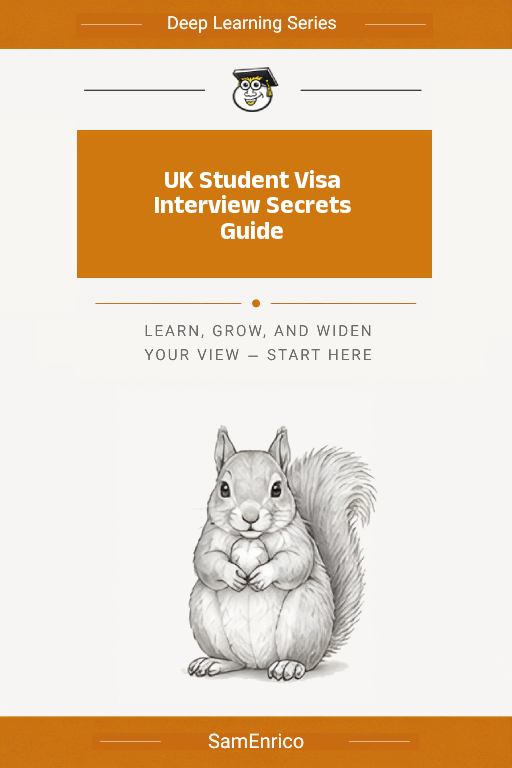
UK Student Visa Interview Secrets Guide eBook
Master the credibility interview for Student Route
Master the credibility interview for Student Route visa with financial proof and course knowledge strategies.
Formats
Free sample
Chapter 1: The Risk Score…--–- Most applicants walk into the UK student visa credibility interview believing two dangerous myths. The first myth is that the interview is random—a lucky draw where some applicants are selected and others are not. The second myth is that if you have a genuine offer from a recognized university and you have maintained the required funds for 28 days, your visa is essentially guaranteed. Both myths are wrong, and believing them has led to thousands of refusals every year.The truth is that the credibility interview is anything but random. Behind the scenes, before you even receive the email inviting you to book your interview slot, the Entry Clearance Officer (ECO) has already run your application through a sophisticated risk-assessment algorithm.
This algorithm scans your Confirmation of Acceptance for Studies (CAS), your financial evidence, your immigration history, and a range of other data points. It then assigns you a provisional risk score. That score determines two things: first, whether you will be called for an interview at all, and second, how aggressively the ECO will question you if you are called.This chapter dismantles the myth of randomness and introduces you to the concept of the risk score. You will learn exactly what triggers a high-risk flag, how the ECO uses your interview to test specific weaknesses in your application, and why the 2026 transition from Biometric Residence Permits (BRPs) to e Visas has made consistency more important than ever. By the end of this chapter, you will understand that your interview is not a conversation—it is a targeted interrogation designed to confirm or overturn a pre-existing suspicion.
And you will learn how to overturn it.The Algorithm That Judges You Before You Speak The United Kingdom’s Student Route operates under what immigration lawyers call a “hostile environment” framework. That term does not mean the ECO hates students. It means the system is designed to assume non-compliance unless proven otherwise. Every application begins with a baseline suspicion. Your job is to erase that suspicion through documentary evidence and verbal testimony.The first layer of scrutiny happens algorithmically.
When you submit your visa application online, UKVI’s caseworking system automatically cross-references your data against dozens of risk indicators. These indicators are not published in full—the Home Office considers them operationally sensitive—but immigration practitioners have reverse-engineered the most common flags through years of analyzing refusal notices and freedom of information requests.The most significant risk indicators fall into four categories: nationality risk, academic progression risk, financial risk, and immigration history risk.Nationality risk is the most controversial but also the most real. UKVI maintains internal country risk ratings based on historical visa overstay rates, asylum claim rates, and document fraud prevalence. Applicants from countries with high refusal rates—such as India, Nigeria, Bangladesh, Sri Lanka, Pakistan, and several Middle Eastern and North African nations—receive automatically elevated risk scores. This does not mean applicants from these countries cannot obtain visas.
It means they face a higher burden of proof. The ECO expects more detailed answers, more specific course knowledge, and more compelling financial explanations.Academic progression risk flags applicants whose educational trajectory does not follow a logical upward curve. A student moving from a bachelor’s degree in engineering to a master’s degree in engineering shows clear progression. A student moving from a bachelor’s degree in history to a master’s degree in data science triggers a flag. Similarly, applying for a course at a lower level than previous study—for example, a second bachelor’s degree after already completing a master’s degree—generates a high-risk score unless there is a compelling regulatory reason, such as a professional licensing requirement.Financial risk flags applications where funds appear suddenly, where the sponsor’s income does not plausibly support the savings, or where the bank statements show irregularities.
The algorithm looks for deposits made exactly 28 days before the application date—a common pattern among coached applicants who borrow money temporarily. It also flags accounts that show minimal activity aside from the required balance, suggesting the funds are not genuinely available for living expenses.Immigration history risk flags any previous visa refusal from any country, not just the UK. A refusal from the United States, Australia, Canada, or the Schengen Area appears on your record and increases your risk score. Previous overstays, voluntary returns, or deportations generate even higher flags. The algorithm also checks for previous applications where you withdrew your application after receiving a refusal warning.Understanding these risk indicators is your first line of defense.
If you know you carry multiple flags, you cannot afford to walk into the interview with generic, rehearsed answers. You need a targeted strategy that addresses each flag explicitly before the ECO even asks.The Provisional Risk Score: Not a Draft Refusal One of the most misunderstood concepts in the visa advice industry is the idea that the ECO has already decided to refuse you before the interview begins. This is not accurate, and treating it as accurate leads to fatalistic thinking and poor preparation. The correct framework is the provisional risk score.Think of the provisional risk score as a traffic light. Green means low risk—the applicant’s profile suggests genuine student intent, and the interview is likely to be brief or waived entirely.
Amber means moderate risk—the applicant has some flags that need clarification, and the interview will probe specific areas. Red means high risk—the applicant has multiple flags, and the interview will be exhaustive, lasting thirty minutes or longer, covering every pillar of credibility.Crucially, the provisional risk score can change. Your interview answers can downgrade your risk from red to amber or even green. They can also upgrade it—if you give inconsistent, vague, or evasive answers, the ECO will note that your verbal testimony did not alleviate the concerns raised by your documentary evidence. This is why the interview matters.
You are not fighting a predetermined outcome. You are fighting a provisional suspicion.The ECO’s mental process follows a simple logic: “Based on the documents, I have concerns A, B, and C. During the interview, I will ask questions designed to test whether those concerns are valid. If the applicant answers clearly, specifically, and consistently with the documents, I will downgrade the risk and approve. If the applicant hesitates, contradicts the documents, or gives generic answers, I will uphold the risk and refuse.”This is the balance of probabilities standard in action.
The ECO does not need to be certain that you are not a genuine student. They only need to believe that, on balance, it is more likely than not that you are not genuine. Your job is to tip that balance back in your favor.The 2026 Shift: From BRP to e Visa and What It Means for Credibility The year 2026 marks a fundamental shift in how UKVI monitors visa holders. The physical Biometric Residence Permit (BRP) card is being phased out and replaced entirely by the e Visa system. This change has profound implications for the credibility interview, most of which applicants do not anticipate.Under the BRP system, your identity and immigration status were…
This is the end of the free sample. Get the eBook to keep going. Buy now
About this book
Details
- Author
- Peltier Garret
- Publisher
- SamEnrico
- Language
- English
- Genre
- Non-Fiction, Student's Shortcut
- Released
- 2026-06-01
- Pages (approx.)
- 150
- Available as
- eBook, Audiobook

Read better in the ZLOADR app
Your eBooks on your phone or tablet. Sign in with your SamEnrico account and start reading.
More by Peltier Garret
 Distraction Log Method PrimerPeltier Garret$11.99
 Battle Of Marengo AccountPeltier Garret$11.99
 Geo Arbitrage for CopywritersPeltier Garret$11.99
 The That's Not All TechniquePeltier Garret$11.99
 Weight Loss Hypnosis ScriptsPeltier Garret$11.99
 Scheduling Self Care BlocksPeltier Garret$11.99
 Emergency Vehicle Response CalmPeltier Garret$11.99
 The Dual Income FreelancerPeltier Garret$11.99
 Elbow Tendonitis Rehabilitation WorkoutPeltier Garret$11.99
 The Boardroom Betrayal: How a 19th-Century Tycoon Outmaneuvered the WorldPeltier Garret$11.99
 The Battle of Trenton: Washington's Gamble in the SnowPeltier Garret$11.99
 The Complete Guide to the Master Cleanse CoachPeltier Garret$11.99
You may also like
 Hong Kong Handover 1997Dunn Johnnie$11.99
 Zumba For Postnatal Recovery CourseNeal Christian$11.99
 Zumba for BeginnersLadner Nikia$11.99
 YouTube Comment Mining GuideHumes Pandora$12.99
 Worry Box MeditationCarlin Rudy$11.99
 Workplace Stress MeditationNguyen Lynn$11.99
 Workplace Stress and Sleep RepairHawley Ivory$11.99
 Workplace Perfectionism CureDelaney Jeffry$11.99
 Workplace Injustice Anger GuideWallen Isabelle$11.99
 Work Addiction and Burnout LinkGreenwood Ester$11.99
 Women in Yoga and WellnessBeattie Galina$11.99
 Women in Stand Up ComedyChun Evangeline$11.99