
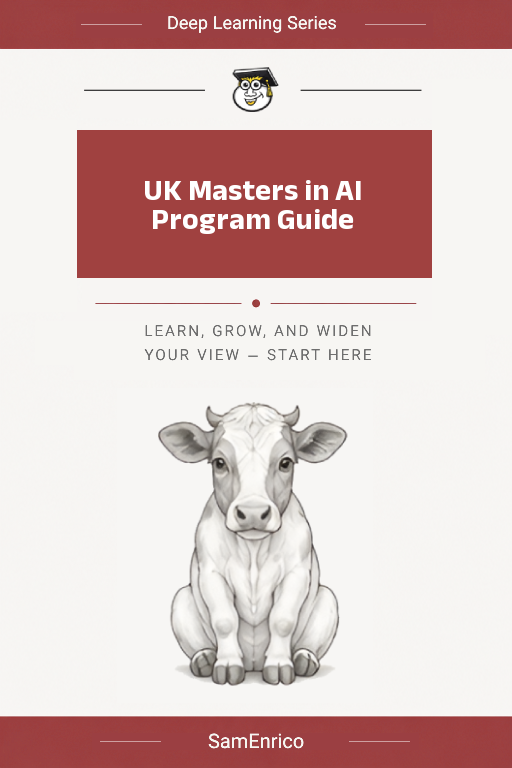
Non-FictionStudent's ShortcutUK Programs
UK Masters in AI Program Guide Audiobook
Explores AI master's degrees at Oxford, Cambridge,
Explores AI master's degrees at Oxford, Cambridge, Imperial, Edinburgh, and UCL with research strengths and industry connections.
Formats
Free sample
Chapter 1: The Oxford Paradox--–- The rejection letter arrived on a Tuesday. It was polite, formulaic, and utterly devastating. "We regret to inform you that your application to the MSc in Machine Learning has not been successful." Three sentences that erased six months of preparation. The candidate had a first-class degree from a top Russell Group university, two internships, and a glowing reference. They had followed every public piece of advice available online.
They were, by any reasonable measure, an excellent applicant. And they were rejected.The same week, another candidate received an acceptance. Their grades were marginally lower. Their internships were less prestigious. But they had done something different.
They had not applied to "Oxford." They had applied to work with Professor Alison Noble's medical imaging group. They had read her paper on ultrasound video analysis and written a personal statement that referenced a specific equation on page seven. They had demonstrated, in 500 words, that they understood not just machine learning, but Oxford's particular flavor of it: theoretical, probabilistic, and deeply mathematical.This is the Oxford Paradox. And it applies not only to Oxford but to Cambridge, Imperial, Edinburgh, and UCL as well. The paradox is simple: the applicants who chase prestige alone almost always lose to those who chase fit.
The most selective AI master's programs in the United Kingdom are not looking for the smartest students in the absolute sense. They are looking for the students who understand what makes each program unique and can prove they belong in that specific research ecosystem.This chapter dismantles the most expensive myth in graduate admissions: that university rankings determine program quality. It provides a comparative analysis of the five target institutions—Oxford, Cambridge, Imperial College London, the University of Edinburgh, and University College London—while acknowledging that several of these universities offer multiple distinct tracks with fundamentally different strengths. By the end of this chapter, you will understand why a "lower-ranked" program in your specific subfield might be a better investment than a "higher-ranked" generalist program. More importantly, you will have a decision matrix that maps your career goals to specific programs, specific professors, and even specific modules.The Landscape of UK AI Education The United Kingdom has emerged as the second most powerful hub for artificial intelligence research and education globally, trailing only the United States in output but arguably leading in certain subfields such as probabilistic machine learning, natural language processing…
This is the end of the free sample. Get the Audiobook to keep going. Buy now
About this book
Details
- Author
- Burgess Caroline
- Publisher
- SamEnrico
- Language
- English
- Genre
- Non-Fiction, Student's Shortcut, UK Programs
- Released
- 2026-05-29
- Pages (approx.)
- 145
- Available as
- eBook, Audiobook

Listen in the VoxFlicks app
Audiobooks and audio dramas wherever you go. Sign in with your SamEnrico account and press play.
More by Burgess Caroline
 The Eyewitness Identification AppBurgess Caroline$11.99
 Mapuche Machi Healing TableBurgess Caroline$11.99
 Divorce Litigation SurvivalBurgess Caroline$11.99
 Naturopathy for Hormone BalanceBurgess Caroline$11.99
 The Prostate Chemotherapy GuideBurgess Caroline$11.99
 The Dubai Gold Scam: How a Billionaire's Betrayal Shattered Trust in the Middle EastBurgess Caroline$11.99
 Franchise Disclosure Document GlobalBurgess Caroline$12.99
 How to Start a Petting Zoos BusinessBurgess Caroline$11.99
 Quantitative AnalystBurgess Caroline$11.99
 Understanding Sclerosing MesenteritisBurgess Caroline$17.99
You may also like
 Hong Kong Handover 1997Dunn Johnnie$11.99
 Zumba For Postnatal Recovery CourseNeal Christian$11.99
 Zumba for BeginnersLadner Nikia$11.99
 YouTube Comment Mining GuideHumes Pandora$12.99
 Worry Box MeditationCarlin Rudy$11.99
 Workplace Stress MeditationNguyen Lynn$11.99
 Workplace Stress and Sleep RepairHawley Ivory$11.99
 Workplace Perfectionism CureDelaney Jeffry$11.99
 Workplace Injustice Anger GuideWallen Isabelle$11.99
 Work Addiction and Burnout LinkGreenwood Ester$11.99
 Women in Yoga and WellnessBeattie Galina$11.99
 Women in Stand Up ComedyChun Evangeline$11.99