
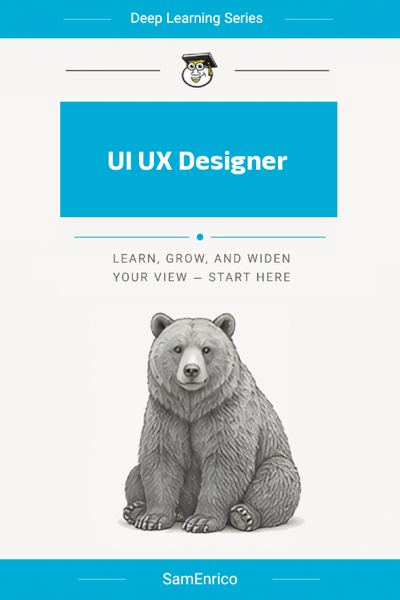
Non-FictionInformativeEducational
UI UX Designer eBook
A Coursebook on UI UX Designer
A Coursebook on UI UX Designer
Formats
Free sample
Chapter 1: The Unified Lie--– You have been lied to. Not maliciously, but persistently. The design industry has spent the last decade convincing you that UI and UX are two separate careers, two separate skillsets, two separate people sitting on opposite sides of a conference room table. This is nonsense. It is a convenient fiction sold by job boards that need categories, bootcamps that need semesters, and Linked In influencers who need content.
The truth is much simpler and much harder: great digital products do not emerge from handoffs between a “UX person” and a “UI person.” They emerge from a single mind that refuses to separate structure from surface, logic from beauty, research from craft.If you opened this book hoping to learn whether you should call yourself a UI designer or a UX designer, close it now and give it to someone else. This book is for people who want to be both. Not sequentially. Not “I learned UX first, now I’m learning UI.” Simultaneously. The way a chef does not separate menu planning from plating.
The way an architect does not separate load-bearing walls from the feeling of light entering a room. The way a novelist does not separate plot from prose. You are about to learn a unified discipline, and the first thing you must unlearn is that there was ever a division in the first place.The Invention of a False Divide The terms “UI” and “UX” emerged from different corners of the same industry. User interface design has roots in human-computer interaction research from the 1980s—think Xerox PARC, early Macintosh, the study of where to put a button so a secretary in 1987 could find it. User experience design was popularized by Don Norman at Apple in the 1990s, when he argued that design should consider the entire experience of a product, not just the screen.
Neither man intended for these terms to become warring factions. Norman himself has said repeatedly that the separation is artificial and unhelpful.But the internet loves categories. Job postings needed checkboxes. University programs needed course codes. And so a generation of designers was told to choose: are you a UI person or a UX person?
The UI person learned colors, typography, spacing, gradients, shadows, the difference between a drop-down and a radio button. The UX person learned research, personas, journey maps, wireframes, user flows, the difference between a problem statement and a feature request. And then they were placed on opposite ends of a production line, passing artifacts back and forth like factory workers, wondering why the final product felt cold.Here is what actually happens in a healthy design process. You start with a question about a human need. You sketch a possible answer.
That sketch has both structure (where things go) and surface (what things look like). You test that sketch. The user gets confused. You realize the structure was wrong—not the surface, not the color, but the very arrangement of information. So you change the structure.
The surface follows. Then you realize a button is too small for thumbs. That is surface, but it affects structure because now you need more space. You move things. The structure shifts again.
Within five minutes of honest design work, UI and UX have intertwined so completely that separating them would be like separating the flour from the cake.The lie persists because it is profitable for institutions that sell education. A ten-week UX bootcamp is easier to market than a twenty-week unified design program. A textbook on UI fundamentals fits neatly on a shelf next to a textbook on UX research. But you are not an institution. You are a person who wants to make things that work.
So from this moment forward, you will treat UI and UX as two lenses on the same act of creation, not two separate jobs.What UX Actually Is (And What It Isn’t)Before we go further, let us define our terms clearly. This book will use these definitions consistently, and you will find a complete glossary in the appendix. But these four sentences are the most important ones you will read.User experience (UX) is the quality of a person’s interaction with a product over time. It includes whether they can achieve their goal, how they feel before, during, and after the interaction, and how much effort was required. UX is invisible when done well and painfully obvious when done poorly.User interface (UI) is the set of visible and interactive components a person uses to accomplish their goal.
Buttons, menus, text fields, icons, colors, typography, spacing, animations, and gestures. UI is the conversation; UX is whether that conversation was worth having.Great UX can exist with mediocre UI. A command-line interface for a database query has terrible UI by modern standards—no colors, no icons, no visual hierarchy beyond monospaced text—but a database administrator who knows the commands can complete their work extremely quickly. The UX is excellent for that person in that context. Great UI cannot rescue bad UX.
You can paint a broken door handle gold, add a custom typeface to the instruction label, and animate the moment the handle falls off in your hand. It is still a broken door handle.This is why the unified mindset matters. UX asks the question: “Does this solve the right problem?” UI asks: “Can the user see and execute the solution without friction?” A designer who only asks the UX question produces correct but unusable products. A designer who only asks the UI question produces beautiful but useless products. You will ask both questions in every decision, every sketch, every line of code or layer in Figma.
That is the unified mindset.The Business Case: Why Companies Pay for This You may be reading this book to get a job. That is an honest and reasonable goal. So let us talk about money. Not because design is only about money, but because companies will not hire you for your love of typography. They will hire you because you can demonstrate that your work drives measurable outcomes.The most famous data point in our industry comes from a 2018 Forrester study, which found that every dollar invested in UX returns between two and one hundred dollars.
The range is wide because the starting point matters. A company with zero UX maturity—no research, no testing, no design system—will see massive returns from even basic improvements. A company that already has a mature design practice sees smaller incremental gains. But the direction is always positive. Design is not a cost center.
Done correctly, it is a growth lever.More specific numbers: IBM tracked the impact of design thinking across their internal teams and found a 300% return on investment. Amazon calculated that a one-second page load delay cost them $1.6 billion in annual sales. Not lost conversions—lost sales from people who gave up before the page loaded. Those people did not have a UI problem. They had an experience problem that manifested through the interface.
The separation was meaningless to the customer. They just left.When you learn to think in a unified way, you become more valuable than…
This is the end of the free sample. Get the eBook to keep going. Buy now
About this book
Details
- Author
- Brannon Celesta
- Publisher
- SamEnrico
- Language
- English
- Genre
- Non-Fiction, Informative, Educational
- Released
- 2026-05-04
- Pages (approx.)
- 155
- Available as
- eBook, Audiobook

Read better in the ZLOADR app
Your eBooks on your phone or tablet. Sign in with your SamEnrico account and start reading.
More by Brannon Celesta
 Age Regression InductionBrannon Celesta$11.99
 The DNA Test SurpriseBrannon Celesta$11.99
 Firefighter Critical Incident StressBrannon Celesta$11.99
 NVC For Addiction RecoveryBrannon Celesta$11.99
 Trolls: The Plastic Invasion - How a Danish Design Took Over the WorldBrannon Celesta$11.99
 Long Term PTSD ManagementBrannon Celesta$12.99
 How to Become a Machine HelperBrannon Celesta$11.99
 How to Produce Bilge CleanerBrannon Celesta$11.99
You may also like
 Hong Kong Handover 1997Dunn Johnnie$11.99
 Zumba For Postnatal Recovery CourseNeal Christian$11.99
 Zumba for BeginnersLadner Nikia$11.99
 YouTube Comment Mining GuideHumes Pandora$12.99
 Worry Box MeditationCarlin Rudy$11.99
 Workplace Stress MeditationNguyen Lynn$11.99
 Workplace Stress and Sleep RepairHawley Ivory$11.99
 Workplace Perfectionism CureDelaney Jeffry$11.99
 Workplace Injustice Anger GuideWallen Isabelle$11.99
 Work Addiction and Burnout LinkGreenwood Ester$11.99
 Women in Yoga and WellnessBeattie Galina$11.99
 Women in Stand Up ComedyChun Evangeline$11.99