
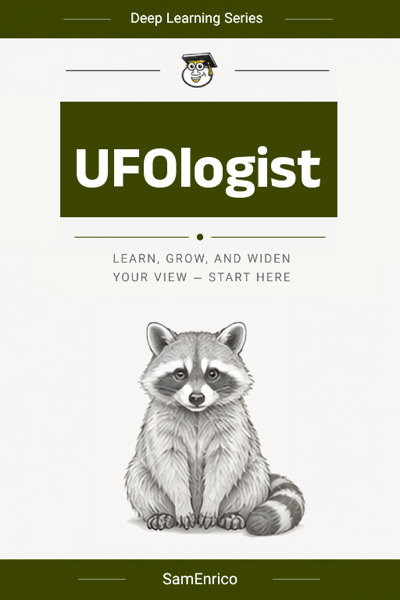
Non-FictionInformativeEducational
UFOlogist eBook
A Coursebook on UFOlogist
A Coursebook on UFOlogist
Formats
Free sample
Chapter 1: The Unlearnable Profession...--The first time Lonnie Zamora saw something he couldn't explain, he almost didn't report it. That was April 24, 1964. Zamora was a patrolman in Socorro, New Mexico—a town of six thousand people, a state police officer with fourteen years of service, a man whose job was to observe, assess, and act. He had seen car accidents, domestic disputes, and the occasional drunk wandering the desert. He had never seen anything like what he saw that afternoon, and when he tried to file his report, his own hands refused to cooperate."I sat down to write it out," Zamora later told investigators.
"And I just couldn't. My hands were shaking too badly."He was chasing a speeding car when he heard a roar and saw a flame—"like someone had lit a torch"—descending into a gully. He abandoned the pursuit and drove toward the flame. What he found was not a crashed vehicle or a brush fire. It was an egg-shaped craft, white and smooth, resting on four legs.
Standing beside it were two small figures, humanoid but not human, dressed in white coveralls. When Zamora approached, the figures appeared to notice him. The craft rose with a deafening shriek, kicked up a cloud of dust, and shot away over the mountains.Zamora's report was investigated by the FBI, the Air Force's Project Blue Book, and the New Mexico State Police. The landing site yielded burned vegetation, depressed soil, and thermal radiation readings above background. No conventional explanation—no weather balloon, no secret aircraft, no hoax—has ever accounted for all the evidence.
The case remains officially unexplained. And Lonnie Zamora, a man who had never believed in flying saucers, spent the rest of his career refusing to discuss what he saw.Zamora was not a UFOlogist. He was a cop. But on that afternoon, he became something more: a witness. And the difference between a witness and an investigator is the difference between having an experience and understanding one.This book is for those who want to make that crossing.The Crisis That Created This Book For seventy-five years, the study of unidentified anomalous phenomena—UAP, the term we will use throughout this book—has been trapped between two equally unhelpful poles.
On one side, true believers have treated every blurry photograph as proof of extraterrestrial visitation, building elaborate mythologies on foundations of sand. On the other side, professional skeptics have dismissed every report as misidentification or hallucination, refusing to engage with evidence that challenges their worldview.Neither camp has served the truth. And neither camp has produced a single certified, trained, professional investigator in any systematic way.That is about to change.The year 2025 represents a turning point in the history of UAP studies. For the first time, the United States government has acknowledged that unidentified phenomena represent a legitimate national security concern. The All-domain Anomaly Resolution Office (AARO) operates with a budget of millions of dollars.
Whistleblowers have testified under oath before Congress. The stigma that kept pilots silent and scientists distant is eroding.But government agencies do not train civilians. Universities do not offer degrees in UAP investigation. The organizations that have carried the torch—MUFON, the National UFO Reporting Center, the various international networks—have done heroic work, but they have never had a standardized curriculum. Investigators learn by doing, which means they learn by making mistakes.
Some of those mistakes have destroyed careers. Some have destroyed lives. And some have allowed genuine evidence to slip away forever.This book is the first systematic attempt to codify what a professional UFOlogist needs to know. It is not a collection of conspiracy theories. It is not a debunker's manifesto.
It is a coursebook—a training manual for the citizen investigator who wants to do this work rigously, ethically, and effectively.Why "UFOlogist" Is the Wrong Word (And Why We Are Keeping It)Before we go any further, we need to address the word itself."UFOlogist" is terrible. It conjures images of rumpled men in cheap suits standing in cornfields, or podcaster with wild hair and wilder claims. The term has been weaponized by debunkers and gentrified by true believers. It carries baggage: the baggage of the 1950s contactees, the 1980s abduction industry, the 1990s cable television circus.And yet, we are using it. Here is why.The alternative terms are bloodless.
"UAP researcher" sounds like a bureaucrat's job title. "Anomalist" is vague. "Phenomenologist" belongs in a philosophy department. "UFOlogist" is the only term the public recognizes, and the public is who we need to reach. More importantly, the word has been reclaimed by a new generation of serious investigators who understand that the old stereotypes are dead.
They call themselves UFOlogists with irony and pride, because they know that the best way to disarm a stereotype is to occupy it and transform it from within.So: UFOlogist it is. But a very specific kind. The kind who carries a Geiger counter, not a crystal. The kind who knows the difference between primary and secondary radar, not the difference between reptilian and Nordic aliens. The kind who respects witnesses without believing them blindly, who trusts evidence without ignoring context, who remains skeptical without becoming cynical.The Three Pillars of the Modern UFOlogist Every profession has its foundational principles.
Medicine has "first, do no harm." Journalism has "verify, then publish." Law has "innocent until proven guilty." The modern UFOlogist operates on three pillars: intellectual humility, forensic skepticism, and open-minded objectivity.Intellectual Humility The first pillar is the hardest. Intellectual humility means admitting that you do not know what you do not know. It means acknowledging that your initial interpretation might be wrong. It means being willing to change your mind when the evidence demands it, and to admit that you were wrong when you were wrong.This sounds simple. It is not.The human brain is wired to seek confirmation, not contradiction.
When we form a hypothesis, we instinctively look for evidence that supports it and ignore evidence that refutes it. This is called confirmation bias, and it is the UFOlogist's greatest enemy. The true believer sees every unexplained light as proof of aliens. The debunker sees every unexplained light as proof of human error. Both are seeing what they expect to see.Intellectual humility requires a different stance.
It requires saying, "I don't know yet." It requires investigating without pre-judging. It requires the courage to follow the evidence where it leads, even if it leads somewhere uncomfortable—like the possibility that a witness is lying, or the possibility that a phenomenon is genuinely inexplicable with current science.Consider the case of Dr. J. Allen Hynek. Hynek was the scientific consultant for Project Blue Book, the US Air Force's official UFO investigation program.
He began his career as a debunker, publicly explaining away sightings as swamp gas, weather balloons, or mass hysteria. He believed that he knew what the evidence would show before he looked at it. He was intellectually arrogant.And then he looked. Really looked. He interviewed witnesses himself.
He examined radar data. He visited landing sites. And he discovered that a significant percentage of cases—by his own estimate, twenty percent of…
This is the end of the free sample. Get the eBook to keep going. Buy now
About this book
Details
- Author
- Loftin Gianna
- Publisher
- SamEnrico
- Language
- English
- Genre
- Non-Fiction, Informative, Educational
- Released
- 2026-06-02
- Pages (approx.)
- 147
- Available as
- eBook, Audiobook

Read better in the ZLOADR app
Your eBooks on your phone or tablet. Sign in with your SamEnrico account and start reading.
More by Loftin Gianna
 Iranian Revolution MartyrsLoftin Gianna$11.99
 Self Hypnosis For Exam NervesLoftin Gianna$11.99
 GAD Relationship Anxiety GuideLoftin Gianna$11.99
 Employee Satisfaction MapLoftin Gianna$11.99
 Eisenhower for Teachers GuideLoftin Gianna$11.99
 When the World Was a Dream: The Yoruba's Orunmila and the Divine ChessboardLoftin Gianna$11.99
 The Frozen Plague: Viking Explorers and the Arctic’s Deadly SecretLoftin Gianna$11.99
 How to Start a Buckets Made of Plastic Business (Beginners Guide)Loftin Gianna$11.99
 Artificial Intelligence Ethics OutlookLoftin Gianna$12.99
 Excel Modeling for Economics StudentsLoftin Gianna$12.99
 Understanding Hair Defect With Photosensitivity and Mental RetardationLoftin Gianna$17.99
You may also like
 Hong Kong Handover 1997Dunn Johnnie$11.99
 Zumba For Postnatal Recovery CourseNeal Christian$11.99
 Zumba for BeginnersLadner Nikia$11.99
 YouTube Comment Mining GuideHumes Pandora$12.99
 Worry Box MeditationCarlin Rudy$11.99
 Workplace Stress MeditationNguyen Lynn$11.99
 Workplace Stress and Sleep RepairHawley Ivory$11.99
 Workplace Perfectionism CureDelaney Jeffry$11.99
 Workplace Injustice Anger GuideWallen Isabelle$11.99
 Work Addiction and Burnout LinkGreenwood Ester$11.99
 Women in Yoga and WellnessBeattie Galina$11.99
 Women in Stand Up ComedyChun Evangeline$11.99