
Non-FictionBusiness BriefSafety
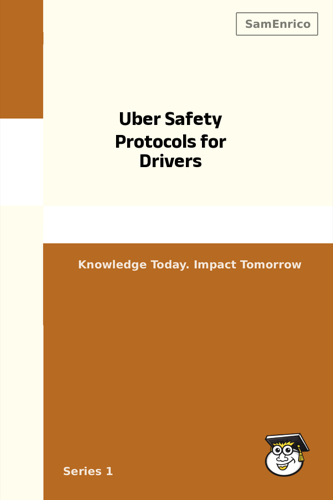
Uber Safety Protocols for Drivers eBook
Risk management strategies and insurance considera
Risk management strategies and insurance considerations for rideshare operators.
Formats
Free sample
Chapter 1: The Phase Trap--It was 11:47 PM on a Saturday, and Maria had just finished her third trip of the night—a quiet ride from a downtown restaurant to a suburban apartment complex. She pulled into a well-lit gas station parking lot, the same one she always used between fares, and did what she had done thousands of times before: she left the Uber app running. No passenger. No ride accepted. Just waiting.
The app displayed the familiar swirling graphic searching for the next request. Maria checked her mirrors, adjusted her seat, and took a sip of water. Thirty seconds later, a pickup truck ran a red light at forty-five miles per hour and slammed into her driver's side door. The impact spun her car one hundred eighty degrees. Airbags deployed.
Glass shattered. Maria survived with a concussion and three cracked ribs. Her car did not. It was totaled. In the days that followed, Maria learned something that no Uber training video had ever taught her: she was completely unprotected for her own vehicle damage at the exact moment she needed coverage most.Maria was in Phase 1.
And Phase 1 is the most misunderstood, most dangerous, and most financially devastating gap in the entire rideshare insurance system.The Four-Phase Framework Every Driver Must Memorize Before we go any further, you need to understand something that Uber and Lyft will never explain to you in plain language. Your insurance coverage is not a single constant. It changes dramatically depending on what you are doing in the app at any given moment. Insurance companies and rideshare platforms divide your driving time into four distinct phases. Each phase has different rules, different coverage amounts, and different gaps.
If you do not know which phase you are in at all times, you are driving blind.Let us walk through each phase in detail, because your financial future depends on understanding the difference between liability coverage and collision coverage.Phase 0: Offline – The Personal Zone When your app is completely off, you are driving for personal purposes. Maybe you are going to the grocery store. Maybe you are picking up your kids from school. Maybe you are driving across town to meet friends for dinner. Whatever the reason, your personal auto policy is the only coverage that applies.
No rideshare coverage is active. Your personal insurer is responsible for everything, provided you have been honest with them about how you use your vehicle.Here is the critical point about Phase 0: it is the only time your personal insurer will protect you without question. The moment you turn that app on, the rules change. Many drivers do not realize this. They assume that because they have a good relationship with their insurance agent, or because they have been with the same company for twenty years, their personal policy will cover them no matter what.
That assumption can cost you everything, as you will see in Chapter 2.Phase 1: Waiting for a Trip – The Dangerous Gap This is the phase that ruined Maria's car and her savings account. Phase 1 begins the moment you turn on the Uber or Lyft app and continues until you accept a ride request. You are online. You are available. You are waiting for the chime that signals your next fare.
But no passenger is in your car, and no pickup location has been assigned.Now here is the confusing part, and I want you to read this carefully because it is where most drivers get into trouble. In Phase 1, Uber and Lyft provide what is called contingent liability coverage. That means if you cause an accident that injures someone else or damages their property, the rideshare company's one million dollar policy will cover that liability. The other driver's BMW, the pedestrian you accidentally hit, the storefront you crashed into—all of that is covered by Uber or Lyft.But what about damage to your own vehicle? What about the three thousand dollar repair bill for your own car?
What about the five thousand dollar cost to replace your own bumper, your own windshield, your own engine?Nothing. Zero. Not a single dime.In Phase 1, the rideshare company's policy does not cover your own vehicle at all. Not for collision. Not for comprehensive.
Not for theft. Not for fire. Not for vandalism. If you are at fault in Phase 1, your own car repairs come entirely out of your pocket. If you are not at fault but the other driver is uninsured, your own car repairs still come out of your pocket.
If a tree falls on your car while you are waiting for a ride, the rideshare company will pay zero.This is the dangerous gap. And it is the single most common misunderstanding among rideshare drivers. Drivers assume that because the app is on, they are covered. They are half right. They are covered for the damage they cause to others.
They are not covered for damage to their own vehicle.Phase 2: En Route to Pickup – Coverage Begins, With a Catch Phase 2 begins the moment you accept a ride request and ends the moment the passenger opens your door. You are driving to the pickup location. The app shows you the route, the passenger's name, and their rating. You are actively engaged in a commercial trip.In Phase 2, everything changes. Your contingent liability coverage continues, but now contingent comprehensive and collision coverage kicks in for your own vehicle.
If you are in an accident while driving to pick up a passenger, Uber or Lyft will cover damage to your car.But here is the catch, and it is a big one. That coverage comes with a deductible. As of the time this book was written, the standard deductible for both Uber and Lyft in most states is twenty five hundred dollars. That means if you cause an accident in Phase 2, you must pay the first twenty five hundred dollars of your own car repairs before the rideshare company pays anything. We will spend all of Chapter 5 on this deductible problem, because twenty five hundred dollars is an amount that most drivers cannot pay out of pocket without going into debt.Phase 3: Passenger Onboard – The Highest Level of Coverage Phase 3 begins when the passenger enters your vehicle and ends when they exit at their destination.
Your passenger is buckled in. You are driving them to their requested location. This is the phase where you are most obviously engaged in commercial activity, and it is also the phase where the rideshare company provides its highest level of coverage.The same one million dollar liability policy applies. The same contingent comprehensive and collision coverage applies. And the same twenty five hundred dollar deductible applies.
The difference is that Phase 3 also includes coverage for certain passenger injuries and, in some states, uninsured motorist protection for you and your passengers.But do not be fooled into thinking Phase 3 is risk-free. The deductible still applies. The coverage gaps for lost wages still apply. And as you will learn in Chapter 11, filing a claim against Uber or Lyft's insurance policy is not a simple or fast process.Why the Distinction Between Liability and Collision Matters At this point, you might be thinking…
This is the end of the free sample. Get the eBook to keep going. Buy now
About this book
Details
- Author
- Hamilton Kristy
- Publisher
- SamEnrico
- Language
- English
- Genre
- Non-Fiction, Business Brief, Safety
- Released
- 2026-06-10
- Pages (approx.)
- 147
- Available as
- eBook, Audiobook

Read better in the ZLOADR app
Your eBooks on your phone or tablet. Sign in with your SamEnrico account and start reading.
More by Hamilton Kristy
 Remote Media Communication GuideHamilton Kristy$11.99
 The Apology NonverbalsHamilton Kristy$11.99
 Gambling Addiction Recovery for Athletes CourseHamilton Kristy$11.99
 Anticipatory Grief TipsHamilton Kristy$11.99
 Rock Climber Flexibility Training GuideHamilton Kristy$11.99
 Daily Review Five Minute RitualHamilton Kristy$11.99
 The Attendance Requirement StressHamilton Kristy$11.99
 Hearst International NewsHamilton Kristy$11.99
 The Silk Road's Shadow Traders: Uncovering the Secret Networks of the Trans-Saharan Spice WarsHamilton Kristy$11.99
 The Blood and Gold of the Peninsular War: How Money Fueled Wellington's TriumphHamilton Kristy$11.99
 Rhythm & Rebellion: The Jazz Age's Secret WeaponHamilton Kristy$11.99
 The Complete Guide to Vegan Diet DeficienciesHamilton Kristy$11.99
You may also like
 Hong Kong Handover 1997Dunn Johnnie$11.99
 Zumba For Postnatal Recovery CourseNeal Christian$11.99
 Zumba for BeginnersLadner Nikia$11.99
 YouTube Comment Mining GuideHumes Pandora$12.99
 Worry Box MeditationCarlin Rudy$11.99
 Workplace Stress MeditationNguyen Lynn$11.99
 Workplace Stress and Sleep RepairHawley Ivory$11.99
 Workplace Perfectionism CureDelaney Jeffry$11.99
 Workplace Injustice Anger GuideWallen Isabelle$11.99
 Work Addiction and Burnout LinkGreenwood Ester$11.99
 Women in Yoga and WellnessBeattie Galina$11.99
 Women in Stand Up ComedyChun Evangeline$11.99