

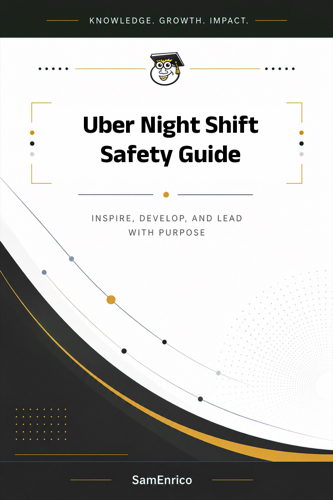
Non-FictionBusiness BriefNight Work Safety
Uber Night Shift Safety Guide eBook
Protect yourself during late hours with cameras, c
Protect yourself during late hours with cameras, check-ins, and high-visibility routes.
Formats
Free sample
Chapter 1: The Predator’s Window--–- The night does not make you a target. The night reveals that you were already one.At 1:47 AM on a Tuesday in Austin, Texas, a 34-year-old Uber driver named Marcus pulled into a cul-de-sac behind a shuttered laundromat. The pickup pin showed a generic address—no house, no business, just a point on a map. His GPS said "You have arrived." His gut said something else. Three figures emerged from the shadows between two dumpsters.
They were not wearing the bright clothing of late-night workers or the sluggish stumble of bar patrons. They moved deliberately, spreading out as they approached his car. Marcus later told police he had three seconds of clarity before one of them pulled on his rear door handle. It was locked. He had locked it instinctively, without thinking, a habit from his first week on the job.
He drove away with the door handle still bouncing. The police report noted that two other rideshare drivers had been robbed at that same GPS pin in the previous month. Both had unlocked their doors. Both had been beaten. One lost his car.Marcus got lucky.
This book exists so you never have to rely on luck.This chapter is not a collection of horror stories to keep you awake. It is a tactical breakdown of why the hours between 10 PM and 6 AM transform ordinary rides into high-stakes encounters, and why most drivers never see the danger until it is already inside their vehicle. You cannot defend against a threat you refuse to recognize. By the end of this chapter, you will understand the predator’s calendar, the predator’s clock, and the predator’s calculus. More importantly, you will understand why your fatigue, your politeness, and your trust in the app are the three weapons used against you most effectively.The Darkness as an Accomplice Predators do not fear the dark.
They use it.Street crime follows predictable light patterns. Assaults, robberies, and carjackings spike not at midnight but between 1:00 AM and 3:30 AM—the period when bars close, streetlights are at their lowest maintenance priority, and the fewest witnesses remain outdoors. According to data compiled from rideshare incident reports across seventeen US cities, 63 percent of serious driver-passenger conflicts occur between 10 PM and 6 AM, with the highest concentration between 1:00 AM and 2:30 AM. That is not random. That is selection.Bad actors choose night hours for three tactical reasons.
First, reduced natural surveillance means fewer cameras, fewer pedestrians, and fewer police patrols. A fight in a well-lit parking lot at noon attracts a dozen cell phone cameras. A fight in a dark cul-de-sac at 2 AM attracts nothing except the echo. Second, darkness provides concealment for pre-attack behaviors—adjusting a waistband, reaching into a pocket, signaling to accomplices. In daylight, these movements are obvious.
Under a single flickering streetlight, they are shadows within shadows. Third, night driving fatigues your responses. A predator knows that a driver at hour six of a shift has slower reaction times, reduced peripheral vision, and a greater reluctance to cancel a ride because they have already driven fifteen minutes to reach the pickup.This is not paranoia. This is pattern recognition.A 2022 analysis of rideshare safety data found that drivers who began their shifts before 8 PM and ended before 2 AM reported 41 percent fewer safety incidents than drivers who worked exclusively between 10 PM and 6 AM. However, the same analysis found that drivers who worked the overnight shift but followed a structured safety protocol—including pre-ride vehicle checks, mandatory interior lighting, and a no-cancel-penalty backup plan—reduced their incident rate to within 12 percent of daytime drivers.
In other words, the night shift is more dangerous, but the danger can be systematically mitigated. That is the entire purpose of this book.The Fatigue Blindness Phenomenon You believe you are alert. You are not.At hour four of a night shift, your cognitive performance degrades to the equivalent of a blood alcohol concentration of 0.05 percent—legally impaired in most contexts. At hour six, that degradation reaches 0.08 percent, the legal limit for driving. At hour eight, you are functioning as if you have had three drinks.
The terrifying reality is that you are legally allowed to transport passengers in this condition, and the app will continue sending you requests while your brain slowly shuts down.Fatigue impairs specifically the parts of your brain responsible for threat detection. The prefrontal cortex, which handles risk assessment and impulse control, slows down first. Your amygdala, the primitive alarm system that screams "danger," becomes less sensitive. This is why tired drivers accept rides they would reject when fresh. This is why tired drivers unlock their doors before verifying the passenger.
This is why tired drivers miss the red flags that, six hours earlier, would have triggered an immediate cancel.A predator can read fatigue. It is visible in your posture (slumped shoulders), your eyes (slow blinking, reduced scanning), and your voice (flat tone, delayed responses). Professional carjackers and robbers often case parking lots and pickup zones specifically looking for drivers who appear exhausted. You are not being targeted at random. You are being selected because you look like an easy win.The chapter will return to fatigue management in detail in Chapter 10, including the personal cutoff time exercise and strategic napping locations.
For now, the critical takeaway is this: your judgment after midnight is not your judgment at noon. Do not trust your tired brain to make safety decisions. Trust your pre-shift protocols and your automated check-ins instead.High-Risk Behaviors The Gift of Fear Taught Us Gavin de Becker’s "The Gift of Fear" remains the foundational text for understanding how predators communicate through apparently normal behavior. The book’s core insight is simple but revolutionary: violence is rarely impulsive. It is preceded by a series of testing behaviors designed to see if the target will resist.
For rideshare drivers, these behaviors appear as seven specific red flags that should trigger immediate cancellation.First, over-explaining the destination. A legitimate passenger says "Take me to 1420 Maple Street." A high-risk passenger says "I need to go to 1420 Maple Street, it's my friend's apartment, he's waiting for me, I've been there before, it's just past the light, you can't miss it." The excessive detail is not helpful. It is rehearsal. The passenger is trying to convince themselves, not you.Second, changing the route multiple times. A passenger who says "Turn left here" and then "Actually go straight" and then "No, turn right at the next light" is not confused.
They are testing whether you will comply with commands without question. Predators want compliant targets.Third, refusal to make eye contact during verification. When you ask "What's the name on the ride?" a legitimate passenger looks at you. A high-risk passenger looks at the ground, the back seat, their phone—anywhere except your face. They do not want to be remembered.Fourth, "hurry up" pressure.
Statements like "Come on, let's go" or "I'm in a rush" or "Just drive, I'll tell you" are attempts to short-circuit your verification process. Predators know that the longer you wait, the more likely you are to notice something wrong. Speed is their ally.Fifth, asking to stop at…
This is the end of the free sample. Get the eBook to keep going. Buy now
About this book
Details
- Author
- Tackett Argentina
- Publisher
- SamEnrico
- Language
- English
- Genre
- Non-Fiction, Business Brief, Night Work Safety
- Released
- 2026-06-09
- Pages (approx.)
- 137
- Available as
- eBook, Audiobook

Read better in the ZLOADR app
Your eBooks on your phone or tablet. Sign in with your SamEnrico account and start reading.
More by Tackett Argentina
 Post Traumatic Growth GuideTackett Argentina$11.99Post Traumatic Growth GuideTackett Argentina$11.99
 Public Speaking for NeurodivergentTackett Argentina$11.99
 Immigrant Entrepreneur ResilienceTackett Argentina$11.99
 The Rescripting Safety PlanTackett Argentina$11.99
 The Arm Drop InductionTackett Argentina$11.99
 Pregnancy Master GuideTackett Argentina$11.99
 Doe Network Skeletal Trauma AnalysisTackett Argentina$11.99
 The Forgotten Champions: Africa's 19th-Century Track and Field PioneersTackett Argentina$11.99
 The African Diamond: How a Kenyan Pitcher Changed the World SeriesTackett Argentina$11.99
 How to Produce Nursing Pads and ShieldsTackett Argentina$11.99
 A Collector's Handbook to the Singer Super TenTackett Argentina$11.99
You may also like
 Hong Kong Handover 1997Dunn Johnnie$11.99
 Zumba For Postnatal Recovery CourseNeal Christian$11.99
 Zumba for BeginnersLadner Nikia$11.99
 YouTube Comment Mining GuideHumes Pandora$12.99
 Worry Box MeditationCarlin Rudy$11.99
 Workplace Stress MeditationNguyen Lynn$11.99
 Workplace Stress and Sleep RepairHawley Ivory$11.99
 Workplace Perfectionism CureDelaney Jeffry$11.99
 Workplace Injustice Anger GuideWallen Isabelle$11.99
 Work Addiction and Burnout LinkGreenwood Ester$11.99
 Women in Yoga and WellnessBeattie Galina$11.99
 Women in Stand Up ComedyChun Evangeline$11.99