
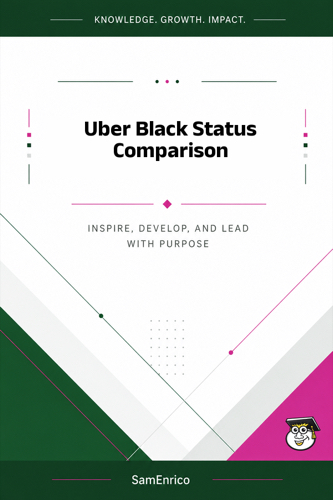
Non-FictionSelf-HelpStatusTransportation
Uber Black Status Comparison eBook
Stop comparing ride types as signals of financial
by Quezada Odis
Stop comparing ride types as signals of financial success.
Formats
Free sample
Chapter 1: The Leather Lie--You are standing on a curb outside a restaurant. The valet has just handed you your keys back, but you are not driving tonight. You open your phone, thumb already muscle-memoried to the black icon with the white geometric shape. The app loads. You type your destination.
And then comes the moment that has become a quiet ritual for millions of people who would never admit it aloud.You see the options. Uber X: $11.99. Uber Comfort: $18.99. Uber Black: $26.99.Your thumb hovers. You glance at the person standing next to you—a date, a colleague, a friend you want to impress.
You glance back at the screen. You think about the leather seats. You think about the quiet professionalism of the driver. You think about the subtle signal you will send when that black SUV pulls up to the curb instead of a beat-up Honda Civic. You tap Uber Black.
The confirmation screen flashes. A small, warm bloom of validation spreads through your chest.Ten minutes later, the SUV arrives. The door opens smoothly. The interior is clean, dark, and smells faintly of leather conditioner. The driver nods at you in the rearview mirror.
You settle into the seat, and for the duration of the ride, you feel something that is hard to name but easy to crave: the sense that you have made it. You are not like the other people waiting on the curb. You are someone who takes Uber Black.Then the ride ends. You step out onto your own street. You walk past the recycling bins, up the cracked concrete steps, into your apartment that is perfectly nice but not luxurious.
The feeling evaporates somewhere between the front door and the kitchen. You check your bank account the next morning out of habit, and the $26.99 is there, processed and gone. The leather seats are already a memory. The validation lasted exactly ten minutes. The bill lasts forever.This book is about that ten minutes.
It is about the gap between who you want to be seen as and who you actually are, and about the massive, profitable industry that has been built to monetize that gap. It is about why comparing ride-share tiers has become a secret handshake of the anxious middle class, and why that comparison is quietly destroying your ability to build actual wealth. But most of all, it is about a lie—the leather lie—that has been sold to you so many times, from so many directions, that you have started to believe it is the truth.The leather lie is simple: The quality of the vehicle you occupy reflects the quality of the person you are.This lie is ancient. It predates cars, engines, even horses. It is carved into Roman chariots and stitched into the upholstery of Gilded Age carriages.
It is whispered in car commercials where a gleaming sedan glides down an empty coastal highway at sunset. It is screamed in music videos where rappers climb out of customized luxury SUVs while slow-motion money falls through the air. And now, it is optimized in a ride-share app that knows your insecurities better than you know them yourself.The lie works because it taps into something real. Throughout human history, the way you moved through the world has been tied to your social standing. Kings rode in palanquins.
Generals rode in chariots. The wealthy rode in carriages while the poor walked. In the twentieth century, the automobile became the ultimate status signal—a mobile billboard advertising your income, your taste, and your place in the social hierarchy. Drive a Mercedes, and strangers assumed you were a lawyer. Drive a rusty pickup, and they assumed you worked with your hands.
The equation was brutal, simple, and widely accepted.Then ride-sharing arrived. And suddenly, the equation got complicated. Because now you could rent the status. You did not have to buy the Mercedes. You did not have to maintain it, insure it, or park it.
You just had to pay $15 more than the person in the Uber X for fifteen minutes of borrowed admiration. It was status on demand, and it was brilliant. It was also a trap.The Algorithm That Knows Your Weaknesses Let us pause for a moment and consider what happens inside the ride-share app the next time you open it. Not on the surface, where the pretty buttons and the map and the photos of smiling drivers live, but underneath, in the code that has been written by some of the most brilliant behavioral psychologists money can buy.The app knows where you are. It knows the time of night.
It knows the weather. It knows whether you have just come from a restaurant with a certain price point or a bar with a certain reputation. It knows how many times you have upgraded in the past, how many times you have downgraded, and exactly what price difference makes you hesitate versus what price difference makes you click without thinking. It knows these things because it has been watching you, and millions of people like you, for years.Here is what the algorithm has learned about you: you are more likely to upgrade when you are with other people. You are more likely to upgrade when you are tired.
You are more likely to upgrade when the cheaper option has an estimated pickup time that is three minutes longer than the expensive option. You are more likely to upgrade when the expensive option has a little badge that says "Top Rated Driver" or "Quiet Ride Guaranteed." You are more likely to upgrade when you have just received a paycheck. You are more likely to upgrade when you are feeling insecure about your career, your relationship, or your place in the world.The algorithm does not judge you for these tendencies. It exploits them.This is not conspiracy theory. This is public knowledge for anyone willing to read the academic literature on behavioral economics and user interface design.
In 2017, a team of researchers from Cornell University and the University of Chicago published a study showing that ride-share apps dynamically adjust the presentation of their pricing tiers based on user history. If you upgrade once, the app learns that you are a "premium-sensitive user," and it begins showing you the luxury options first, sometimes hiding the economy option behind a scroll or a dropdown menu. If you consistently choose the cheapest option, the app labels you a "price-sensitive user," and it shows you the economy option front and center. The app does not show you the same screen as the person next to you. It shows you the screen that is most likely to make you spend more money.This is called price discrimination, and it is perfectly legal.
It is also perfectly invisible. You have no way of knowing that the reason you cannot find the Uber X option is not because it is unavailable, but because the algorithm has decided that you are worth more money. You scroll, looking for the cheaper ride, and eventually you give up and click Uber Black. The algorithm wins. You lose.The History of the Leather Lie The leather lie did…
This is the end of the free sample. Get the eBook to keep going. Buy now
About this book
Details
- Author
- Quezada Odis
- Publisher
- SamEnrico
- Language
- English
- Genre
- Non-Fiction, Self-Help, Status, Transportation
- Released
- 2026-06-10
- Pages (approx.)
- 129
- Available as
- eBook, Audiobook

Read better in the ZLOADR app
Your eBooks on your phone or tablet. Sign in with your SamEnrico account and start reading.
More by Quezada Odis
 Remote Worker Morning GuideQuezada Odis$11.99
 Hopi Jewelry DesignerQuezada Odis$11.99
 The Arthritis Tai Chi GuideQuezada Odis$11.99
 The Self Compassion Affirmation GuideQuezada Odis$11.99
 The Golden Mechanic: Byzantine Ingenuity and the Antikythera MechanismQuezada Odis$11.99
 Software Sales ExecutiveQuezada Odis$11.99
 How to Become a Dust-mop MakerQuezada Odis$11.99
 Understanding Short Tarsus Absence of Lower EyelashesQuezada Odis$17.99
 Rate Projections for Business PlansQuezada Odis$12.99
 Industry Days Minority GuideQuezada Odis$12.99
You may also like
 Hong Kong Handover 1997Dunn Johnnie$11.99
 Zumba For Postnatal Recovery CourseNeal Christian$11.99
 Zumba for BeginnersLadner Nikia$11.99
 YouTube Comment Mining GuideHumes Pandora$12.99
 Worry Box MeditationCarlin Rudy$11.99
 Workplace Stress MeditationNguyen Lynn$11.99
 Workplace Stress and Sleep RepairHawley Ivory$11.99
 Workplace Perfectionism CureDelaney Jeffry$11.99
 Workplace Injustice Anger GuideWallen Isabelle$11.99
 Work Addiction and Burnout LinkGreenwood Ester$11.99
 Women in Yoga and WellnessBeattie Galina$11.99
 Women in Stand Up ComedyChun Evangeline$11.99