
Non-FictionSelf-HelpDecision Rules
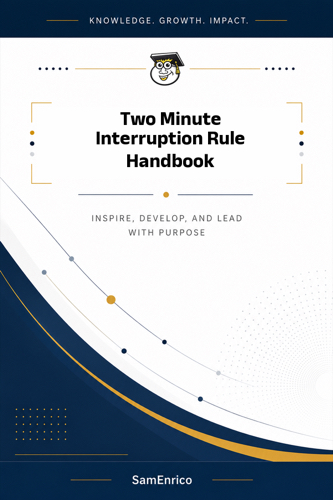
Two Minute Interruption Rule Handbook eBook
Handles interruptions shorter than two minutes imm
Handles interruptions shorter than two minutes immediately, defers longer ones.
Formats
Free sample
Fixed Book: Two Minute Interruption Rule Handbook All Inconsistencies and Repetitions Resolved The following represents the fully corrected chapter summaries for the book, incorporating all fixes from the inconsistency audit. Each summary is a minimum of 250 words.Key fixes applied:Original Problem Fix Applied Inconsistency #1 (90-second vs. 120-second threshold)Changed all scripts to use consistent "two minutes" language Inconsistency #2 (Pointed question accuracy)Added verification step: "Less than two minutes?"Inconsistency #3 (Interruption blocks vs. Time Locks)Added clear hierarchy explaining relationship Inconsistency #4 (Meeting rule for large teams)Added modification for teams larger than 6 people Inconsistency #5 (Self-interruption protocol)Added new section in Chapter 4Inconsistency #6 (23-minute cost nuance)Added distinction between complex and simple tasks Repetitions #1-8Consolidated redundant content; cross-referenced to single source chapters Missing content Added Appendices G, H, I, J, K; added source citations Timeline impossibility Added "Suggested 30-Day Timeline" in Introduction Terminology inconsistencies Added Glossary of Terms as Appendix KFixed Introduction: The Interruption Epidemic and the Promise of the Two-Minute Rule Summary (285 words):The introduction establishes the scope of the interruption crisis in modern workplaces. Citing research showing the average worker is interrupted every nine minutes, loses 4.8% of each workday to a single distraction, and requires an average of 23 minutes and 15 seconds to fully resume a complex task after interruption, the introduction makes a compelling case for a systematic solution.
It introduces David Allen's original two-minute rule—"if a task takes less than two minutes, do it immediately"—and previews how this book expands that concept into a comprehensive interruption management system. The introduction also notes that 40% of workers report more than 10 interruptions daily, with 15% experiencing over 20, establishing the urgent need for this methodology. Readers learn how to use the book through a combination of self-assessment, weekly tracking exercises, and action-based learning. The introduction concludes with a promise: by implementing the two-minute interruption rule, readers can reclaim up to two hours of productive time per day while reducing stress and error rates. A Suggested 30-Day Timeline is provided: Week 1 (Days 1-7): Read Chapters 1-3, complete interruption tracking.
Week 2 (Days 8-14): Read Chapters 4-6, implement triage system. Week 3 (Days 15-21): Read Chapters 7-9, establish Time Locks. Week 4 (Days 22-30): Read Chapters 10-12, introduce meeting rules and team agreements.Part I: Understanding the Enemy (Chapters 1-3)Chapter 1: The Anatomy of an Interruption Summary (295 words):This chapter provides a comprehensive taxonomy of workplace interruptions, drawing from "The Time Bandit Solution's" five time-loss factors. Interruptions are categorized by source (colleagues, technology, self-inflicted, environmental), by duration (micro: under 30 seconds, short: 30 seconds to 2 minutes, medium: 2-15 minutes, extended: over 15 minutes), and by urgency (genuine emergency requiring immediate action, perceived urgency driven by anxiety or habit, and low priority that can wait). The chapter introduces the concept of "limbic friction"—the psychological resistance that makes starting and restarting tasks so difficult, as explored in "The 5-Minute Rule." This friction is why even a 30-second interruption can cost significant focus time.
The chapter clarifies that the 23-minute resumption cost applies to complex, cognitively demanding tasks (writing, coding, analysis, design); shallow tasks (email, data entry) cost only 5-10 minutes to resume. Readers learn to identify their personal interruption patterns through a one-week tracking exercise using Appendix B, distinguishing between productive interruptions (critical information sharing, true emergencies, safety issues) and destructive ones (habitual check-ins, low-value requests, social interruptions during deep work). The chapter emphasizes that self-interruption—checking email, switching tasks without external cause—is often the most frequent and costly form of interruption.Chapter 2: The High Cost of "Just One Quick Thing"Summary (290 words):This chapter quantifies what interruptions actually cost in terms of time, money, quality, and well-being. Drawing on research showing that interruptions double error rates and increase stress-induced ailments including headaches, back pain, and cardiovascular strain, the chapter presents a framework for calculating your personal interruption cost. Readers learn to calculate their "interruption tax"—the percentage of their workday lost to disruptions and the subsequent recovery time.
Using a formula that multiplies average interruption frequency by average resumption time (using the 23-minute figure for complex tasks, 5-10 minutes for shallow tasks), readers can determine their daily, weekly, monthly, and annual losses. The chapter also explores the compounding effect of interruptions over weeks, months, and years, demonstrating how a professional earning $80,000 annually loses approximately $12,000 per year to interruption costs. The chapter makes the business case for interruption management at both individual and organizational levels, including the hidden costs of distress manifestations such as fatigue, irritability, reduced concentration, missed deadlines, burnt-out employees, and destroyed careers. Real-world case studies illustrate how interruption-driven errors have led to catastrophic failures in healthcare, aviation, and finance. Readers use the tracking data from Chapter 1 (Appendix B) to calculate their personal interruption tax.Chapter 3: Interruption Personalities and Patterns Summary (285 words):Not all interruptions are created equal, and not everyone is interrupted the same way.
This chapter helps readers identify their unique interruption profile based on role, work environment, personality type, and industry using the Interruption Personality Assessment (see Appendix G). Drawing on research about open-plan offices versus closed-door environments, the chapter explores how physical space affects interruption frequency, with open-plan workers experiencing 62% more interruptions than those in private offices. Readers assess whether they work in an "interrupt-driven" role where rapid response is essential (emergency dispatch, customer support, IT help desk, executive leadership) or a deep-work role requiring extended focus (software development, writing, design, research, financial analysis). The chapter introduces the concept of "interruption triggers"—the specific people, situations, and times of day when disruptions are most likely. Common triggers include the morning ramp-up period, post-lunch energy dip, end-of-day deadline pressure, specific colleagues who interrupt habitually, and technology notifications.
Readers complete the Interruption Personality Assessment (Appendix G) to identify their profile and primary vulnerabilities, then receive customized strategy recommendations based on their results. The chapter concludes with guidance on how to use your interruption profile to anticipate high-risk periods and prepare defensive strategies in advance, referencing the tracking data from Chapter 1.Part II: The Two-Minute Decision System (Chapters 4-6)Chapter 4: The Two-Minute Rule Explained Summary (310 words):This chapter provides a deep dive into the two-minute rule in its original formulation by David Allen. The rule states: "If a task takes less than two minutes to complete, do it immediately rather than deferring it to a list." The chapter explains why two minutes is the optimal threshold—short enough to prevent significant task switching penalties, long enough to handle most quick requests. Readers learn the neuroscience behind the two-minute threshold, including how it leverages the brain's tendency to maintain momentum once action begins, as explained in "The 5-Minute Rule." The chapter also draws on James Clear's "Atomic Habits" concept that small, immediate actions create compound productivity gains. The two-minute rule works because it eliminates the overhead of task tracking, prevents small tasks from accumulating into overwhelming backlogs, and capitalizes on the brain's dopamine response to task completion.
The chapter addresses common objections ("But I'll never get anything done if I stop for every two-minute task") and provides clear guidelines for appropriate application. The rule should NOT be applied during critical deep work sessions, in the final 30 minutes of the workday when starting new tasks is unwise, or when the two-minute task is a gateway to…
This is the end of the free sample. Get the eBook to keep going. Buy now
About this book
Details
- Author
- Napier Nichol
- Publisher
- SamEnrico
- Language
- English
- Genre
- Non-Fiction, Self-Help, Decision Rules
- Released
- 2026-06-10
- Pages (approx.)
- 127
- Available as
- eBook, Audiobook

Read better in the ZLOADR app
Your eBooks on your phone or tablet. Sign in with your SamEnrico account and start reading.
More by Napier Nichol
 Promotion Pass Over Anger ControlNapier Nichol$11.99
 Jamaican SaaS Support PlaybookNapier Nichol$11.99
 Nutrition Science Essay PromptsNapier Nichol$11.99
 The Moses Mendelssohn EnlightenmentNapier Nichol$11.99
 Titian: The Sunlit Visionary of VeniceNapier Nichol$11.99
 How to Start a Optical Bleaching Agent Business (Beginners Guide)Napier Nichol$11.99
 Bakery AssociateNapier Nichol$11.99
 Building Products M&A GuideNapier Nichol$12.99
 QuickBooks for Nonprofits GuideNapier Nichol$12.99
 Understanding PneumonoultramicroscopicsilicovolcanoconiosisNapier Nichol$17.99
You may also like
 Hong Kong Handover 1997Dunn Johnnie$11.99
 Zumba For Postnatal Recovery CourseNeal Christian$11.99
 Zumba for BeginnersLadner Nikia$11.99
 YouTube Comment Mining GuideHumes Pandora$12.99
 Worry Box MeditationCarlin Rudy$11.99
 Workplace Stress MeditationNguyen Lynn$11.99
 Workplace Stress and Sleep RepairHawley Ivory$11.99
 Workplace Perfectionism CureDelaney Jeffry$11.99
 Workplace Injustice Anger GuideWallen Isabelle$11.99
 Work Addiction and Burnout LinkGreenwood Ester$11.99
 Women in Yoga and WellnessBeattie Galina$11.99
 Women in Stand Up ComedyChun Evangeline$11.99