
Non-FictionStartup GuidePaid TrialSkills Test
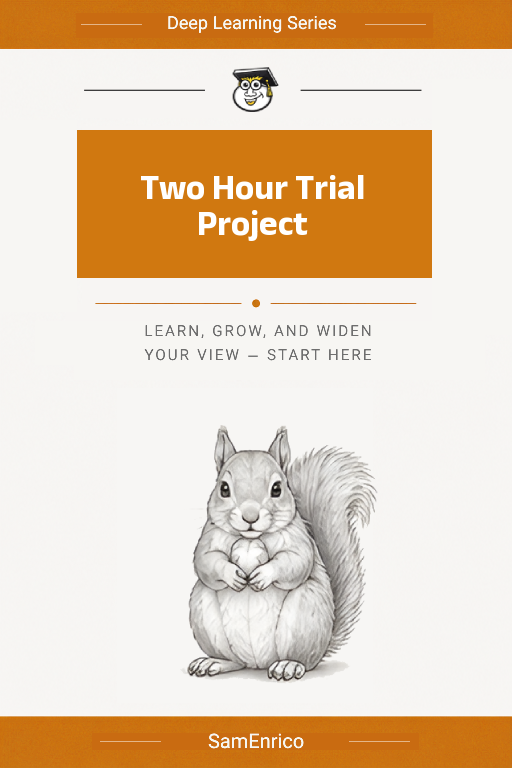
Two Hour Trial Project eBook
Pay candidates for a 2-hour paid trial building a
Pay candidates for a 2-hour paid trial building a small feature or fix.
Formats
Free sample
Chapter 1: The Audition Trap--–- The email arrived at 11:47 PM on a Tuesday. Sarah, a senior backend engineer with twelve years of experience, had just finished putting her two children to bed. She opened her laptop to find a message from a fast-growing startup she admired: "Congratulations on making it to the final round! Please complete our take-home coding project. Estimated time: 8-10 hours.
Deadline: Sunday at midnight. This is unpaid."She stared at the screen. Eight to ten hours. Unpaid. She had a full-time job, two kids, a mortgage, and a burning question: why was she being asked to work for free for a company that had just raised $50 million in Series B funding?
She closed her laptop, wrote a polite rejection, and never applied there again. That startup spent the next three months complaining about how hard it was to find "committed" senior engineers.This is not an isolated story. It happens thousands of times every day across the technology industry. And it reveals a deep, systemic failure in how we evaluate talent.The Cost of Getting It Wrong Let us start with a story that ended very differently. A well-funded startup spent six weeks interviewing a senior backend engineer.
Their process was thorough by conventional standards: resume screening, a thirty-minute phone screen, four rounds of whiteboard coding challenges, a twelve-hour take-home project, and an onsite interview with six separate people. They hired the candidate. He quit after ninety days.His exit interview was devastating. "The actual work is nothing like the interview," he said. "I spent six weeks solving puzzles and writing code nobody will ever use.
On my first day, I inherited a legacy codebase with no tests, a bug tracker with four hundred open issues, and a product manager who changes requirements twice a week. None of your interview process prepared me for that, and none of it helped you see that I hate that kind of work."The cost of that single mis-hire, by the company's own accounting: $120,000 in sunk recruiting fees, lost productivity during his ninety-day ramp-up, manager distraction, and the cost of reopening the search. But the true cost was higher. Three team members quit within six months, citing burnout from covering the mis-hire's failed deliverables. The startup missed its product launch by four months.
A competitor launched first and captured the market.This is not an edge case. According to the US Department of Labor, a bad hire costs at least 30% of the employee's first-year earnings. For a 120,000role,thatis120,000 role, that is 120,000role,thatis36,000 in direct costs. But for technical roles with high collaboration requirements, the true cost approaches 100-200% of salary. Why?
Because a single underperforming engineer does not just fail to contribute. They actively consume the time and energy of everyone around them.Consider the math. A senior engineer earning 120,000coststhecompanyroughly120,000 costs the company roughly 120,000coststhecompanyroughly60 per hour including benefits. If that engineer spends two hours per day helping a struggling hire, that is 120perday,120 per day, 120perday,600 per week, 30,000peryear—justinseniorengineertimedivertedfromproductivework.Multiplythatacrossateamoffivetoeightpeople,andthenumbersbecometerrifying.Abadhiredoesnotcost30,000 per year—just in senior engineer time diverted from productive work. Multiply that across a team of five to eight people, and the numbers become terrifying.
A bad hire does not cost 30,000peryear—justinseniorengineertimedivertedfromproductivework.Multiplythatacrossateamoffivetoeightpeople,andthenumbersbecometerrifying.Abadhiredoesnotcost36,000. They cost $100,000 or more.The Resume Delusion Why do companies continue to make these expensive mistakes? The answer begins with a false god: the resume.Drawing from Work Rules! by Laszlo Bock, the former head of People Operations at Google, this chapter reveals a shocking finding. Google, a company built on data, decided to test whether its hiring process actually worked.
They analyzed every piece of data they had: resumes, GPAs, test scores, interview ratings, and eventual job performance. The result? Resumes, GPAs, and prestigious degrees collectively explained less than 2% of the variance in who became a top performer.Two percent. That is statistical noise. It means you would be just as accurate flipping a coin as reading a resume.But the industry continues to worship resumes because they feel rigorous.
A resume with Stanford, Google, and five years of experience feels safe. A resume with University of Phoenix, a bootcamp, and three years at a no-name startup feels risky. Yet the data shows that resume is almost useless. What predicts success? Actual work samples.
Real tasks performed in realistic conditions. But traditional interviews almost never use them correctly.The reasons are cultural and psychological. Hiring managers fear being blamed for a bad hire, so they reach for credentials that offer the illusion of safety. Recruiters are measured on time-to-fill, not quality-of-hire, so they prioritize candidates who look good on paper. And candidates have learned to game the system, crafting resumes that tell a story of linear progression and flawless achievement.None of this measures the ability to debug a race condition at 2 AM, refactor legacy code written by someone who left three years ago, or collaborate with a product manager who speaks a different language.
These are the skills that determine success.The Whiteboard Ritual If resumes are useless, whiteboard interviews are actively harmful.The chapter deconstructs the infamous "reverse a binary tree on a whiteboard" problem, tracing its origins to competitive programming culture. In the late 1990s and early 2000s, companies like Microsoft and Google popularized these puzzles as a way to test "raw intelligence." The logic seemed plausible: a smart person can solve any problem, so give them a hard problem and see what happens.But the logic was flawed. These puzzles test three things, none of which predict job performance.First, memorization. Have you seen this problem before? If you have, you will solve it quickly.
If you have not, you will struggle. This favors candidates who spend their free time grinding through coding challenge websites, not candidates who spend their time building actual products.Second, stress tolerance. Can you perform under artificial pressure while someone watches you write on a vertical surface with a dry-erase marker that might run out of ink? This favors candidates who are comfortable being watched, not candidates who think deeply before writing code.Third, conformity. Do you know the ritual?
Have you learned the specific dance moves that signal you are "one of us"? This favors candidates who have been socialized into tech culture, typically young, single, child-free, and male.What do these puzzles not test? Debugging a race condition in production. Refactoring legacy code without breaking anything. Collaborating on a feature spec with a product manager.
Writing a clear commit message. Handling a deployment that failed at 11 PM. Asking for help when you are stuck. Giving constructive code review feedback. Estimating how long a task will take.
Communicating trade-offs to non-technical stakeholders.These are the skills that determine success. None of them appear on a whiteboard.Companies that abandoned whiteboard interviews report dramatic improvements. Basecamp eliminated them entirely and saw no decline in hire quality. Git Lab replaced them with paid trials and reduced time-to-hire by 60%. Automattic, the company behind Word Press, has never used whiteboard interviews and operates one of the most successful distributed engineering teams in the world.The Unpaid Take-Home Epidemic If whiteboard interviews are theater, unpaid take-home assignments are exploitation dressed as rigor.Drawing…
This is the end of the free sample. Get the eBook to keep going. Buy now
About this book
Details
- Author
- Metzger Dovie
- Publisher
- SamEnrico
- Language
- English
- Genre
- Non-Fiction, Startup Guide, Paid Trial, Skills Test
- Released
- 2026-06-01
- Pages (approx.)
- 133
- Available as
- eBook, Audiobook

Read better in the ZLOADR app
Your eBooks on your phone or tablet. Sign in with your SamEnrico account and start reading.
More by Metzger Dovie
 NVC For Parents GuideMetzger Dovie$11.99
 Tenzing Everest DiplomatMetzger Dovie$11.99
 RLS And Mental Health Connection GuideMetzger Dovie$11.99
 The Interruption Energy DrainMetzger Dovie$11.99
 Emotional Intelligence for VolunteersMetzger Dovie$11.99
 Retainage Management GuideMetzger Dovie$11.99
 Personalization Fallacy FixMetzger Dovie$11.99
 Twelve Step After RelapseMetzger Dovie$11.99
 Saadia Gaon Jewish PhilosophyMetzger Dovie$11.99
 The Quantum Whisperer: How a Teen Girl Cracked the Code of TimeMetzger Dovie$11.99
 The Icebound Plague: Viking Healers and the Arctic's First ImmunityMetzger Dovie$11.99
 The Oxford Renaissance: Scholars, Scribes, and the Birth of the Modern MindMetzger Dovie$11.99
You may also like
 Hong Kong Handover 1997Dunn Johnnie$11.99
 Zumba For Postnatal Recovery CourseNeal Christian$11.99
 Zumba for BeginnersLadner Nikia$11.99
 YouTube Comment Mining GuideHumes Pandora$12.99
 Worry Box MeditationCarlin Rudy$11.99
 Workplace Stress MeditationNguyen Lynn$11.99
 Workplace Stress and Sleep RepairHawley Ivory$11.99
 Workplace Perfectionism CureDelaney Jeffry$11.99
 Workplace Injustice Anger GuideWallen Isabelle$11.99
 Work Addiction and Burnout LinkGreenwood Ester$11.99
 Women in Yoga and WellnessBeattie Galina$11.99
 Women in Stand Up ComedyChun Evangeline$11.99