
Non-FictionBusiness BriefEmailTime Management
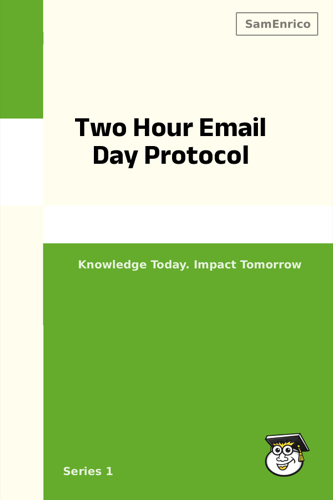
Two Hour Email Day Protocol eBook
Schedule dedicated email blocks to stop constant i
Schedule dedicated email blocks to stop constant inbox interruption.
Formats
Free sample
Chapter 1: The $25,000 Habit--–- Let me ask you a question, and I want you to answer honestly. When you woke up this morning, what was the first thing you did? Not the second thing. Not “I made coffee and then checked email.” The first thing. If you are like ninety percent of the knowledge workers I have surveyed over the past five years, the answer is this: you reached for your phone, tapped the mail icon, and watched those unread messages scroll into view before your feet touched the floor.
You did this while still half-asleep, before you had spoken a single word to another human being, before you had formed a clear thought about what you actually wanted to accomplish that day.I know this because I used to do the same thing. Every morning, without fail. The little red badge would show seventeen new messages, then thirty, then fifty-two, and I would feel a strange combination of dread and importance. Look at me, the badge seemed to say. People need you.
The world is happening, and you are at the center of it. So I would scroll. Sometimes I would reply. Sometimes I would just scan and close the app, feeling vaguely productive, as if the act of looking had somehow moved me forward. Then I would get out of bed, brush my teeth, and start my day already behind.Here is what I did not know at the time, and what this chapter will prove to you beyond any reasonable doubt: that morning scroll was costing me twenty-five thousand dollars per year.
Not in hypothetical “lost opportunity” speak. In real, measurable, cash-on-the-table value. And it is costing you the same.Let me show you the math, because the math is what breaks the spell. Assume you earn fifty dollars per hour. That is a hundred thousand dollars per year for a standard two-thousand-hour work schedule.
Now assume you check email fifty times per day. Fifty times sounds high, but let us be honest with ourselves. A quick check when you wake up. A glance during breakfast. A look on the train or in the car.
Another glance when you sit down at your desk. A peek before your first meeting. A scroll after the meeting. Before lunch. After lunch.
Mid-afternoon. Late afternoon. Before you leave. On the way home. After dinner.
Before bed. Fifty checks is not an exaggeration. For many people, it is an undercount.Now here is the devastating part. Research in cognitive psychology, particularly the work of Gloria Mark at the University of California, Irvine, has shown that it takes an average of twenty-three minutes and fifteen seconds to return to a state of deep focus after an interruption. Twenty-three minutes.
Not one minute. Not five minutes. Twenty-three minutes. But for the sake of being painfully conservative, let us use just one minute of recovery time per check. One minute.
That is fifty minutes per day of recovery cost. Over a two-hundred-fifty-day work year, that is twelve thousand five hundred minutes, or two hundred eight hours. At fifty dollars per hour, that is ten thousand four hundred dollars per year.But that is the conservative estimate. If we use the real research number of twenty-three minutes per interruption, the math becomes staggering. Fifty checks per day times twenty-three minutes equals one thousand one hundred fifty minutes, or nineteen point one hours per day.
That is impossible, of course, because there are only twenty-four hours in a day. What this tells us is that we do not actually return to deep focus most of the time. We simply stop trying. We swim in shallow waters all day, never diving deep, never surfacing with anything valuable. The real cost is not measured in minutes of recovery.
It is measured in the complete absence of deep work. It is measured in the projects you never start, the ideas you never develop, the promotions you never get, the business you never build.This is the twenty-five-thousand-dollar habit. And it is the subject of this chapter.The Neuroscientist Who Changed Everything Let me introduce you to a man named Dr. David Meyer, a cognitive scientist at the University of Michigan. In the late nineteen nineties, Meyer conducted a series of experiments that should have ended the era of workplace multitasking forever.
He put people in f MRI machines and asked them to perform two simple tasks simultaneously: solving math problems and identifying shapes on a screen. The results were unambiguous. When people switched between tasks, their response times slowed by half a second. Half a second does not sound like much, but Meyer calculated that this tiny delay represented a forty percent loss in productivity. More importantly, the brain scans showed that task switching is not just inefficient.
It is exhausting. Each switch required the brain to disengage from one cognitive framework, inhibit that framework from interfering with the next, and activate a completely new set of neural pathways. The brain was doing real work every time you looked away from your spreadsheet and glanced at your inbox.Meyer called this the “switch cost.” I want you to sit with that phrase for a moment. Switch cost. Every time you switch from writing a proposal to checking email, you pay a toll.
That toll is measured in seconds, but seconds add up to minutes, minutes to hours, hours to days, days to your life. The average knowledge worker switches tasks every three minutes and five seconds. That is not a typo. Every three minutes. You never settle into anything long enough to do it well.
You are a hummingbird, flitting from flower to flower, burning enormous energy just to stay aloft, producing nothing of substance.But the switch cost is only half the story. The other half is something called attention residue, and it is the real thief of your focus.The Residue That Ruins Your Day Sophie Leroy, a professor at the University of Washington Bothell, coined the term “attention residue” in a 2009 paper that should be required reading for every manager on earth. Here is what Leroy discovered. When you work on Task A, then switch to Task B, your attention does not fully transfer. A portion of your cognitive resources remains stuck on Task A.
It lingers there like smoke in a room after a fire. You are thinking about what you just did while trying to do what you are doing now. This split attention degrades performance on both tasks. Leroy found that even when people completed Task A before switching, attention residue persisted. The only way to eliminate it was to establish a clear, intentional boundary between tasks.Let me give you a concrete example from my own life.
Before I adopted the Two Hour Email Day Protocol, I was writing a book proposal. This was important work. The proposal would determine whether I got a six-figure advance. I sat down at my desk at nine in the morning, opened my document, and wrote the first sentence. Then my phone buzzed.
A client had sent a quick question about a project timeline. I answered it. Thirty seconds. No big deal. I returned to the…
This is the end of the free sample. Get the eBook to keep going. Buy now
About this book
Details
- Author
- Briseno Maxie
- Publisher
- SamEnrico
- Language
- English
- Genre
- Non-Fiction, Business Brief, Email, Time Management
- Released
- 2026-06-10
- Pages (approx.)
- 129
- Available as
- eBook, Audiobook

Read better in the ZLOADR app
Your eBooks on your phone or tablet. Sign in with your SamEnrico account and start reading.
More by Briseno Maxie
 Self Care Partnership GuideBriseno Maxie$11.99
 Deep Work Flow HandbookBriseno Maxie$11.99
 The Chunking Study GuideBriseno Maxie$11.99
 The Healers of Timbuktu: Africa's Forgotten Medical RenaissanceBriseno Maxie$11.99
 Snowboard BuilderBriseno Maxie$11.99
 Korea via Madrid SystemBriseno Maxie$12.99
 Venture Debt Post FundingBriseno Maxie$12.99
 How to Start a Bleached Paper Pulp Made By Non-dissolving Processes Business (Beginners Guide)Briseno Maxie$11.99
 Understanding Weaver SyndromeBriseno Maxie$17.99
You may also like
 Hong Kong Handover 1997Dunn Johnnie$11.99
 Zumba For Postnatal Recovery CourseNeal Christian$11.99
 Zumba for BeginnersLadner Nikia$11.99
 YouTube Comment Mining GuideHumes Pandora$12.99
 Worry Box MeditationCarlin Rudy$11.99
 Workplace Stress MeditationNguyen Lynn$11.99
 Workplace Stress and Sleep RepairHawley Ivory$11.99
 Workplace Perfectionism CureDelaney Jeffry$11.99
 Workplace Injustice Anger GuideWallen Isabelle$11.99
 Work Addiction and Burnout LinkGreenwood Ester$11.99
 Women in Yoga and WellnessBeattie Galina$11.99
 Women in Stand Up ComedyChun Evangeline$11.99