
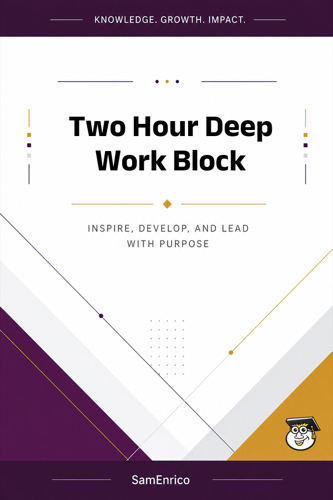
Two Hour Deep Work Block eBook
Structures extended focus sessions with break prot
Structures extended focus sessions with break protocols.
Formats
Free sample
Chapter 1: The 120-Minute Lie--–- Every productivity book you have ever read has lied to you. Not maliciously, but quietly, indirectly, by omission. They told you to use the Pomodoro Technique—twenty-five minutes of work, five minutes of rest. They told you to wake up at 5 AM, to batch your emails, to say no to meetings. They gave you systems, templates, and apps.
And yet, here you are, still feeling like you are running on a treadmill that is slowly accelerating beneath your feet. You finish a "productive" day only to realize you cannot name a single thing you completed that truly mattered. You close your laptop at 6 PM with the vague, sinking sensation that you spent eight hours being busy without being effective.The lie is not that those techniques are useless. The lie is that they are optimized for the wrong unit of work. They assume that attention is a faucet—turn it on, do some work, turn it off, take a break, repeat.
But attention is not a faucet. Attention is a furnace. It takes time to light, time to reach operating temperature, and once it is hot, it can melt through problems that would otherwise take days. The unit of work that most productivity systems are built around—the hour, the twenty-five-minute sprint, the thirty-minute call—is fundamentally mismatched to how the human brain actually performs at its highest level.This book makes a single, radical argument: The two-hour block is the atomic unit of elite output. Shorter than ninety minutes, and you never truly arrive at deep work.
Longer than two and a half hours, and you enter the zone of diminishing returns, where cognitive fatigue erases your gains. The 120-minute window is the sweet spot—long enough to reach flow, short enough to recover from it. And yet, almost no one is trained to use this unit effectively. Most professionals cannot sustain focus for ninety minutes without checking their phone. Fewer still have ever experienced what it feels like to emerge from a two-hour block having completed what would normally take a full day.This chapter dismantles the assumptions that have kept you trapped in shallow work.
It will show you why the single hour is a trap, why your brain takes longer to warm up than you think, and why the 120-minute block is not a luxury but a necessity for anyone doing complex knowledge work. By the end of this chapter, you will never look at your calendar the same way again.The Warm-Up Fallacy: Why Your First Thirty Minutes Are Wasted Let us start with a simple experiment you can run on yourself tomorrow. Sit down to work on a difficult cognitive task—writing a proposal, debugging code, analyzing a spreadsheet. Set a timer for sixty minutes. At the end of that hour, ask yourself: how many minutes of that hour were you truly, deeply focused?
Not just "doing the task," but fully absorbed, with no wandering thoughts, no micro-distractions, no background hum of anxiety about your email inbox?If you are like most knowledge workers, the answer will be somewhere between twenty and thirty-five minutes. The rest of the hour was spent in what neuroscientists call the attention ramp-up phase—the period during which your brain disengages from the default mode network (the neural circuitry associated with mind-wandering, self-referential thought, and daydreaming) and engages the task-positive network (the circuitry associated with focused, goal-directed attention).Here is what happens during those first fifteen to thirty minutes. Your brain is still processing the residue of whatever you did before. If you came from a meeting, the social dynamics, unresolved tensions, and action items from that meeting continue to circulate in your working memory. If you came from email, the urgent requests and open loops occupy cognitive slots that should be dedicated to deep work.
If you came from social media, the dopamine hits and novel stimuli have left your attentional system scattered, like a flashlight beam bouncing off mirrors.The default mode network does not shut off immediately. It takes time. Research using functional magnetic resonance imaging (f MRI) shows that the transition from default mode to task-positive network takes anywhere from nine to twenty-seven minutes, depending on the complexity of the task and the level of distraction in the environment. During this transition period, you are doing something that looks like work—your fingers are typing, your eyes are scanning, your mouse is clicking—but your cognitive depth is shallow. You are operating at perhaps sixty to seventy percent of your true capacity.This is the Warm-Up Fallacy: the mistaken belief that the moment you sit down to work, you are working.
You are not. You are warming up. And if your work session is only sixty minutes long, you have just lost your entire warm-up period to inefficiency. A sixty-minute block yields, at best, thirty minutes of actual deep work. A ninety-minute block yields forty-five to sixty minutes.
A one-hundred-twenty-minute block yields seventy-five to ninety minutes of peak cognitive performance.The math is devastating. If you structure your day around one-hour blocks, you are effectively working at half your potential capacity. You are spending eight hours at your desk to achieve four hours of real output. And because deep work is nonlinear—a single hour of uninterrupted flow is worth three hours of interrupted, shallow effort—the gap is even larger than the raw numbers suggest.Ultradian Rhythms: The Body's Hidden Clock Your brain is not designed to focus for eight consecutive hours. It is not even designed to focus for four consecutive hours.
It is designed to operate in cycles that biologists call ultradian rhythms—recurring periods of high and low physiological activity that last between ninety and one hundred twenty minutes.The concept of ultradian rhythms was first documented in sleep research, where scientists observed that REM cycles occur in roughly ninety-minute intervals. But the same rhythm governs wakefulness. Throughout the day, your body moves through alternating phases of high alertness (characterized by increased heart rate, higher cortisol levels, and heightened cognitive processing) and low alertness (characterized by fatigue, lower body temperature, and decreased attention). These cycles are not optional. They are hardwired into your biology.During the high-alertness phase—which lasts approximately ninety to one hundred twenty minutes—your brain is capable of its deepest, most sustained focus.
Problem-solving is faster, creativity is higher, and error rates are lower. During the low-alertness phase, which follows, your brain naturally seeks rest, distraction, and lower-cognitive-load activities. Fighting this rhythm—trying to push through the low phase with caffeine or willpower—is like trying to sprint through a red light. You can do it, but you will pay a price, and you will not sustain it.Here is where most productivity advice gets it wrong. The classic Pomodoro Technique (twenty-five minutes of work, five minutes of rest) operates on a thirty-minute cycle that has no relationship to your ultradian rhythm.
It interrupts you just as you are beginning to reach depth. The 90/20 rule (ninety minutes of work, twenty minutes of rest) is closer to your biological baseline, but it leaves fifteen to thirty minutes of potential flow on the…
This is the end of the free sample. Get the eBook to keep going. Buy now
About this book
Details
- Author
- Valles Ursula
- Publisher
- SamEnrico
- Language
- English
- Genre
- Non-Fiction, Self-Help, Extended Focus
- Released
- 2026-06-06
- Pages (approx.)
- 159
- Available as
- eBook, Audiobook

Read better in the ZLOADR app
Your eBooks on your phone or tablet. Sign in with your SamEnrico account and start reading.
More by Valles Ursula
 Road Rage and New DriversValles Ursula$11.99
 Immigrant Landscaping Empire CourseValles Ursula$11.99
 Stress And SciaticaValles Ursula$11.99
 1031 Exchange Related Party RulesValles Ursula$11.99
 Nap HandbookValles Ursula$11.99
 Loving Kindness for a Spouse's CareerValles Ursula$11.99
 Visualization GuideValles Ursula$11.99
 NVC For NeighborsValles Ursula$11.99
 Jingwei's Vengeance: The Phoenix That Drowned the SeaValles Ursula$11.99
 The Last Lament of the Silk RoadValles Ursula$11.99
 The Great Bitcoin Heist: How a Trusted CEO Vanished with MillionsValles Ursula$11.99
 How to Start a Mechanical Ash Dischargers Business (Beginners Guide)Valles Ursula$11.99